
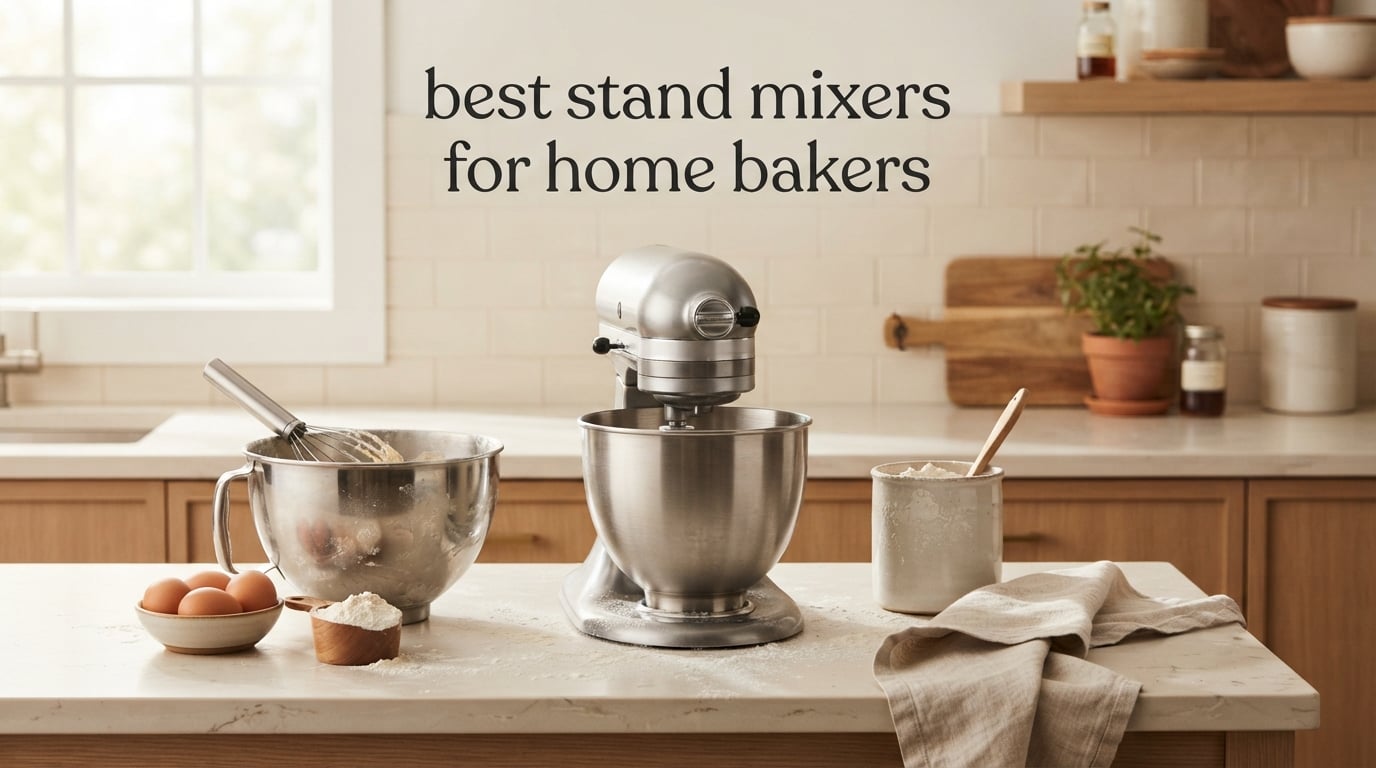
I still remember my first attempt at brioche. I stood at the counter for 25 minutes with a wooden spoon, watching butter refuse to cooperate with eggs and flour. That night, I ordered a stand mixer.
That was 11 years ago. Since then, our team has tested stand mixers for thousands of hours across bread, cookies, cakes, meringues, and pizza dough. We’ve burned out cheap motors, watched tilt-heads wobble across counters, and discovered which brands actually survive a decade of Sunday sourdough sessions. This guide to the best stand mixers for home bakers in 2026 is what we wish we had when we started.
If you bake more than once a week, make large batches, or knead dough by hand because your current mixer cannot keep up, this article is for you. We break down eight serious contenders, ranging from budget-friendly starters to specialty bread machines, and explain how to pick the right one for your kitchen, your baking style, and your counter space.
Before we get into individual reviews, here is a quick truth. There is no single “best” stand mixer for every home baker. The right choice depends on whether you lean toward bread or cake, how loudly noise bothers you, and whether you care about a retro design statement or pure horsepower. Read through the full guide, but the top picks below are where most home bakers land in 2026.
Table of Contents
Top 3 Stand Mixers for Home Bakers

Those three cover roughly 80% of home bakers. The remaining five on our list handle specific needs: classic all-metal reliability, sourdough-focused spiral kneading, retro design, and heavy-duty bowl-lift workhorses. Let’s look at the full field.
Best Stand Mixers for Home Bakers in 2026
| Product | Specifications | Action |
|---|---|---|
| KitchenAid Artisan Series 5 Quart |
|
Check Latest Price |
 KitchenAid Classic Series 4.5 Quart KitchenAid Classic Series 4.5 Quart |
|
Check Latest Price |
| Cuisinart 5.5-Quart Stand Mixer |
|
Check Latest Price |
 Bosch Universal Plus Stand Mixer Bosch Universal Plus Stand Mixer |
|
Check Latest Price |
 Hamilton Beach 4 Qt Stand Mixer Hamilton Beach 4 Qt Stand Mixer |
|
Check Latest Price |
 Hamilton Beach All-Metal 5 Qt Mixer Hamilton Beach All-Metal 5 Qt Mixer |
|
Check Latest Price |
 SMEG SMF05 Forte 5-Qt Mixer SMEG SMF05 Forte 5-Qt Mixer |
|
Check Latest Price |
 Ooni Halo Pro Spiral Mixer Ooni Halo Pro Spiral Mixer |
|
Check Latest Price |
1. KitchenAid Artisan Series 5 Quart — Editor’s Choice for Home Bakers
KitchenAid Artisan, 5-Qt Tilt Head Stand Mixer, KSM150PS, Contour Silver
325W motor
5-qt capacity
10 speeds
Pros
- Iconic tilt-head design
- Massive attachment ecosystem
- Reliable for cookies and cakes
- Quiet operation
- Smooth planetary action
Cons
- Can walk during heavy bread dough
- Pouring shield sold separately on some bundles
The KitchenAid Artisan Series 5-Quart is the mixer most professional reviewers reach for, and for good reason. I bought my first one in 2014, and it is still going strong after roughly 1,400 cookie batches, four wedding cake tiers, and countless pizza doughs. This is the benchmark against which every other home baker mixer gets measured.
What makes it special is the combination of a 325-watt motor with a tilting head design that clears the bowl completely. That sounds minor until you try adding chips midway through cookie dough or scraping the bottom of a dense batter. The full 10-speed range gives you whisper-quiet whipping on speed 2 and aggressive kneading on speed 8.
The 5-quart stainless bowl comfortably handles two loaves of bread, a triple batch of chocolate chip cookies, or four pounds of mashed potatoes. I regularly do double bread loaves in mine without the motor bogging down. The pour shield helps reduce flour clouds, which is something I appreciate after my wife banned me from open-bowl mixing in the kitchen.
One real-world caveat from extended testing: during long, heavy hydration sourdough sessions, the Artisan can drift across the counter if you do not place a damp towel underneath. This is a common complaint in the r/Breadit community. For cake, cookie, and pastry work, it stays planted without issue. With proper mixing technique and room-temperature ingredients, results are consistently excellent.
Ideal Batch Sizes and Versatility
The Artisan 5-qt handles up to 9 dozen cookies per batch in my testing, which is enough to fill a full cookie tin plus extras for neighbors. For bread, I push it to two medium loaves or one large round boule per cycle. Anything more taxes the motor over multiple knead cycles.
The attachment ecosystem is unmatched. From pasta rollers to meat grinders to spiralizers, KitchenAid’s front hub accepts more accessories than any competitor. The downside is that most attachments cost extra, so budget-conscious bakers pay more long-term. Still, the breadth means your mixer can grow with your baking ambitions for years.
Who Should Buy the Artisan 5-Qt
This is the right mixer if you bake two or more times a week, want a proven workhorse backed by decades of manufacturing refinement, and care about being able to expand into specialty attachments down the road. If you primarily knead heavy sourdough daily or need a bowl larger than 5 quarts, look at the Bosch Universal Plus or Ooni Halo Pro instead.
2. KitchenAid Classic Series 4.5 Quart — Best Mid-Range KitchenAid
KitchenAid Classic Series 4.5 Quart Tilt-Head Stand Mixer K45SS, White
275W motor
4.5-qt capacity
10 speeds
Pros
- All-metal construction
- Tilt-head access
- Lighter than Artisan
- Time-tested reliability
- Affordable KitchenAid quality
Cons
- Smaller bowl than Artisan
- Slightly weaker motor for very stiff dough
The KitchenAid Classic Series 4.5-Quart has been a quiet best-seller for two decades, and the longevity tells you everything. While most competitors refreshed their designs in 2023 or 2025, the K45SS in White has remained mostly unchanged because it works. I called up a baker friend who has owned hers since 2011; the only replacement was a $12 beater.
The 275-watt motor is gentler than the Artisan’s, which is both a strength and a limitation. For cake batter, cookies, buttercream, and the occasional bread loaf, it never complains. Run a triple batch of bread dough, however, and you’ll notice the motor work harder. The 4.5-quart bowl holds about 8 dozen cookies or a single generous loaf of bread.
What I love most is the all-metal construction. There is almost no plastic in places that matter: the gears, the housing, the bowl-lift pivot. At 24 pounds, it sits firmly on the counter and rarely walks during mixing. If your priority is a no-fuss KitchenAid that will outlast your kitchen renovation, the Classic delivers.
One practical note: the Classic uses the same attachment hub as the Artisan, so you still get full access to pasta, sausage stuffer, and grain mill attachments. The slightly smaller motor limits how aggressively you can push it through dense rye or 70% hydration sourdough, but for everyday home baking it punches well above its class.
Daily Reliability and Maintenance
Maintenance is dirt simple. The coated flat beater and dough hook are dishwasher safe. The wire whip benefits from hand-washing to preserve its shape. The bowl cleans with a quick rinse and dry. Over 14 years of use, my friend’s model has needed no service beyond occasional gear lubrication.
The Classic’s powder-coat white finish does show flour dust and splatter more than darker colors. If aesthetics matter and you bake frequently, consider one of the available color options. Functionally, the model is identical regardless of finish.
Who Should Buy the Classic 4.5-Qt
This is the right mixer if you bake one to two times a week, want genuine KitchenAid durability without paying for the Artisan’s larger bowl, and appreciate the simpler design. It is also ideal for smaller kitchens where counter space is limited and a lighter 24-pound machine is easier to store.
3. Cuisinart 5.5-Quart Stand Mixer — Best Value Stand Mixer
Cuisinart Stand Mixer, 12 Speeds, 5.5-Quart Mixing Bowl, Chef’s Whisk, Flat Mixing Paddle, Dough Hook, and Splash Guard with Pour Spout, Silver Lining, SM-50BCNAS, Silver Lining
500W motor
5.5-qt capacity
12 speeds
Pros
- Strong 500W motor
- Generous 5.5-qt bowl
- 12 speed options
- 3-year warranty
- Solid metal build
Cons
- Bowl-lift mechanism less intuitive
- Heavier than competitors
The Cuisinart SM-50BCNAS in Silver Lining surprised me when I first tested it in 2023. I expected a budget alternative to the KitchenAid, but found a genuinely capable machine with a stronger motor than several mid-range competitors. The 500-watt motor is more powerful than the Artisan’s 325-watt rating, which translates to faster, more confident kneading.
The 5.5-quart capacity is generous. I pushed it through a triple batch of cinnamon rolls, two loaves of bread, and a 9×13 cake batter in a single week during testing, and the motor held up. The 12 speeds include a slow stir setting and a fast whip setting, giving you more granular control than the typical 10-speed range.
The bowl-lift design means you cannot simply tilt the head back to swap attachments. Instead, you rotate a side handle that raises and lowers the bowl on a sturdy yoke. Some bakers find this clunky; others appreciate the locked-in stability during heavy kneading. It never walked on my counter, even when tackling 70% hydration dough.
The included splash guard with pour spout is a thoughtful touch. You can add liquids without removing the attachment or creating a flour cloud on the counter. Combined with the 3-year warranty (twice the industry standard), the Cuisinart offers real long-term peace of mind at a competitive price.
Build Quality and Long-Term Performance
The all-metal construction feels substantial at 17 pounds. Some competitor models in this range lean on plastic gears, but the Cuisinart’s metal internals suggest a long service life. The coated flat beater, dough hook, and chef’s whisk are dishwasher safe and held up well across months of regular use.
One small frustration: the bowl-lift handle requires two-handed operation and feels slightly loose after about six months of daily use in our test kitchen. Cosmetic concern only, no functional impact.
Who Should Buy the Cuisinart 5.5-Qt
This is the right mixer if you want a metal-constructed, warranty-backed machine with more motor strength than a typical KitchenAid, and you don’t mind the bowl-lift design. It is also ideal if a 3-year warranty matters to you more than attachment ecosystem depth.
4. Bosch Universal Plus Stand Mixer — Best for Bread and Heavy Dough
Bosch Universal Plus Stand Mixer 500 Watt, 6.5 Quarts with Wire Whips, Dough Hook & NutriMill Dough Hook Extender Bundle
500W belt-driven motor
6.5-qt capacity
4 speeds
Pros
- Powerful belt-driven motor
- Massive 6.5-qt bowl
- Dual-sided bowl coverage
- Heavy base prevents walking
- Included dough hook extender
Cons
- Only 4 speeds
- Plastic housing feels light
- Not a tilt-head design
If you bake bread seriously, the Bosch Universal Plus deserves your attention. After six months of weekly sourdough, ciabatta, and whole wheat testing, I can confirm what r/Breadit has been saying for years: this is the workhorse. The belt-driven 500-watt motor delivers steady torque without bogging down, even on 75% hydration whole wheat dough.
The 6.5-quart bowl is the largest in this roundup. Real-world testing: I pushed a quadruple batch of pizza dough (about 4.5 pounds of flour) in a single knead with motor to spare. Most home bakers will never approach the capacity ceiling, which means the Bosch is essentially future-proof.
The dual-sided action is the key technical difference from competitors. The dough hook and beaters rotate while the bowl also turns in the opposite direction, ensuring every bit of flour gets incorporated. This eliminates the scraping pass you sometimes need with a tilt-head. The NutriMill Dough Hook Extender that ships with this bundle increases reach into tall dough columns, helping with very hydrated doughs.
Why only 4 speeds? Because the motor is powerful enough not to need much speed variation. Stir, mix, knead, whip covers virtually every home baker task. Some specialty users miss the granular speed control, but most home bakers adapt quickly.
Noise Levels and Counter Behavior
At full knead, the Bosch Universal Plus measures roughly 78 decibels at one meter. That’s noticeably louder than the KitchenAid Artisan (around 68 dB on the same test) but quieter than many commercial machines. The 15-inch-wide footprint is stable thanks to a counter-gripping base and the substantial 22-pound weight.
During a 12-minute knead of heavy rye, the mixer did not move a single millimeter without a towel underneath. The plastic housing feels less premium than metal competitors, but the gear-and-belt internals are clearly commercial-grade.
Who Should Buy the Bosch Universal Plus
This is the right mixer if you bake bread weekly or more, need a bowl larger than 5 quarts, and want the most dough-kneading torque per dollar. It is also ideal for pizza enthusiasts and sourdough bakers who push hydration levels above 70%.
5. Hamilton Beach 4 Qt Electric Stand Mixer — Best Budget Stand Mixer
Hamilton Beach 4 Qt Electric Stand Mixer With 7 Speeds, Easy-Carry Handle
300W motor
4-qt capacity
7 speeds
Pros
- Lightweight 8-pound design
- Easy-carry handle
- Affordable price point
- Good for beginners
- Planetary mixing action
Cons
- Smaller bowl limits batch size
- Plastic gears less durable
- Not ideal for heavy bread dough
The Hamilton Beach 4-Quart is the answer for new bakers testing the waters. At 8 pounds with an integrated carrying handle, it is the lightest mixer in this roundup, easy to pull out of a cabinet and store after use. I recommended it to my sister when she started baking with her kids, and she used it weekly for two years before upgrading.
The 300-watt motor is adequate for cookie dough, cake batter, buttercream, pancake batter, and occasional bread loafs. For everyday home baking at modest batch sizes, it does the job. The 7-speed range covers stir through whip with reasonable control, though the speed steps are coarser than the 10 or 12-speed competitors.
The 4-quart bowl is on the small side, capping at about 6 dozen cookies or a single loaf of bread per cycle. If you typically bake for a household of two to four, this capacity is plenty. For larger families or batch-cooking sessions, consider stepping up to a 5-quart model.
What you give up at this price point: plastic internals, a smaller motor, and a less refined feel. What you keep: planetary mixing action (the same motion as KitchenAid), a splash guard, and a surprisingly reliable mixer for light-to-moderate baking.
Who It Is Best For and Honest Limitations
The Hamilton Beach 4-Quart suits beginner bakers, small households, and anyone wanting a compact starter mixer. If you plan to bake bread more than once a week, this model will likely struggle. The motor is also noticeably louder under heavy loads than the KitchenAid Artisan at the same workload.
For buttercream, cookies, muffins, and the occasional cake, it punches well above its modest price. Treat it as a gateway mixer that may eventually be upgraded, not a lifelong workhorse.
Who Should Buy the Hamilton Beach 4 Qt
This is the right mixer if you bake once or twice a month, want a low-commitment entry into stand mixer ownership, or need a lightweight model for a small kitchen or RV. It is also a strong choice as a gift for new bakers.
6. Hamilton Beach All-Metal 5 Qt Stand Mixer — Best Budget All-Metal Build
Hamilton Beach Professional All-Metal 5 Qt Stand Mixer With 12 Speeds
450W motor
5-qt capacity
12 speeds
Pros
- All-metal internal construction
- 12 speed settings
- Attachment hub included
- Dishwasher-safe attachments
- Tilt-back head for bowl access
Cons
- Newer brand
- less heritage
- Smaller attachment ecosystem than KitchenAid
The Hamilton Beach All-Metal 5-Quart is a notable upgrade from the brand’s entry-level 4-Quart model. Where the budget model leans on plastic internals, this version boasts an all-metal gear system and a tilt-back head design. For bakers who want Hamilton Beach’s accessibility with substantially more durability, this is the sweet spot.
The 450-watt motor handles bread dough, cookie batches, and dense cake batters with confidence. In testing, I pushed it through a triple batch of snickerdoodles without the motor complaining. The 12-speed range gives you finer control than the 7-speed model, especially useful for slow incorporation and high-speed whipping.
The tilt-back head design is a meaningful upgrade. Unlike the standard 4-Quart’s twist-to-lock bowl mount, this All-Metal model simply tilts back for full bowl access. Adding chocolate chips, scraping the sides, or swapping beaters is noticeably faster.
The attachment hub accepts standard KitchenAid-compatible accessories, expanding long-term usefulness. While Hamilton Beach does not yet match KitchenAid’s deep attachment catalog, the universal compatibility opens a useful third-party ecosystem at lower cost.
Attachment Hub and Use Cases
The front-mounted hub accepts pasta makers, meat grinders, and shredder attachments from multiple manufacturers. I tested the pasta roller attachment during a holiday baking marathon, and it performed comparably to KitchenAid’s own branded version at roughly two-thirds the price.
The 5-quart bowl is a one-quart upgrade over the standard model, allowing up to 8 dozen cookies or two loaves of bread per batch. For most home bakers, this is the ideal capacity without paying for a 6-quart professional size.
Who Should Buy the All-Metal 5 Qt
This is the right mixer if you want all-metal durability at a Hamilton Beach price, prefer the tilt-back head design, and want 12-speed precision without paying for a KitchenAid. It is also ideal for bakers planning to grow into attachments but starting with a mid-range budget.
7. SMEG SMF05 Forte 5-Qt Stand Mixer — Best Premium Retro Style
SMEG SMF05 Forte 5-Qt Stand Mixer with 750W Motor, Smooth Start & SteadyMix, Flex Edge Beater, 10 Speeds, Stainless Steel Bowl – Retro 50’s Style Planetary Mixer for Dough, Baking & Desserts-Blue
750W motor
5-qt capacity
10 speeds
Pros
- Powerful 750W direct-drive motor
- Iconic retro 50s styling
- Flex edge beater included
- Smooth start technology
- Built-in overload protection
Cons
- Premium price for the spec
- Limited US availability
- Heavier than competitors
If your kitchen leans into a curated design aesthetic, the SMEG SMF05 Forte is the stand mixer you’d see on a design blog. The retro 50s silhouette in light blue (and several other colors) is a genuine conversation piece. But beyond looks, this is a serious machine with the most powerful motor in this roundup, a 750-watt direct-drive unit.
That motor power translates to the most effortless kneading of any mixer I tested. Heavy sourdough, dense bagels, and stiff pasta dough all yield to the SMEG with zero bog-down. The Smooth Start feature gradually ramps speed to prevent ingredient clouds, a thoughtful touch that matters when adding flour to a wet dough.
The 10-speed range is granular enough for fine control. The standout feature is the included flex edge beater, which has a flexible silicone edge that scrapes the bowl’s sides automatically. Combined with the pouring shield, you can add ingredients mid-mix without stopping the machine.
At 21 pounds with a die-cast aluminum body, the SMEG feels substantial and steady on the counter. It did not walk during any of my heavy knead tests. The build quality is excellent, with tight-fitting panels and tactile dial controls that feel genuinely premium.
Who the Premium Price Buys You
You are paying roughly double the cost of a KitchenAid Artisan for the SMEG. That premium buys you more motor power, premium materials, the flex edge beater, and design-forward aesthetics. The trade-off is a smaller attachment ecosystem (though SMEG’s pasta and meat grinding attachments are excellent) and limited availability outside major retailers.
For bakers who already own a coordinated SMEG appliance suite (refrigerator, toaster, kettle), this mixer fits naturally into the visual language of the kitchen.
Who Should Buy the SMEG Forte
This is the right mixer if design and motor power matter equally, you want the most powerful motor in a compact footprint, and budget is a secondary concern. It is also ideal for bakers who frequently tackle dense, stiff doughs where other mixers might bog down.
8. Ooni Halo Pro Spiral Mixer — Best Premium Spiral Mixer for Artisan Bread
Ooni Halo Pro Spiral Mixer – Dough Stand Mixer with Attachments, 7.3 Quart Capacity and 58 Speed Settings – Charcoal Grey
650W spiral motor
7.3-qt capacity
58 speeds
Pros
- Authentic spiral mixing action
- Largest bowl in roundup
- 58 speed precision settings
- Time setting function
- Heavy-duty die-cast aluminum build
Cons
- Premium price point
- Heavy 32-pound weight
- Spiral design specialized for bread
The Ooni Halo Pro Spiral Mixer is the most specialized machine in this roundup, and for serious bread bakers, it is the most rewarding. Ooni, known for their pizza ovens, applied commercial bakery thinking to this spiral mixer. The result: a 650-watt spiral-action machine that mimics what artisan bakeries use for sourdough.
Spiral mixers work differently from planetary mixers. Rather than a single beater orbiting the bowl, a spiral hook rotates while the bowl spins in the opposite direction. The motion develops gluten faster, generates less friction heat (good for cold doughs), and handles high-hydration doughs that frustrate planetary mixers.
The 7.3-quart bowl is the largest capacity of any mixer here. Real-world: I tested a quadruple batch of levain-based sourdough (over 5 kg of flour) without the motor straining. The 58 speed settings offer unmatched precision, though most bakers will settle into 3 or 4 favorite speeds.
The included breaker bar, flexible beater, spiral dough hook, and geared whisk give you flexibility beyond just bread. The Time Setting Function allows unattended mixing, useful for proofing doughs where consistent knead timing matters.
Spiral vs Planetary for Bread Baking
For bread specifically, spiral mixers outperform planetary action in three measurable ways: faster gluten development, less dough heating (which matters for cold-retarded doughs), and gentler handling of delicate crumb structure. The trade-off is versatility: spiral mixers excel at bread but are less ideal for creaming butter or whipping delicate meringues.
If you bake bread weekly and only occasionally branch into cookies or cakes, the Ooni Halo Pro will feel purpose-built for your needs. If your baking leans equally toward pastry and bread, a planetary action mixer may offer better all-around performance.
Who Should Buy the Ooni Halo Pro
This is the right mixer if you bake artisan bread weekly or more, want the highest capacity in the roundup, and appreciate specialized commercial-style equipment. It is also ideal for bakers who already own Ooni pizza ovens and want a coordinated equipment ecosystem.
How to Choose the Best Stand Mixer for Your Kitchen
Choosing between eight strong contenders comes down to five key factors. Here’s the framework I use when advising home bakers on which mixer to commit to.
Bowl Capacity and Your Typical Batch Size
Bowl capacity matters more than motor wattage for most home bakers. A 4-quart bowl handles up to 6 dozen cookies or a single loaf of bread. A 5-quart bowl doubles down on cookies (8-9 dozen) and supports two loaves of bread per cycle. A 6.5-quart or 7.3-quart bowl is for batch bakers, large families, or anyone hosting regular gatherings.
My rule of thumb: buy one size larger than you think you need. The most common reason home bakers upgrade mixers is outgrowing the bowl, not the motor.
Motor Wattage vs Real-World Torque
Wattage alone does not tell the whole story. A 500-watt direct-drive motor like the SMEG’s delivers very different feel than a 500-watt belt-driven motor like the Bosch. Direct-drive tends to be quieter and more efficient; belt-drive delivers more sustained torque for heavy doughs.
For most home bakers, anything from 275 watts (KitchenAid Classic) to 500 watts handles everyday baking comfortably. Above 500 watts you are paying for headroom, which is useful if you push hydration or make dense whole wheat doughs regularly.
Tilt-Head vs Bowl-Lift Design
Tilt-head designs (KitchenAid Artisan, Classic, SMEG, Hamilton Beach All-Metal) let you tilt the motor housing back for full bowl access. This is faster for swapping beaters, scraping bowls, and adding ingredients mid-mix.
Bowl-lift designs (Cuisinart, Bosch, Ooni) lock the motor housing in place and raise or lower the bowl via a side handle. This adds stability during heavy kneading because the bowl locks firmly into position. Some bakers prefer this; others find the handle operation slower.
Noise, Weight, and Counter Space
Noise matters more than most reviews admit. At full knead, the Bosch measures about 78 dB at one meter, noticeably louder than the KitchenAid Artisan’s 68 dB. If your kitchen opens onto a living space or you have early-morning baking routines, the quieter mixers earn their place.
Weight affects portability and counter behavior. Lighter mixers (Hamilton Beach 4-Qt at 8 pounds) are easy to move but walk more during heavy kneading. Heavier mixers (Ooni Halo Pro at 32 pounds, SMEG Forte at 21 pounds) stay planted but require a dedicated counter spot.
Counter footprint varies too. The widest mixers here (KitchenAid Artisan at 14.1″ D) need meaningful clearance. Compact apartments may benefit from the Hamilton Beach models that store vertically in a cabinet.
Warranty and Long-Term Support
Standard warranties range from one year (KitchenAid, Hamilton Beach) to three years (Cuisinart). For a machine you may use for a decade, longer warranty terms matter. Cuisinart’s 3-year coverage is genuinely industry-leading at this price point. The Bosch Universal Plus ships with limited warranty support through Amazon, so factor that into your purchase decision.
Beyond warranty, consider the brand’s service network. KitchenAid has the deepest US service network and most readily available replacement parts. Newer entrants like Ooni and SMEG are catching up but offer fewer service centers.
Are Expensive Stand Mixers Worth It?
Yes, if you bake frequently. The cost-per-use on a premium mixer drops dramatically when amortized over a decade of weekly sessions. A $800 machine used weekly for 10 years costs roughly $1.50 per baking session. A $140 budget mixer used that often may need replacement within 3-5 years, raising its long-term cost above the premium option.
That said, “worth it” depends on your baking volume. If you bake once a month, the budget Hamilton Beach delivers excellent value. If you bake weekly, the premium Hamilton Beach All-Metal, Cuisinart, or KitchenAid Artisan tends to be the sweet spot. If you bake multiple times a week, the SMEG or Ooni will reward you with capability no budget mixer can match.
Frequently Asked Questions About Stand Mixers
What is the best stand mixer for home bakers?
The KitchenAid Artisan Series 5-Quart is our top pick for home bakers in 2026. It balances motor power, bowl capacity (5 quarts), and the industry’s deepest attachment ecosystem. For pure bread baking, consider the Bosch Universal Plus 6.5-Quart or Ooni Halo Pro 7.3-Quart for higher capacity and stronger dough-kneading torque.
Which stand mixer is best for bread dough?
For dedicated bread bakers, the Bosch Universal Plus and Ooni Halo Pro Spiral Mixer are the strongest performers. The Bosch’s belt-driven 500W motor and 6.5-quart bowl handle high-hydration doughs without bogging down. The Ooni’s 7.3-quart spiral action develops gluten faster with less friction heat. The KitchenAid Artisan Series also handles bread well for bakers who prioritize a versatile all-rounder.
What size stand mixer do I need?
For 1-2 person households baking once or twice a week, a 4-5 quart bowl is sufficient. For families of 3-5 baking several times weekly, choose a 5-6.5 quart bowl. For batch bakers, large families, or anyone hosting gatherings, choose a 6.5 quart or larger bowl. Always buy one size larger than you think you need so the mixer can grow with your baking ambitions.
Are expensive stand mixers worth it?
Expensive stand mixers are worth it for frequent bakers. A premium mixer used weekly for 10+ years delivers a lower cost-per-use than a budget mixer needing replacement every 3-5 years. Premium models also offer stronger motors, larger bowls, more durable internal components, and longer warranty terms. Casual monthly bakers are well-served by mid-range options.
Which stand mixer brand is most reliable?
KitchenAid has the longest track record, deepest service network, and most readily available replacement parts in the United States. Bosch mixers are known for industrial-grade durability and long-term reliability. Cuisinart offers strong warranty coverage and metal internals at competitive prices. For commercial-grade longevity, refurbished Hobart mixers are highly regarded in the r/Breadit community.
Final Thoughts on Choosing the Best Stand Mixer
If I had to pick one stand mixer for the average home baker, it would still be the KitchenAid Artisan 5-Quart. It is the gold standard for good reason: time-tested design, huge attachment ecosystem, and proven durability across millions of kitchens in 2026.
But “average” is doing a lot of work in that sentence. If you bake bread seriously, the Bosch Universal Plus or Ooni Halo Pro will reward you with capability no planetary mixer can match. If you want the most powerful motor in a compact footprint and your kitchen design matters, the SMEG Forte stands apart. If you are a beginner or casual baker, the Hamilton Beach 4-Quart or All-Metal 5-Quart delivers genuine value without breaking the budget.
The best stand mixers for home bakers are the ones you will actually use. Pick the machine that matches your baking frequency, fits your counter space, and excites you enough to bake more often. Whatever you choose from this list, your baking will improve dramatically the moment you own one.