
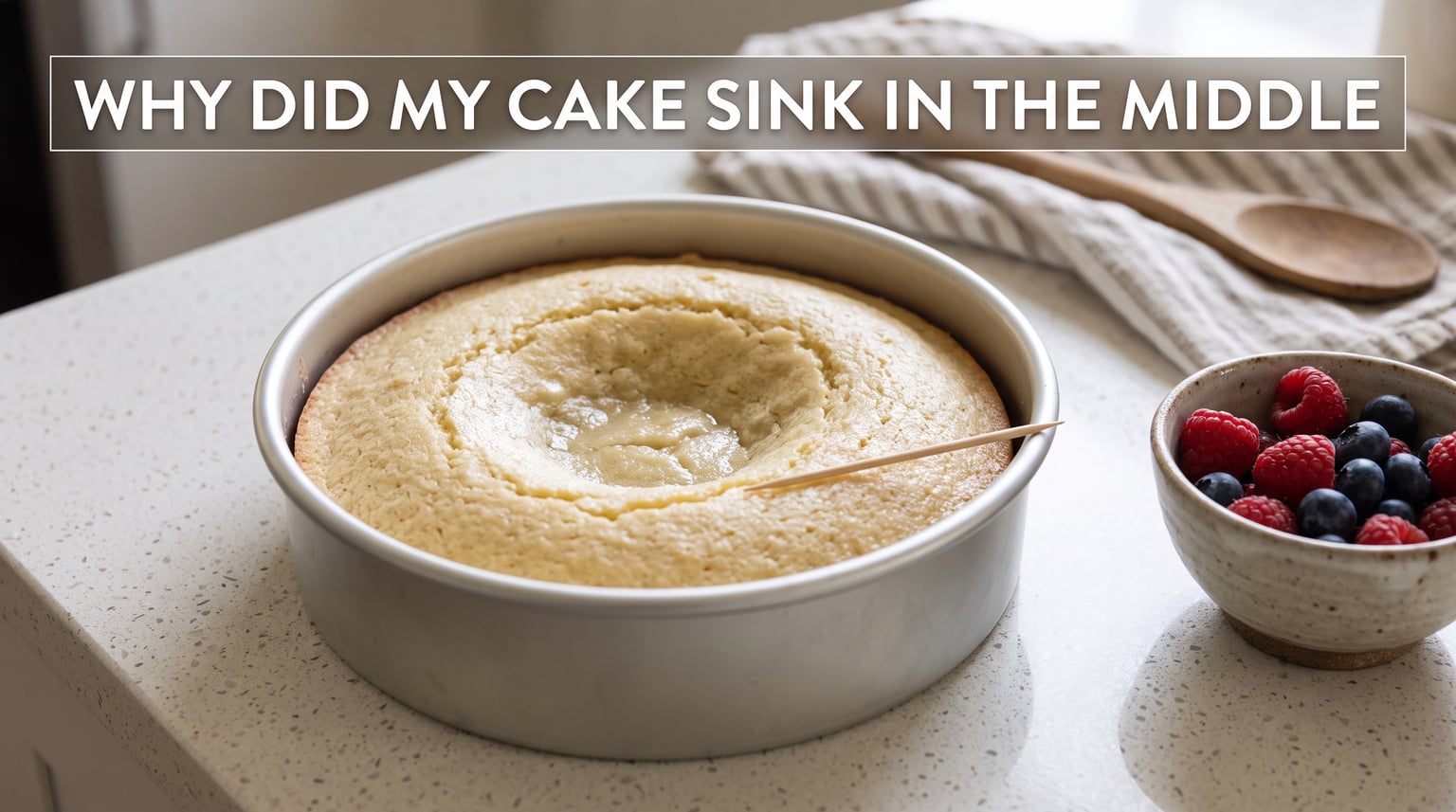
A cake sinks in the middle when the center has not set firmly enough to support the lift created in the oven. The usual reasons are underbaking, an oven that runs too hot or too cool, too much leavening, or batter that was mixed or handled in a way that left the crumb weak.
If you are asking, “why did my cake sink in the middle?”, start with the timing of the collapse. A dip that appears while baking points toward heat, leavening, or early movement; a cake that looks tall and then drops while cooling is often underbaked in the center.
The good news is that a sunken cake is a diagnostic clue, not a mystery. This guide explains what the cake structure needs, how to find the likely mistake, how to prevent cake sinking next time, and what you can do with the layer already on your counter.
Table of Contents
Most sunken cakes trace back to one of nine causes
A cake can collapse for more than one reason, but these are the checks I would make first. Start at the top of the list when the middle is wet, gummy, or visibly lower than the edges.
- Underbaking: The outside looks done while the middle is still too liquid to hold its shape after cooling.
- Too much baking powder or baking soda: The batter rises fast, then the air bubbles outgrow the structure meant to support them.
- Inactive or incorrectly measured leavening: Old ingredients and inaccurate measuring both change the intended rise.
- An oven that is too hot: The edges set too quickly while the center lags behind, creating a cracked dome and a weak middle.
- An oven that is too cool: The cake may rise slowly without building structure on schedule, then fall flat.
- Opening the oven door or moving pans too early: A rush of cooler air can deflate an unset cake.
- Overmixing or over-aerating: Excess gluten development or unstable air bubbles can leave a dense, collapsed center.
- The wrong pan or pan material: A batter that is too deep, or one baked in glass instead of the pan called for, can cook unevenly.
- Ingredient, recipe, altitude, or scaling changes: Cold ingredients, substitutions, high altitude, and altered batch sizes can upset the formula.
The center collapses because the cake structure did not set in time: why did my cake sink in the middle?
Cakes rise as baking powder or baking soda creates gas bubbles and heat expands the air already in the batter. At the same time, egg proteins, flour, and starch must firm up around those bubbles to make a stable crumb.
When the bubbles expand faster than the cake can set, or when the center remains soft, the middle cannot hold itself up. It falls as the cake cools and the gases contract, which is the cake structure collapse you see as a sunken center.
That is why a cake can look perfect through the oven window and still deflate later. The rise is only half the job; the center also has to finish baking.
Underbaking is the most common reason a cake falls after rising
An underbaked cake may have firm-looking edges and a browned top while the middle is still wet or only partly set. Once it leaves the oven, the unsupported center cannot keep its height, so it sinks as it cools.
A toothpick test helps, but do not rely on one clean toothpick alone. Forum bakers often report a clean pick followed by cake deflation because they tested a spot away from the deepest, slowest-baking part of the center.
Multiple doneness signals give a more reliable answer than one toothpick
Test near the center, not next to the pan wall, and use more than one sign. A fully baked cake should have a center that springs back lightly when touched, edges that are beginning to pull from the pan, and a tester with no wet batter on it.
- Look for a level or gently domed center rather than a shiny, jiggly patch.
- Tap the center lightly; it should feel set instead of sloshy or loose.
- Insert a tester in two nearby center spots, especially if the cake has a high dome.
- Follow the recipe time as a range, then bake until the physical signs agree.
For a cake that is still clearly underbaked when you first take it out, return it to the oven promptly if the center has not fully collapsed and the recipe allows more time. Covering the top loosely if it is browning fast may help, but do not expect a cooled, collapsed cake to rise again through rebaking.
Too much or stale leavening can make a cake rise beyond what it can support
Baking powder and baking soda are chemical leavening agents: they make the bubbles that lift the batter. The commonly cited starting point is about 1 teaspoon of baking powder per cup of flour, but the recipe’s stated formula should always lead because ingredients and cake styles differ.
Adding extra baking powder will not make a cake reliably taller. It can produce a rapid rise, large air bubbles, tunneling, and then a cake collapsed in the middle when the thin walls around those bubbles fail.
Fresh, accurately measured leavening keeps the rise predictable
Use the amount the recipe specifies and level measuring spoons rather than estimating. Old baking powder may lose activity, especially after long storage or humidity exposure, which can leave a cake not rising evenly.
Check the use-by information on the container and replace leavening that is old or has been stored poorly. Do not swap baking powder and baking soda unless the recipe specifically gives an alternative, because baking soda also depends on the recipe’s acids for its intended reaction.
An oven that runs too hot or too cool can leave the middle weak
An oven that is too hot may set and brown the crust before the interior has caught up. The cake can climb quickly, crack, and appear finished even though it has an underbaked cake center that sinks later.
An oven that is too cool can also cause cake deflation. Without enough steady heat, the cake may not set on time, so the air bubbles lose support before the crumb has developed.
A stable oven temperature matters more than the dial setting
Place the rack where the recipe directs, allow the oven to preheat fully, and bake in the pan size named in the recipe. If sinking happens repeatedly at the same stage, check whether the oven is actually holding its stated temperature with a separate oven thermometer.
Dark metal pans usually absorb heat differently from light metal pans, and glass pans can heat and cool differently as well. If a recipe was written for metal, a glass pan may need a changed approach; follow a reliable recipe’s directions for that exact substitution instead of guessing.
Opening the door or rotating pans too early can deflate an unset cake
Opening the oven door early drops the oven temperature and sends cooler air across batter that is still rising. That temperature shock can make a tender, unset center fall, especially in sponge cake, layer cake, and other airy formulas.
Keep the door closed until the cake has begun to set and the recipe indicates it is safe to check. If the recipe calls for rotating pans, do it at the stated point rather than at the first sign of a dome.
Small changes matter here. Pulling the rack out hard, slamming the door, or moving a fragile pan around before its structure has formed can all turn a good rise into a sunken cake.
Overmixing, undermixing, and over-aerating can weaken the crumb
After flour meets liquid, mixing develops gluten. Too much mixing can make the crumb tough and create tunneling, while an overbeaten batter can also disturb the balance of tiny air bubbles needed for an even rise.
Undermixing creates a different problem: dry flour pockets, uneven leavening, and inconsistent texture. Both extremes can leave one part of the cake with less support than another.
A properly mixed batter looks uniform, not endlessly beaten
Cream butter and sugar only for the texture and time your recipe calls for, then add eggs as directed. Once flour is added, mix just until the batter looks even and no dry streaks remain, scraping the bowl as needed rather than beating for extra minutes.
- Possible overmixing signs: a very glossy or unusually elastic batter, visible tunnels in the baked crumb, and a cake that feels dense instead of tender.
- Possible over-aerating signs: an exaggerated rise, a coarse crumb with large holes, and a center that drops away from tall edges.
- Possible undermixing signs: flour streaks, gummy spots, or uneven pockets of rise.
Butter that is overly soft can also trap air poorly and make a creamed batter less stable. Ingredients at room temperature combine more evenly; one competitor reference places room temperature around 68 degrees F, but recipe instructions should take priority for specific ingredients.
A mismatched pan, altered recipe, or altitude change can make a correct batter fail
A pan that is too small makes the batter too deep, so the outside bakes long before the center. A pan that is too large leaves a shallower layer that bakes faster and may change the cake’s intended texture and rise.
Use the pan size and shape specified, then fill it only to the recipe’s intended level. Bundt cake, tube pan, and layer cake recipes are not automatically interchangeable because the pan changes heat flow and batter depth.
High altitude and recipe scaling need a tested formula, not a casual adjustment
At high altitude, reduced air pressure can make gases expand more readily, which can contribute to a cake rising and falling. Use a recipe written for your altitude or a trusted high-altitude adaptation, then change one variable at a time if you are troubleshooting.
Scaling a recipe up or down also changes pan depth, bake time, and the balance of leavening. Box mix users can face the same cake problems when extra ingredients, a different pan, or a different oven changes the directions on the package.
A simple checklist prevents most cakes from sinking in the oven
Use this sequence before you bake a birthday cake, chocolate cake, vanilla cake, or quick bread. It gives you a repeatable way to remove the common failure points before the pan goes into the oven.
- Read the recipe from start to finish. Confirm the pan size, rack position, ingredient temperatures, mixing method, and bake-time range.
- Measure leavening precisely. Use level measuring spoons and the exact baking powder or baking soda specified.
- Prepare the ingredients as directed. Bring ingredients to the requested temperature and do not make untested substitutions.
- Mix to the correct stage. Cream where instructed, then stop mixing flour-based batter as soon as it is smooth and uniform.
- Preheat fully. Give the oven time to reach temperature before the batter goes in, and check accuracy if the same issue keeps happening.
- Leave the door closed early in the bake. Avoid checking, rotating, or moving the pan until the cake has had time to set.
- Test the center with several signals. Look for spring-back, set edges, and a tester without wet batter before you remove it.
- Cool gently. Let the cake rest in the pan for the recipe’s stated time before turning it out, since a very hot cake is still fragile.
A fully baked but sunken cake is often safe to serve and easy to salvage
If the center is baked through and the cake smells and tastes normal, a dip is usually a presentation problem rather than a reason to discard it. Check that there is no wet batter or gummy, raw middle before deciding how to use it.
For a layer cake, level the tall edges carefully and use frosting, fruit, curd, whipped topping, or a filling in the low area. For a single cake, turn the dip into a deliberate well for berries, glaze, ice cream, or a dusting of sugar.
If the center is raw, do not try to hide it under frosting. Trim away fully baked portions for a trifle, parfait, or cake crumbs only after you have removed any underbaked area.
These answers cover the most common questions about a cake that sinks
How do you fix a cake that sinks in the middle?
First check whether the center is fully baked. If it is set, level tall edges and fill or frost the dip; if it is still wet and you noticed immediately after removal, you may return it to the oven briefly, but a cooled collapsed cake will not regain its height. For the next cake, check pan size, oven heat, leavening measurement, and center doneness.
Is a cake still good if it sinks in the middle?
Yes, a cake with a sunken middle is usually still good if the center is fully baked and the cake otherwise smells and tastes normal. A shallow dip can be filled with frosting, fruit, or whipped topping. Do not serve a cake with wet batter or a gummy raw center; remove that portion or discard the cake.
Can you rebake a sunken cake?
You can return a cake to the oven only when you discover very soon after removal that the center is underbaked and has not completely collapsed. Bake just until the center is set, then cool it as directed. Once a cake has cooled and sunk, rebaking will not restore the lost structure and may dry out the edges.
How can you tell if you have overmixed cake batter?
Overmixed batter may look unusually glossy or elastic after flour is added. The baked cake can be dense, tough, or marked with long tunnels and an uneven crumb. Mix flour-based batter only until it is uniform and free of dry streaks, then stop rather than beating for extra time.
Why does my chocolate cake sink in the middle?
Chocolate cake can sink for the same reasons as other cakes: underbaking, excess leavening, incorrect oven heat, or batter handling. Test the deepest part of the center because a dark surface can make browning a less useful doneness clue. Follow the recipe’s pan and bake-time guidance closely.
Why does my cake sink in the middle at high altitude?
At high altitude, lower air pressure can make gases expand more readily, so a cake may rise quickly and then lose support. Use a tested high-altitude version of the recipe and follow its adjustments for your location. Avoid adding extra leavening, since that can make the collapse worse.
A sunken center is feedback about structure, heat, or timing
Why did my cake sink in the middle? In most cases, the center was underbaked, the rise was out of balance, or the oven and pan conditions did not let the crumb set evenly. Start with multi-signal doneness testing, accurate leavening, steady heat, and gentle handling during the early bake.
Keep one note about what happened and change one variable on the next attempt. With that simple approach, cake sinking becomes a fixable baking troubleshooting problem instead of a repeated surprise.