
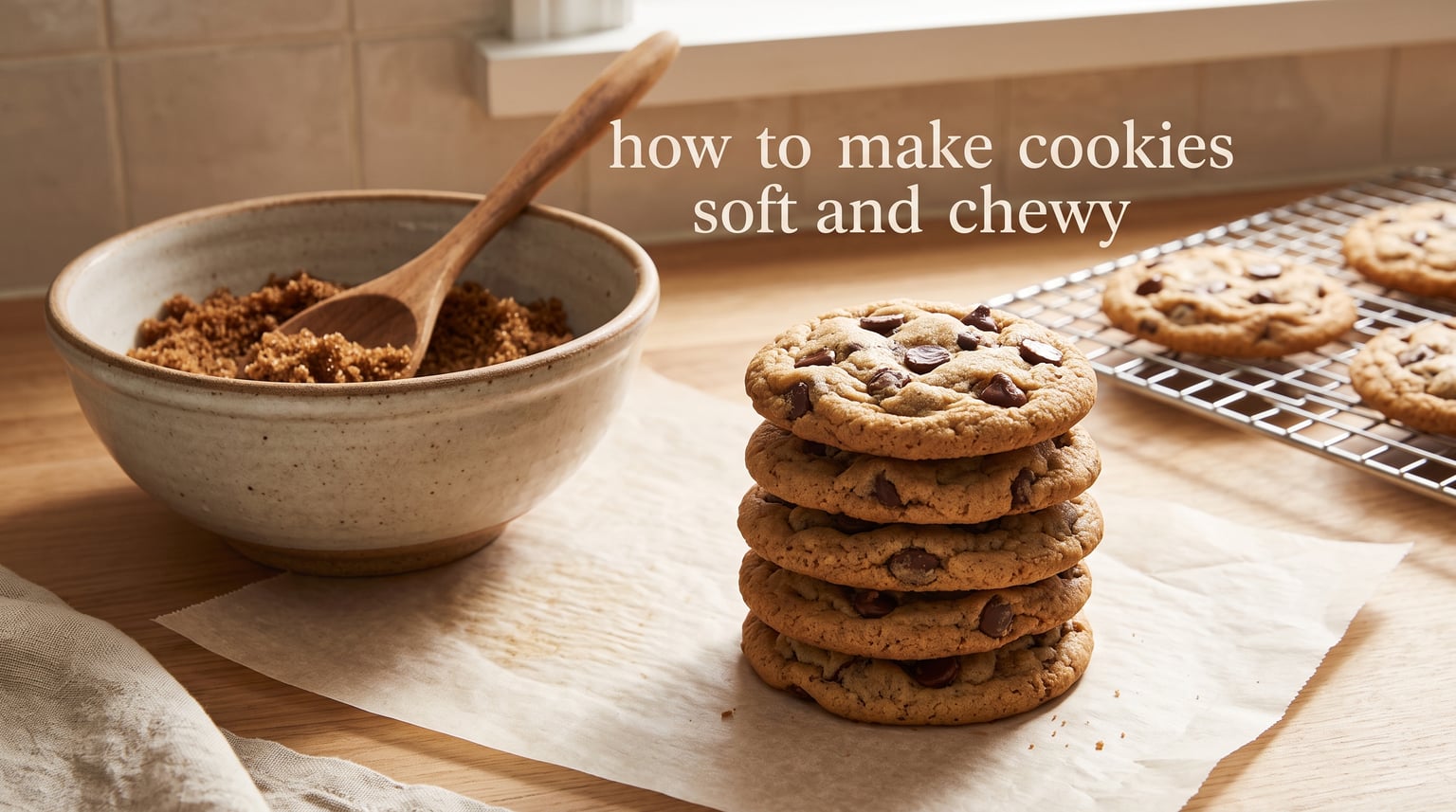
Learning how to make cookies soft and chewy is less about finding one magic ingredient and more about holding on to moisture while building the right dense structure. The target is a tender, soft center with a pleasant pull when you bite it, often paired with lightly crisp edges.
Brown sugar, fat, egg yolk, flour handling, dough temperature, cookie shape, and bake time all affect that result. Once you know what each one does, you can fix a batch that turns hard, cakey, thin, or crunchy instead of starting over with a different recipe.
I think of chewy cookies as a balance: enough spread for a tender middle, enough structure to stay thick, and enough retained moisture to keep the cookie pliable after it cools. This guide walks through that balance step by step for chocolate chip cookies, brown sugar cookies, peanut butter cookies, and many other homemade cookies.
Table of Contents
Soft and chewy cookies start with moisture, sugar, and controlled baking
The short answer is to favor brown sugar over white sugar, handle flour lightly and accurately, consider an extra egg yolk or a little cornstarch when the recipe suits it, chill the dough, and take cookies out while their centers still look slightly underdone. Those choices support moisture content and a dense, chewy texture instead of a dry snap or puffy cake-like crumb.
- Choose brown sugar for moisture. Its molasses content helps cookies stay softer and contributes a deeper flavor.
- Keep white sugar in balance. It helps spread and can give crisp edges, but an all-white-sugar formula tends to bake crisper.
- Use fat with intention. Melted butter promotes spread and a denser bite, while softened butter beaten with sugar traps air and can make cookies puffier.
- Add yolk when the formula allows. Extra yolk adds fat and emulsifiers, supporting richness and tenderness without the extra water from an added white.
- Do not overload the dough with flour. Too much flour is a common route to dry, stiff, or cakey cookies.
- Chill cookie dough before baking. Cold dough spreads more slowly, which helps thick chewy cookies keep a soft center.
- Stop baking before the middle looks fully finished. Residual heat continues to set the cookies on the hot sheet.
These are controls, not rules that must all appear in every recipe. A peanut butter dough, a sugar cookie dough, and a chewy chocolate chip dough contain different amounts of fat and moisture, so change one or two variables at a time.
How to make cookies soft and chewy: understand what creates the bite
Chewiness is not the same as softness alone. A soft cookie can be airy and cakey, while a chewy cookie is usually denser, a little elastic, and moist enough to bend before it breaks.
That distinction solves a frequent baking frustration. When a baker adds more leavening or beats a dough for a long time to make it “soft,” the result can become tall and fluffy rather than dense and thick with a fudgy middle.
Brown sugar keeps more moisture in the finished cookie
Brown sugar contains molasses, and that molasses changes both flavor and texture. In practice, brown sugar cookies tend to stay more pliable than cookies made with only granulated sugar because the dough and baked cookie retain moisture differently.
Granulated white sugar still has a role. It encourages spread and contributes crisp edges, so a blend can give a cookie the contrast many people want: a soft center, a chewy texture, and a thin crisp rim.
When a cookie is crunchy from edge to center, look at the sugar ratios before changing everything else. Moving some of the white sugar toward brown sugar is a more targeted change than adding extra liquid, which can make the dough behave unpredictably.
Fat distribution decides whether a cookie spreads or puffs
Butter provides flavor and fat, but its temperature changes the way the dough develops. Melted butter cookies generally spread more readily and can bake with a denser, chewier profile because the fat is already fluid rather than holding tiny air pockets.
Softened butter beaten with sugar creates air in the mixture. That is useful for recipes that need lift, but too much creaming can move a cookie toward a lighter, cakier texture.
Neither method is automatically better. Follow the butter state written into a tested recipe, then make your texture adjustments around it instead of swapping melted and creamed butter without expecting a different cookie spread and thickness.
Egg yolk adds tenderness without turning the dough into cake
Egg yolk supplies fat and emulsifiers that support a rich, tender bite. An extra egg yolk is often associated with chewy chocolate chip cookies because it can add body while avoiding the additional water and protein in a whole extra egg.
An entire extra egg can make cookies softer in some formulas, yet it can also increase puffiness and cake-like structure. If the goal is how to make cookies chewy not cakey, yolk is the more focused adjustment when the recipe has room for it.
Do not assume every dough needs extra yolk. A dough already high in yolk-rich ingredients or fat can become overly rich, greasy, or prone to spreading, so compare one batch against the original before making more changes.
Cornstarch softens the crumb but does not create chewiness by itself
Cornstarch cookies are often praised for a soft, pliable texture. It can make the crumb feel more tender, which explains why bakers often reach for it when their cookies feel tough.
It is not a substitute for moisture, sugar ratios, or correct baking. A cookie with too much flour or too long in the oven will still dry out even if cornstarch is present.
Think of cornstarch as a small texture adjustment rather than the main answer. Forum bakers often describe it as helpful for pliability without making cookies fall apart, which is exactly the narrow role it can play in a balanced dough.
Flour and gluten set the structure around the chew
Flour absorbs moisture and provides the structure that stops a cookie from becoming a puddle. Too little can lead to thin, greasy spread; too much can produce a dry cookie that feels hard before it ever reaches the cooling rack.
Gluten development matters as well. Once flour meets wet ingredients, prolonged or aggressive mixing can build more structure than a tender cookie needs, so stir only until no dry streaks remain.
Bread flour has higher protein content than many all-purpose flours and can help some doughs bake thicker with more chew. It is a deliberate substitution, not a universal fix, because the extra structure can also change flavor and make a tender recipe feel less delicate.
Measure and mix with a repeatable soft-cookie method
A consistent method makes it easier to learn from each batch. The steps below work as a texture framework for a reliable recipe; they do not replace the ingredient amounts, pan size, or stated temperature in that recipe.
Measure flour by weight first
Step 1: Weigh ingredients if the recipe gives weights, especially flour and sugar. Baking forums repeatedly point to consistent measurements as the best defense against batches that change for no obvious reason.
If you only have volume measures, fill the flour measure gently rather than packing it down. A compressed cup holds more flour than a lightly filled one, and that hidden excess is enough to pull moisture from the dough.
Follow the recipe’s butter temperature before changing sugar
Step 2: Start with butter in the state the formula calls for. If it calls for melted butter, let it cool until it is no longer hot before it meets eggs; if it calls for softened butter, it should yield to pressure without looking oily or melted.
Then combine the fat and sugars as directed. Brown sugar should be free of large hard lumps so it disperses through the dough and contributes evenly to moisture and flavor.
A melted-butter method needs no long whipping to work. A creamed-butter method needs enough mixing to combine butter and sugar, but extending that stage too far can add air you may not want in dense, bakery style cookies.
Add eggs and yolk without overbeating the dough
Step 3: Mix in eggs, and any extra egg yolk specified by the recipe, just until the mixture looks unified. Scrape the bowl so a streak of unmixed fat does not leave one cookie spreading differently from the next.
At this point, the mixture should look smooth rather than fluffy from prolonged beating. The goal is an even fat distribution that supports a tender dough, not a large amount of trapped air.
Fold dry ingredients only until the flour disappears
Step 4: Whisk dry ingredients together separately when the recipe directs it, then add them to the wet mixture. Fold or mix slowly until the final pockets of flour disappear.
Add chocolate, nuts, or other mix-ins at the end and stop as soon as they are distributed. This restrained mixing protects tenderness and keeps the dough from becoming more developed than it needs to be.
If the dough feels unusually warm or loose, do not judge its final spread yet. Warm fat makes almost every dough look softer than it will after it has rested in the refrigerator.
Chill the dough until it is firm enough to portion cleanly
Step 5: Cover and chill cookie dough for the time specified in the recipe. Chilling firms the fat, hydrates the flour, and slows spreading in the oven, which gives the center more time to set before the cookie becomes too thin.
A longer rest can also deepen flavor, a point many bakers notice when dough rests for a day or two. It does not automatically make cookies chewier, though; chewiness still comes from the overall sugar, fat, moisture, and bake balance.
That distinction matters when troubleshooting contradictory advice. Resting is helpful for flavor and control, but it cannot rescue a formula that is too dry or a cookie baked well past its soft-center stage.
Shape tall dough portions for thick chewy cookies
Step 6: Portion chilled dough as evenly as possible, then keep each portion taller than it is wide if you want a thick result. A rounded mound gives the center more depth than a flattened puck, which makes a soft middle easier to preserve.
Leave space between portions because cookie spread needs room. Crowded dough can run together and create thin edges that bake far ahead of the middle.
For especially large cookies, a slightly rugged top can create a more varied surface and center. Avoid compressing the dough into a dense smooth disk before baking unless the formula specifically calls for a flat cookie.
Bake until edges set and centers still look soft
Step 7: Place the sheet in a fully heated oven and start checking near the earliest time in the recipe. Take cookies out when the edges are set and lightly colored while the centers look puffed, soft, and not quite finished.
They continue cooking on the sheet after leaving the oven. Waiting for the center to look dry and firm while the pan is still in the oven is one of the fastest ways to turn a promising chewy cookie into a crisp one.
Oven behavior differs, which is why real-time visual cues matter more than treating the timer as an absolute command. If one side of the sheet colors faster, rotate the pan only when the recipe’s timing and the dough’s stability allow it.
Cool cookies on the sheet before judging their final texture
Step 8: Let cookies sit on the baking sheet long enough for their fragile centers to finish setting, then move them when they can hold together. A hot cookie may seem underbaked even when it will settle into the dense, soft center you wanted.
Do not stack them while they are steaming. Trapped steam can make surfaces damp, while moving a very tender cookie too early can break its structure and make it hard to tell whether the method worked.
Choose texture adjustments that match the problem you have
Small changes work better than piling on every popular tip. Before the next batch, name the actual problem: too flat, too cakey, too crisp, too dry, or soft at first but hard the next day.
Choose more brown sugar when the cookie is crunchy or dries quickly
When a cookie is crunchy all the way through, shifting the sugar balance toward brown sugar is a sensible first adjustment. It supports a softer center and a more pronounced chewy bite without needing to add a lot of extra liquid.
Keep some white sugar when you enjoy crisp edges and ordinary spread. The right sugar ratios are personal, but the texture direction is reliable: more brown sugar generally favors moisture and chew, while more white sugar generally favors crispness and spread.
Choose melted butter when you want a denser, more spread cookie
Melted butter is a useful route when a formula feels too puffy or cake-like and you want a denser cookie. It encourages spread, so pair it with dough chilling and a tall shape if thickness is part of the goal.
Do not make this swap casually in every recipe. Because butter temperature changes fat distribution and spread, a recipe designed around creamed butter may need more than one adjustment to retain the intended structure.
Choose a little cornstarch when tenderness is missing
If a correctly baked cookie has a firm, less tender crumb, a small cornstarch addition can be worth testing in a compatible recipe. It is most useful when the cookie needs to bend and feel soft rather than become simply thicker.
Keep the test controlled: change cornstarch in one batch, leave the sugar and bake timing alone, and compare after the cookies have cooled. That is more informative than changing flour, yolk, butter, chill time, and oven time all at once.
Choose extra yolk when richness and chew are missing
An extra egg yolk can support a fuller, chewier center in a dough that otherwise bakes dry or lacks richness. It is particularly relevant to classic chewy chocolate chip cookies because yolk adds fat and binding properties without adding a second egg white.
If your cookies are already very soft but too cakey, adding a whole extra egg is less likely to help. Focus instead on avoiding over-creaming, avoiding excess flour, and reducing the tendency toward an airy crumb.
Choose a short, cold rest when cookie spread prevention is the priority
Cold dough spreads more slowly than warm dough, which gives it a chance to keep more height. This is why chilling is one of the clearest fixes for cookies that race outward before their centers can set.
Chilling also makes portioning easier and makes batches more consistent. A long rest can improve flavor, but do not equate longer rest with guaranteed chewiness; the formula and baking point still decide the final bite.
Choose a gentle pan slam only when you want ripples and a denser middle
Pan-slamming means lifting the baking sheet a short distance and letting it land during baking so the puffed cookie falls back into itself. The technique can create ripples, encourage a denser middle, and contribute to the chew many bakers like.
Use it gently and only with a sturdy rimmed baking sheet. It is an optional finishing technique, not a remedy for a dough with incorrect flour, sugar, or fat balance.
Fix hard, cakey, flat, and dry cookies by reading the symptom
Cookie problems are easier to solve when you trace them to one likely cause. Start with the symptom below, make the smallest logical change, and keep notes on dough temperature, portion shape, and the moment you removed the pan from the oven.
Hard cookies usually need less baking or better moisture retention
Hard cookies are often baked until the centers look fully done, then they continue setting on the hot pan. Pull the next batch when the edges are set but the centers remain visibly soft, and let carryover heat finish the job.
If the first cookie is soft but becomes hard the next day, look at storage and the brown-to-white sugar balance. Overmeasured flour and an all-crisp formula can also leave too little moisture for a soft center to last.
Cakey cookies usually have too much air, flour, or leavening
A cakey cookie is light, puffy, and crumbly rather than dense and chewy. It can come from beating softened butter and sugar for too long, adding too much flour, relying on too much leavening, or adding a whole extra egg when the dough needed yolk instead.
For the next batch, measure flour carefully, mix after the flour goes in only until combined, and follow the recipe’s butter method. If the formula permits texture testing, try a yolk-focused adjustment before adding more whole egg.
Flat cookies usually need colder dough or more structure
Flat cookies can begin with butter that was too warm, dough that never chilled, a very warm baking sheet, or a formula with too little structure for its fat. Start by chilling the dough and baking on a cool sheet rather than adding flour right away.
Also check whether the portions were pressed flat before baking. A tall mound and a properly heated oven help a cookie set upward before it spreads outward.
Dry or crumbly cookies usually contain too much flour or too little retained moisture
Dry cookies commonly point back to flour measurement, overbaking, or a formula that leans too far toward crispness. Weighing flour and removing the cookies earlier are the first corrections because both directly protect moisture.
Do not try to fix a crumbly dough by pouring in liquid without understanding the recipe. A small ingredient ratio error can have a larger effect than it seems, and a wet correction may make a cookie spread badly.
Pale, greasy cookies usually need temperature and fat checks
A pale cookie that spreads into a greasy-looking round can mean the oven was not fully heated, the dough was too warm, or the fat ratio was not balanced by enough structure. Chill the next portioned sheet and verify the oven is at the recipe’s stated heat before changing dry ingredients.
Butter that is fully melted when a recipe calls for softened butter will also alter the result. Texture troubleshooting starts with following the original method closely enough to identify what actually changed.
Inconsistent batches usually need a controlled process
When one tray is thick and the next is thin, look for changing dough temperature, uneven portions, a warm baking sheet, or inaccurate volume measurements. Portioning evenly and returning the bowl to the refrigerator between trays can make the result much more repeatable.
Keep a brief note after baking: butter state, chill length, portion shape, oven position, and whether the center was still soft at removal. That record is more useful than chasing every tip you see online because it points to the variable that moved your own cookies.
Adjust for weather and altitude without abandoning the cookie’s texture goal
Humidity and elevation can make dough feel different before it goes into the oven. Treat them as conditions to observe, not as proof that the basic method has failed.
High altitude calls for careful, small tests
At higher elevations, cookies may spread, dry, or set differently because baking conditions change. Follow an altitude-tested version of the recipe when one is available, and test small changes in dough chill, flour handling, and bake point rather than rewriting the full formula in one attempt.
Watch the cookie, not only the listed minutes. The desired cue remains the same: set edges with a center that has not dried out.
Humid and dry kitchens call for attention to the dough feel
In a humid kitchen, brown sugar and flour can behave differently than they do in dry air, and dough may feel softer. Chilling gives you a stable checkpoint before you decide a dough needs any change.
In a very dry kitchen, protect brown sugar from hardening and avoid leaving portioned dough uncovered. The goal is to preserve the intended moisture balance, not to chase a perfectly identical feel at every stage.
Keep cookies soft after baking by cooling and storing them correctly
How you store cookies can preserve or undo the texture work from the oven. Let cookies cool enough that they are no longer releasing visible steam, then place them in an airtight container.
Store soft cookies separately from crisp cookies. Crisp cookies can pull the container toward a drier environment, while tender cookies need their own space to hold onto moisture.
Seal cooled cookies promptly to slow moisture loss
Airtight storage limits the drying that makes cookies hard overnight. Do not leave the lid off for long after they have cooled, and avoid refrigerating baked cookies unless a filling or food-safety requirement calls for it, because refrigerator air can make many cookies seem stale and firm.
For longer keeping, freeze fully cooled cookies in a well-sealed container or wrap. Freezing is often a better texture-preserving choice than letting a batch sit exposed for days.
Soften a hard baked cookie with gentle added moisture
If cookies have already turned hard, place them in an airtight container with a small source of moisture, such as a piece of bread, and check them after they sit. The bread is there to give up moisture; it is not meant to be served with the cookies.
You can also warm an individual cookie briefly until the center softens. Warming improves the immediate eating texture, but proper storage is what helps the rest of the batch stay soft and chewy.
Soft cookies become bakery style cookies through consistency, not a secret shortcut
Bakery-style texture comes from repeatable portion size, controlled dough temperature, correct flour measurement, a formula with enough brown sugar and fat for moisture, and a bake point that leaves the center soft. Many bakery cookies are also larger and thicker, which naturally gives them more protected interior than a very small, flat cookie.
Fresh ingredients matter too, especially butter and brown sugar. Yet the most useful professional habit is consistency: keep the dough condition, portion shape, pan temperature, and visual bake cue as steady as possible from sheet to sheet.
Common cookie questions have simple texture-focused answers
What is the trick to making soft and chewy cookies?
The main trick is retaining moisture without making the cookie cakey. Favor brown sugar, measure flour accurately, chill the dough, keep portions thick, and remove cookies when the edges are set but the centers still look soft. An extra yolk or a small amount of cornstarch can support tenderness in recipes designed for them.
How do bakeries get their cookies so soft?
Bakeries get soft cookies through consistent dough temperature, accurate scaling, generous portions, and controlled baking. A dough with brown sugar and enough fat holds moisture well, while a thick portion protects the center. Cookies are usually removed before the center dries and are stored airtight after cooling.
What ingredient makes a cookie more chewy?
Brown sugar is the most direct ingredient choice for a chewier cookie because its molasses supports moisture retention. Extra egg yolk can add rich chew, melted butter can make a cookie denser, and bread flour can add structure in some formulas. The result still depends on accurate flour, chilling, and not overbaking.
How do I make my cookies chewy instead of crunchy?
Use more brown sugar relative to white sugar, avoid excess flour, chill the dough, and bake only until the edges set. Do not wait for the center to become dry in the oven because it will continue to cook on the hot sheet. Store fully cooled cookies in an airtight container.
How do I keep cookies soft and chewy?
Cool cookies until steaming stops, then seal them in an airtight container. Keep soft cookies separate from crisp cookies, avoid leaving them exposed, and freeze fully cooled cookies for longer storage. If a batch has hardened, a small piece of bread in the sealed container can gently return moisture.
Does adding an extra egg make cookies softer?
A whole extra egg can make a cookie softer, but it may also make the texture puffier and more cakey. An extra yolk is often the better choice when you want richness and chew because it adds fat and emulsifiers without the extra egg-white water. Only make the change when the recipe can support it.
Soft and chewy cookies come from a few repeatable choices
To make cookies soft and chewy, begin with a moisture-friendly sugar balance, accurate flour, the butter method your recipe calls for, a cold dough, tall portions, and early removal from the oven. If one batch disappoints, change the variable that matches the symptom rather than changing every ingredient.
Start with the simplest improvement for your result: bake a little earlier for hard cookies, measure flour for dry or cakey cookies, chill dough for excess spread, or favor brown sugar for a more flexible chew. That approach turns how to make cookies soft and chewy from a guessing game into a method you can repeat for every batch.