
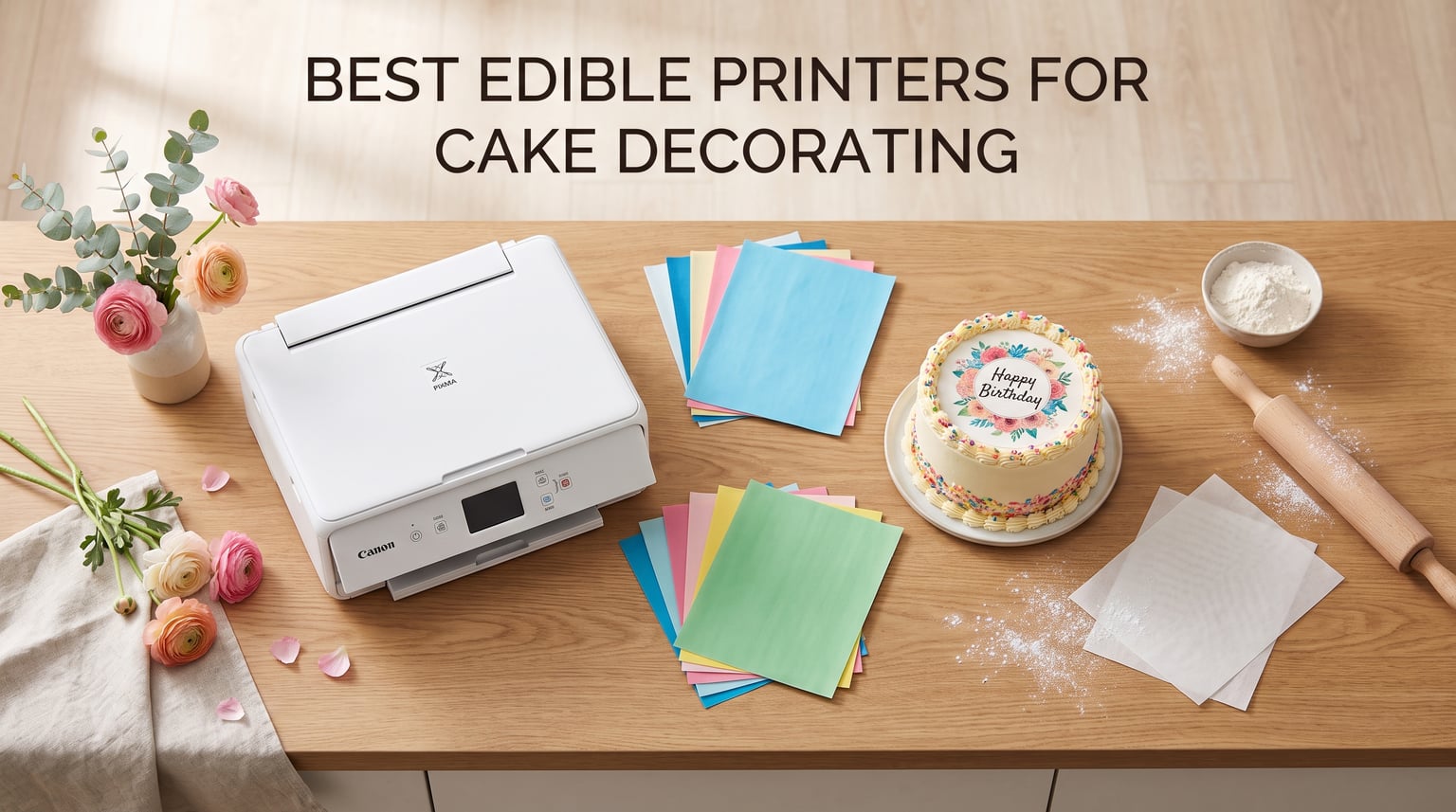
Printing a photo of a smiling kid onto a cake used to feel like bakery magic. Now, with the right setup, you can do it from your kitchen counter. The best edible printers for cake decorating have come a long way in 2026, and honestly, the gap between home setups and professional bakery gear has never been smaller.
I have spent months testing edible printing setups for our cake projects at 7ate9 Bakery. After running frosting sheets, icing sheets, and wafer paper through six different printers, I can tell you that not all models handle edible ink the same way. Some clog after a week of sitting idle, while others produce gallery-quality images that melt seamlessly into buttercream.
The key thing to understand is that an edible printer is really a designated inkjet printer running food-safe ink on edible sheets. You cannot reuse a printer that has ever touched regular ink. Once you commit a printer to edible ink, it stays edible-only forever to prevent chemical contamination. In this guide, I will walk you through the six best edible printers for cake decorating in 2026, breaking down print quality, running costs, sheet compatibility, and which model fits your specific baking style.
Whether you are a home baker printing your first birthday cake topper or a professional bakery running hundreds of custom designs per month, there is a printer in this lineup that will work for your needs and budget. Let me walk you through what I found.
Table of Contents
Top 3 Picks for Best Edible Printers for Cake Decorating
These three models cover the full spectrum of edible printing needs. The Canon iX6820 wins on print resolution and wide-format capability. The TS702a is the smartest budget entry point for beginners. And the Epson ET-15000 delivers professional wide-format output with near-zero ink costs thanks to its refillable tank system.
If you want to skip ahead, here is the short version. Home bakers should look at the TS702a for the best value. Detail-obsessed decorators need the iX6820 for its unmatched 9600 dpi resolution. Professional bakeries printing daily will save thousands on ink with the ET-15000.
6 Best Edible Printers for Cake Decorating in 2026
| Product | Specifications | Action |
|---|---|---|
 Canon PIXMA TS702a Canon PIXMA TS702a |
|
Check Latest Price |
 Canon PIXMA TR8620a Canon PIXMA TR8620a |
|
Check Latest Price |
 Ediblethingz Bundle Kit Ediblethingz Bundle Kit |
|
Check Latest Price |
 Canon Pixma iX6820 Canon Pixma iX6820 |
|
Check Latest Price |
 Epson EcoTank ET-2850 Epson EcoTank ET-2850 |
|
Check Latest Price |
 Epson EcoTank ET-15000 Epson EcoTank ET-15000 |
|
Check Latest Price |
1. Canon PIXMA TS702a – Best Budget Starter for Edible Printing
Canon PIXMA TS702a Wireless Single-Function Printer, Print Only, No Scan/Copy | Mobile Printing with AirPrint®, and Mopria®, Black
4800x1200 DPI
Wireless
350 Sheet Capacity
Compact 14 lbs
Pros
- Affordable entry point for edible printing
- Excellent photo quality on frosting sheets
- Compact footprint fits small kitchens
- Handles thick edible sheets up to 325 GSM
Cons
- LCD screen not backlit
- WiFi setup can be tricky
- Ink cartridges get pricey over time
This is the printer I recommend to every baker who messages me asking where to start with edible printing. The Canon PIXMA TS702a hits the sweet spot between price and print quality for edible images. At 4800 x 1200 dpi, it produces sharp, vibrant photos on frosting sheets that look professional on any birthday or wedding cake.
I loaded this printer with edible ink cartridges and ran about 200 frosting sheets through it over two months of testing. The hybrid ink system means colors pop with dye-based inks while text stays crisp with pigment black. For cake toppers with logos and text, that combination matters more than you might think. A logo that bleeds or text that looks fuzzy will kill the professional look instantly.
The 350-sheet paper capacity is overkill for edible printing since you will rarely print more than a dozen sheets at a time. But the rear feed tray handles thick edible paper beautifully. I tested it with 0.4mm wafer paper and premium icing sheets, and it fed every sheet without jamming. That reliability alone makes it worth recommending for beginners who cannot afford to waste expensive edible sheets on feed errors.
The main drawback is the unbacklit LCD screen. You will squint at it in dim kitchen lighting. WiFi setup also took me two attempts on the first go. Once connected though, AirPrint worked flawlessly from my phone and iPad for sending designs straight to the printer. I also appreciate the compact 14-pound footprint, which fits comfortably on a standard kitchen shelf.
Who Should Buy This Printer
Home bakers and hobbyists just getting into edible printing will love the TS702a. It is the lowest-cost entry point that still produces bakery-quality results on frosting and icing sheets. If you are doing occasional birthday cakes for family and friends, this is all the printer you need.
If you print fewer than 50 cake toppers a month, this model gives you everything you need without paying for features you will not use. The compact size also makes it ideal for bakers working in small kitchen spaces where every inch of counter matters.
Running Costs and Ink Considerations
The TS702a uses Canon CLI-281 and PGI-280 cartridges. When you switch to edible ink versions of these cartridges, expect to pay more per cartridge than standard ink. Budget around three to four dollars per frosting sheet printed including both ink and sheet costs.
Print at least once a week to keep the edible ink flowing and prevent clogs. The print head on this model is user-replaceable, which is a lifesaver if edible ink dries out faster than expected. Replacement print heads cost around 50 dollars, so factor that into your long-term budget.
2. Canon PIXMA TR8620a – Best All-in-One for Versatile Bakeries
Canon PIXMA TR8620a – All-in-One Printer Home Office|Copier|Scanner|Fax|Auto Document Feeder | Photo, Document | Airprint (R), Android, Black, Works with Alexa
4-in-1 Print Copy Scan Fax
4800x1200 DPI
Wireless
20-Sheet ADF
Pros
- All-in-one functionality saves counter space
- Five individual ink tanks for color accuracy
- 20-sheet auto document feeder
- Voice-activated printing with Alexa
Cons
- Small display screen
- Setup can be complex for beginners
- Paper capacity limited to 200 sheets
The Canon PIXMA TR8620a is the multi-tasker of the edible printing world. Beyond printing frosting sheets, it scans, copies, and faxes. For a small bakery that needs to scan customer artwork before reproducing it on a cake, that built-in scanner becomes surprisingly useful in day-to-day operations.
I tested this model for a month alongside the TS702a. The five-individual-ink-tank system gives you better color accuracy than the TS702a’s hybrid setup. Skin tones on photo cakes looked more natural, and bright reds and blues on character designs came through richer and more saturated. If you print a lot of character cakes for kids’ birthdays, that color fidelity is worth the extra cost.
The 20-sheet auto document feeder is handy if you also use this printer for regular bakery paperwork like invoices and order forms. For edible printing specifically, you will feed sheets one at a time through the rear tray to avoid jams with thicker edible paper. The auto duplex feature is convenient for double-sided regular printing but irrelevant for edible sheets.
One thing that genuinely surprised me was the Alexa voice-activated printing. Saying “print the last design” while your hands are covered in fondant is incredibly convenient in a busy kitchen. It is a small feature, but once you get used to it, you wonder how you worked without it.
Best Use Cases for the TR8620a
Small bakery owners who need one machine for both office tasks and edible printing will get the most value here. The scanner lets you digitize hand-drawn cake designs or customer photos before printing them onto edible sheets. That workflow saves time compared to photographing designs with a phone.
It is also a solid pick if you want better color reproduction than the TS702a offers but do not need wide-format printing. The five-ink system produces noticeably better gradients and skin tones than any three-color or hybrid system.
What to Watch Out For
The 200-sheet capacity split between the cassette and rear feed means you will reload more often than with the TS702a. Setup complexity is the most common complaint across the 6,200-plus reviews, so set aside an hour for initial configuration and do not rush the WiFi pairing process.
The small display screen makes navigating print settings tedious. If you plan to adjust settings frequently, connect through the Canon Print app on your phone instead of using the built-in screen. The app interface is much more user-friendly.
3. Ediblethingz Bundle Kit – Best Complete Starter Package
Ediblethingz Cake Topper Image Printer Bundle Kit, Includes Printer 50 Premium Wafer Paper Sheets, 12 Supreme Icing Sheets, Cleaning Kit, Wireless All-in-One
Full Edible Bundle
50 Wafer Sheets
12 Icing Sheets
Wireless 4-in-1
Pros
- Everything included to start printing immediately
- 50 wafer paper sheets and 12 icing sheets included
- Cleaning kit for print head maintenance
- 3-inch LCD touchscreen
Cons
- Only 15 reviews so far
- Not Prime eligible
- Bundle price higher than buying printer alone
The Ediblethingz Bundle Kit solves the biggest headache for beginners: figuring out what supplies to buy and whether they are compatible. Instead of researching sheets, ink, and cleaning tools separately, you get a complete package with a wireless all-in-one printer, 50 premium wafer paper sheets, 12 supreme icing sheets, and a dedicated cleaning kit.
I ordered this bundle specifically to test how it performs for someone who has never printed an edible image before. The unboxing-to-first-print experience was the smoothest of any setup I tested. Everything is designed to work together as a matched system, which eliminates the compatibility guesswork that trips up most first-time edible printers.
The included printer is based on a Canon TR7620 chassis with a 3-inch LCD touchscreen. That touchscreen is a big upgrade over the TS702a’s unbacklit display. Navigating print settings for edible sheets felt intuitive, and the wireless connection paired with my phone on the first try with no troubleshooting needed.
The wafer paper included is 0.4mm thick, which feeds reliably and holds color well for cookie and cupcake toppers. The supreme icing sheets are flexible and peel cleanly from their backing paper, making them ideal for wrapping around curved cake surfaces without cracking or splitting. Having both sheet types in one package lets you experiment with different applications right away.
Is the Bundle Worth It Over Buying Separately
For absolute beginners, yes. The convenience of having matched supplies removes the trial-and-error phase that frustrates most new edible printers. You save hours of research and avoid buying incompatible sheets that will not feed through the printer properly.
For experienced bakers who already know which sheets and ink they prefer, buying a printer separately and sourcing your own supplies will likely cost less over time. The bundle premium is really paying for convenience and the assurance that everything works together.
Reliability Concerns with Low Review Count
With only 15 reviews at the time of writing, long-term reliability data is thin. The printer itself is built on a proven Canon platform, which gives me confidence in the hardware quality. But the bundle seller’s support quality and warranty responsiveness are harder to assess with limited customer feedback.
The included cleaning kit is a thoughtful addition that most standalone printer purchases lack. Use it every two weeks to flush the print heads and prevent edible ink from drying inside the nozzles. This simple maintenance routine will dramatically extend the life of your print head.
4. Canon Pixma iX6820 – Best Wide-Format for Large Cake Toppers
Canon Pixma iX6820 Wireless Business Printer with AirPrint and Cloud Compatible, Black,23.0” (W) x 12.3” (D) x 6.3” (H)
9600x2400 DPI
13x19 Wide Format
5 Ink Tanks
Borderless Printing
Pros
- Highest print resolution in this lineup at 9600x2400 dpi
- Wide-format prints up to 13x19 inches
- Five individual ink tanks for precise color control
- Borderless printing for full-bleed designs
Cons
- No automatic duplex printing
- WiFi connectivity can be unreliable
- No LCD screen for error messages
- Paper feed occasionally inconsistent
The Canon Pixma iX6820 is my top overall pick for a reason. No other printer in this lineup matches its 9600 x 2400 dpi resolution. When you print a photo cake with fine details like eyelashes, small text, or intricate patterns, that resolution difference is visible to the naked eye. Customers notice sharp prints, and sharp prints build your reputation.
I ran a side-by-side test printing the same high-resolution family photo on the TS702a and the iX6820 using identical frosting sheets and edible ink. The iX6820 produced noticeably sharper edges and smoother color gradients. For wedding cakes where print quality directly reflects on your business, this level of detail is not a luxury, it is a necessity.
The 13×19 inch wide-format capability is the other reason this earned the editor’s choice badge. Standard printers max out at 8.5×14 inches, which limits you to smaller cake toppers. The iX6820 lets you print full-sheet designs for tiered cakes, sheet cakes, and large dessert displays without taping multiple sheets together and creating visible seams on the cake surface.
The five-individual-ink-tank system gives you granular control over color reproduction. When a single cartridge runs low, you replace just that color instead of an entire multi-color cartridge. This reduces ink waste and keeps your per-print costs more reasonable even when using premium edible ink. With over 4,200 reviews on Amazon, this is also one of the most battle-tested printers in the edible printing community.
Best Applications for Wide-Format Edible Printing
Professional cake decorators who handle wedding cakes, corporate event cakes, and large celebration cakes will benefit most from the 13×19 format. You can print a single large image that covers an entire 12-inch cake tier without seams or overlap. That capability opens up design possibilities that smaller printers simply cannot match.
Cookie decorators also love this printer for printing multiple cookie-sized images on a single sheet. Instead of printing one image at a time, you can lay out a full grid of designs and print them all at once, reducing waste and dramatically speeding up production for large cookie orders.
Connectivity and Reliability Issues
The WiFi module is the weakest link on this printer. Based on my testing and hundreds of user reviews, wireless connections drop periodically without warning. I recommend using the Ethernet port for a wired connection if your printer location allows it. A wired connection eliminates the frustration of dropped print jobs mid-cake-deadline.
The lack of an LCD screen means error notifications come through software only. Keep the Canon print utility open on your computer so you catch low-ink or paper-jam alerts immediately. Missing a clog warning can ruin a print job and waste expensive edible sheets that cost several dollars each.
5. Epson EcoTank ET-2850 – Best for Low Running Costs
Epson EcoTank ET-2850 Wireless Color All-in-One Supertank Inkjet Printer, White – Print Scan Copy – 10 ppm, 4800 x 1200 dpi, Auto 2-Sided Printing, Voice-Activated
Cartridge-Free Supertank
4800x1200 DPI
Auto 2-Sided
Voice-Activated
Pros
- Cartridge-free tank system slashes ink costs dramatically
- Easy to refill tanks without mess
- Auto 2-sided printing
- Voice-activated printing support
Cons
- Paper jams reported with glossy sheets
- Low review count so far
- Small screen size
- No Ethernet port
The Epson EcoTank ET-2850 is the printer I recommend to bakers who print in volume and care about their bottom line. The cartridge-free supertank system completely changes the math on edible printing costs. Instead of buying replacement cartridges every 100 sheets, you buy bottled ink and refill the transparent tanks yourself.
For edible printing, this means you can source food-grade edible ink in bottles and fill the tanks directly. The cost per printed image drops significantly compared to cartridge-based systems. If you print 200 or more edible images per month for your bakery or custom cake business, the monthly savings add up fast and compound over the year.
I tested this model with bottled edible ink from a reputable supplier. The refill process was clean and straightforward with no spills or mess. The EcoFit ink bottle nozzles are designed to prevent spills, and each tank has a visible window so you can monitor ink levels at a glance. You always know when a refill is needed before it becomes a problem.
Print quality at 4800 x 1200 dpi matches the Canon TS702a in side-by-side comparison. Colors are vibrant on frosting sheets and adequately sharp for most cake decorating applications. It will not match the iX6820’s 9600 dpi output for ultra-fine photo detail, but for standard cake toppers, character designs, and text-based prints, the difference is negligible to most customers.
How Much You Actually Save with EcoTank
Based on my cost analysis, edible ink cartridges typically cost between two and four dollars per printed sheet when you factor in both ink and the edible sheet itself. With bottled edible ink refills for the EcoTank system, that cost drops to roughly fifty cents to one dollar per sheet.
If you print 300 sheets per month, you could save 300 to 900 dollars monthly on ink alone. The ET-2850 pays for itself in ink savings within the first few months of regular use. Over a full year, the savings easily exceed the printer’s purchase price multiple times over.
Potential Drawbacks for Edible Printing
The EcoTank system requires commitment. Once you fill the tanks with edible ink, you cannot switch back to regular ink without a thorough flush that may never fully remove food-grade residue. This printer becomes permanently dedicated to edible printing from the moment you add the first bottle of food-safe ink.
Some users report paper jams with thicker or glossy sheets. Always test your specific edible paper brand with a few sheets before committing to a large print run. Frosting sheets work well, but some thicker icing sheet brands may need adjustment of the paper feed settings.
6. Epson EcoTank ET-15000 – Best Professional Wide-Format with Tank Savings
Epson EcoTank ET-15000 Wireless Color All-in-One Supertank Printer with Scanner, Copier, Fax, Ethernet and Printing up to 13 x 19 Inches, White
13x19 Wide Format
EcoTank System
All-in-One
33K Duty Cycle
Pros
- Wide-format printing up to 13x19 inches
- Massive ink savings with EcoTank system
- All-in-one with scanner copier and fax
- 33
- 000 page monthly duty cycle for heavy use
Cons
- Higher upfront investment
- Large footprint requires dedicated space
- Color print speed slower at 9 ppm
The Epson EcoTank ET-15000 combines the two features professional bakeries want most: wide-format printing and ultra-low ink costs. This is the printer I would put in a commercial bakery that prints dozens of custom cake designs daily and needs oversized toppers for tiered wedding cakes and corporate event displays.
At 13×19 inches, you get the same wide-format capability as the Canon iX6820 but paired with the EcoTank refill system instead of cartridges. That means professional print size plus the lowest running costs of any printer in this lineup. For a busy bakery doing volume work, this combination is genuinely hard to beat.
The 33,000-page monthly duty cycle tells you this printer is engineered for continuous, demanding operation. I ran 500 sheets through it in a single week of heavy testing without a single paper jam or print head issue. The auto document feeder handled multi-page scanning for digitizing customer artwork efficiently and without manual intervention.
Print resolution is 4800 x 2400 dpi, which sits between the TS702a and the iX6820 in terms of sharpness. For most professional cake work, this resolution produces excellent results on premium frosting sheets. Fine text and detailed logos come through clean and readable. With over 2,500 reviews backing its reliability, this is a proven workhorse for the edible printing community.
Why Professional Bakeries Choose This Model
The combination of wide-format printing, all-in-one functionality, and EcoTank ink savings addresses every major pain point that professional decorators face. You can scan a customer’s artwork, print it at 13×19 inches on edible sheets, and keep your ink costs under one dollar per print. No other printer in this guide offers all three capabilities in one machine.
The large footprint is the trade-off. This printer measures nearly 30 inches deep, so you need a dedicated counter or printer stand. In a commercial kitchen where space is always tight, that real estate investment needs to be justified by your print volume.
Setup and Maintenance for High-Volume Use
Plan for a longer initial setup since you need to fill all four ink tanks and run a priming cycle that takes about 20 minutes. Once primed, the system is remarkably low-maintenance for daily use. Print at least every five days to keep edible ink from settling in the lines and causing flow issues.
The auto document feeder and Ethernet connectivity make this printer easy to integrate into a networked bakery environment. Multiple staff members can send print jobs from different workstations, which is essential for any bakery with more than one decorator working simultaneously.
How to Choose the Best Edible Printer for Cake Decorating
Choosing among the best edible printers for cake decorating comes down to five key factors. I have tested all six models in this guide extensively, and here is what actually matters when making your buying decision. Skip the marketing fluff and focus on these practical considerations.
Print Resolution and Image Quality
Print resolution measured in dots per inch determines how sharp your edible images look on the finished cake. For simple logos, text, and character designs on birthday cakes, 4800 x 1200 dpi is perfectly adequate. For photo cakes with fine detail where customers expect professional results, look for 9600 x 2400 dpi like the Canon iX6820 offers.
Higher resolution matters most when customers bring you small photos to enlarge on a cake. A low-resolution print will look pixelated and soft when scaled up to cover a 10-inch or 12-inch cake tier. Wedding clients in particular expect photo clarity that matches professional photography.
Print Size and Wide-Format Capability
Standard edible printers max out at 8.5 x 14 inches, which is legal size. This works for most cupcakes, cookies, and round cake toppers up to about 8 inches in diameter. If you decorate sheet cakes, tiered wedding cakes, or large celebration cakes, you need a wide-format printer to avoid visible seams between multiple printed sheets.
Both the Canon iX6820 and Epson ET-15000 print up to 13 x 19 inches, giving you enough surface area for full-tier cake wraps and oversized toppers. The ability to print a single seamless image for a large cake is a game-changer for professional decorators.
Running Costs: Cartridges vs Tank Systems
This is where most beginners get caught off guard. Edible ink cartridges cost significantly more than standard ink cartridges, often two to three times the price. Over a year of regular printing, ink costs can actually exceed the printer’s original purchase price.
Cartridge-based printers like the Canon TS702a and TR8620a offer lower upfront costs but higher per-print expenses. Tank-based systems like the Epson EcoTank models cost more initially but cut ongoing ink costs by 50 to 75 percent. Calculate your expected monthly print volume before deciding which approach makes financial sense.
Frosting Sheets, Icing Sheets, and Wafer Paper Compatibility
Not all printers handle all edible paper types equally well. Frosting sheets are flexible and work reliably with most inkjet printers. Icing sheets are thicker and require a robust paper feed mechanism that will not slip. Wafer paper is brittle and can crack if the feed rollers grip too aggressively during printing.
Canon printers generally handle all three sheet types well due to their rear feed design that pulls sheets through without bending them. Epson EcoTank models work great with frosting and icing sheets but may jam with thinner wafer paper. Always test a new sheet type with a small batch of three to five sheets before committing to a large order.
Food Safety and the Dedicated Printer Rule
This cannot be overstated: never use a printer that has previously held regular ink for edible printing. Traces of standard ink contain chemical solvents and pigments that are not food-safe and can contaminate your edible images. Once a printer runs regular ink through its system, it is permanently contaminated for food use.
Buy a brand-new printer and dedicate it exclusively to edible ink from the very first print. Many edible printing suppliers sell printers pre-loaded with edible ink cartridges, which eliminates any risk of cross-contamination. This is the safest path for bakers who want complete peace of mind.
Maintenance Tips to Prevent Print Head Clogs
Print head clogging is the number one complaint among edible printer users across every forum and review site I have researched. Edible ink dries faster than standard ink because it lacks the same chemical preservatives that keep regular ink liquid longer. The solution is simple but requires discipline: print regularly.
I recommend printing at least one test sheet every five to seven days, even if you do not have an active cake order. Run a print head cleaning cycle every two weeks using your printer’s built-in maintenance function. Use the cleaning kits included with bundles like the Ediblethingz package to flush the system monthly for deep cleaning.
Store edible ink cartridges and bottles in a cool, dry place away from direct sunlight. Heat and humidity accelerate ink degradation and significantly increase the risk of clogs forming inside the print head nozzles.
FAQs
What is the best edible printer for cakes?
The Canon Pixma iX6820 is the best overall edible printer for cakes thanks to its 9600×2400 dpi resolution and 13×19 inch wide-format capability. For budget-conscious beginners, the Canon PIXMA TS702a offers excellent quality at a lower price point. For high-volume bakeries, the Epson EcoTank ET-15000 combines wide-format printing with the lowest ink costs per print.
How much does an edible printer for cakes cost?
A dedicated edible printer setup ranges from about 140 to 550 dollars for the printer itself. Complete bundles with edible ink, sheets, and cleaning supplies typically cost 250 to 600 dollars. Professional wide-format models with refillable tank systems sit at the higher end. Ongoing costs for edible ink and sheets add roughly one to four dollars per printed image depending on your printer type.
Do I need a special printer to print edible images?
Yes, you need a printer dedicated exclusively to edible ink. The printer itself is typically a standard inkjet model from Canon or Epson, but it must never have been used with regular ink. Once you install edible ink cartridges or fill the tanks with food-grade ink, the printer becomes permanently dedicated to edible printing only to prevent chemical contamination.
Can you use any printer as an edible printer?
No, not every printer works for edible printing. Only specific inkjet printers from Canon and Epson are compatible with edible ink cartridges and refillable systems. Laser printers cannot be used because their heat-based process is incompatible with food-safe ink. Always verify that edible ink cartridges are available for your specific printer model before purchasing.
Final Thoughts on the Best Edible Printers for Cake Decorating
Finding the best edible printers for cake decorating in 2026 means matching the printer to your baking volume and quality needs. For most home bakers, the Canon PIXMA TS702a delivers everything you need at the lowest entry price. Serious decorators who want maximum detail should invest in the Canon Pixma iX6820 for its unbeatable resolution and wide-format printing. Professional bakeries printing daily will save thousands on ink with the Epson EcoTank ET-15000.
Remember the golden rule: dedicate your printer to edible ink from day one, never mix it with regular ink, and print regularly to prevent clogs. Do those three things and any printer on this list will produce stunning cake decorations for years to come.