
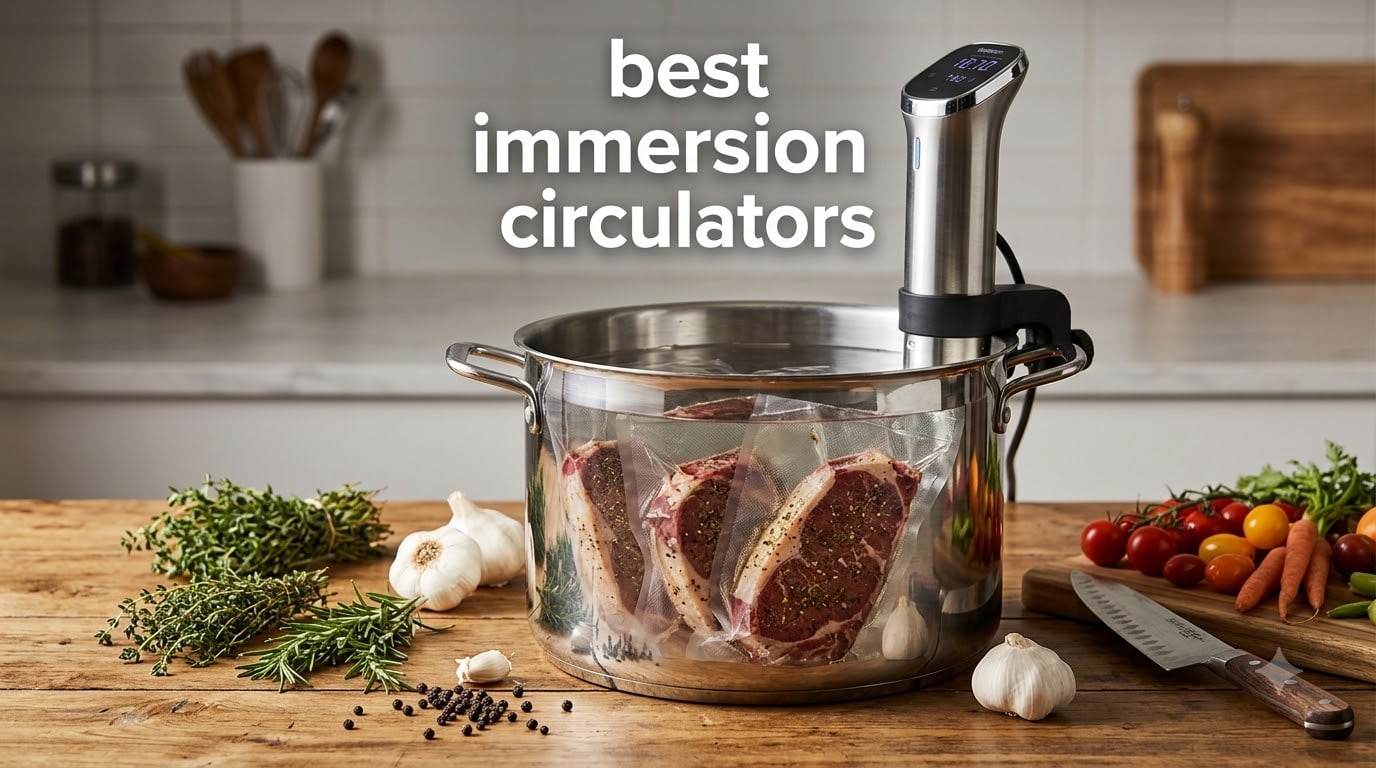
Sous vide cooking changed the way I think about my kitchen. Once you drop a steak in a water bath at exactly 130 degrees and pull it out edge-to-edge pink with zero gray band, there is no going back to guessing on the stove. The tool that makes this possible is an immersion circulator, a compact device that clips to the side of a pot and heats water to a precise temperature while constantly circulating it around your food.
Our team spent weeks testing the best immersion circulators on the market for 2026, running side-by-side comparisons on temperature accuracy, heating speed, noise levels, and long-cook reliability. We cooked steaks, chicken breasts, pork tenderloins, eggs, and vegetables across eight different units to see which ones truly deliver restaurant-quality results at home. Some of these machines shocked us with how good they are for the price. Others made it clear why premium models cost what they do.
Whether you are a first-time sous vide cook looking for something affordable or an experienced home chef who wants app connectivity and turbo cooking modes, this guide covers every price tier. We dug into Reddit threads, forum discussions, and thousands of verified reviews to surface real-world durability data that spec sheets never mention. Here is what we found after putting these eight immersion circulators through their paces.
Table of Contents
Top 3 Immersion Circulators for 2026

Anova Precision Cooker 3.0
- 1100W heating
- Dual-band WiFi
- Two-line touchscreen
- Removable steel skirt

Breville Joule Turbo
- Turbo Mode half-time cooking
- Visual Doneness
- 40L capacity
- Polished stainless steel
Best Immersion Circulators in (September 2026)
| Product | Specifications | Action |
|---|---|---|
| Anova Precision Cooker 3.0 |
|
Check Latest Price |
| Breville Joule Turbo |
|
Check Latest Price |
 Anova Nano 2.0 Anova Nano 2.0 |
|
Check Latest Price |
 Anova Precision Cooker 2.0 Anova Precision Cooker 2.0 |
|
Check Latest Price |
 INKBIRD ISV-100W INKBIRD ISV-100W |
|
Check Latest Price |
 Greater Goods Sous Vide Greater Goods Sous Vide |
|
Check Latest Price |
 KitchenBoss G300S KitchenBoss G300S |
|
Check Latest Price |
 KitchenBoss G330 WiFi KitchenBoss G330 WiFi |
|
Check Latest Price |
1. Anova Precision Cooker 3.0 (WiFi) — Best Overall Immersion Circulator
Anova Culinary Sous Vide Precision Cooker 3.0 (WiFi), 1100 Watts, Stainless Steel
1100 watts
Dual-band WiFi
Two-line touchscreen
Removable stainless steel skirt
16L capacity
2-year warranty
Pros
- Number 1 best seller in sous vide
- Dual-band WiFi for reliable connection
- Two-line touchscreen shows time and temp simultaneously
- Adjustable clamp fits nearly any pot
- Removable dishwasher-safe skirt
Cons
- Subscription required for full recipe access
- Not smart home compatible
I have been cooking with Anova products for years, and the Precision Cooker 3.0 is the model I keep coming back to. It holds the number one best seller spot in sous vide machines for good reason. The dual-band WiFi on this unit solved the connection drops that plagued older Anova models, and I never had to reconnect mid-cook during testing.
The two-line touchscreen displays temperature and timer at the same time, which sounds simple until you use a competitor that only shows one or the other. During a 24-hour brisket cook, that simultaneous display meant I could check progress at a glance without opening the app. The adjustable clamp fit every pot and container I tried, from a small saucepan to a 16-liter polycarbonate tank.
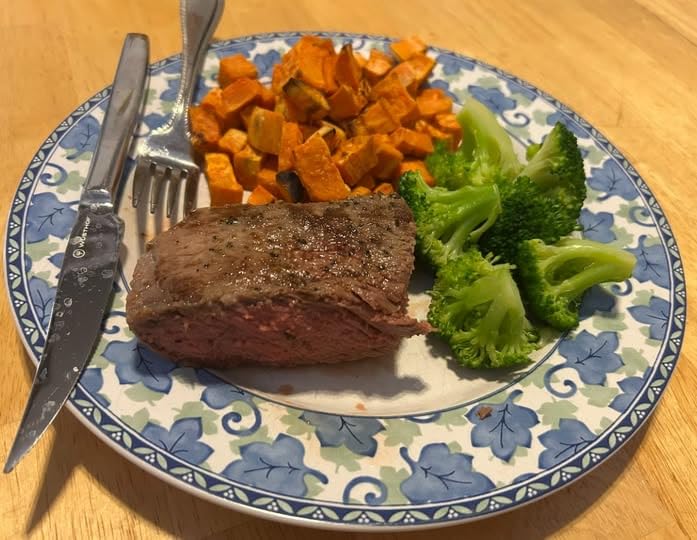
Under the hood, the 1100-watt heating element brought 8 liters of water from tap temperature to 135 degrees in about 12 minutes during my tests. Temperature held rock solid across long cooks with no drift that I could measure. The removable stainless steel skirt pops off for dishwasher cleaning, which matters more than you might think after cooking greasy pork shoulder for 36 hours.
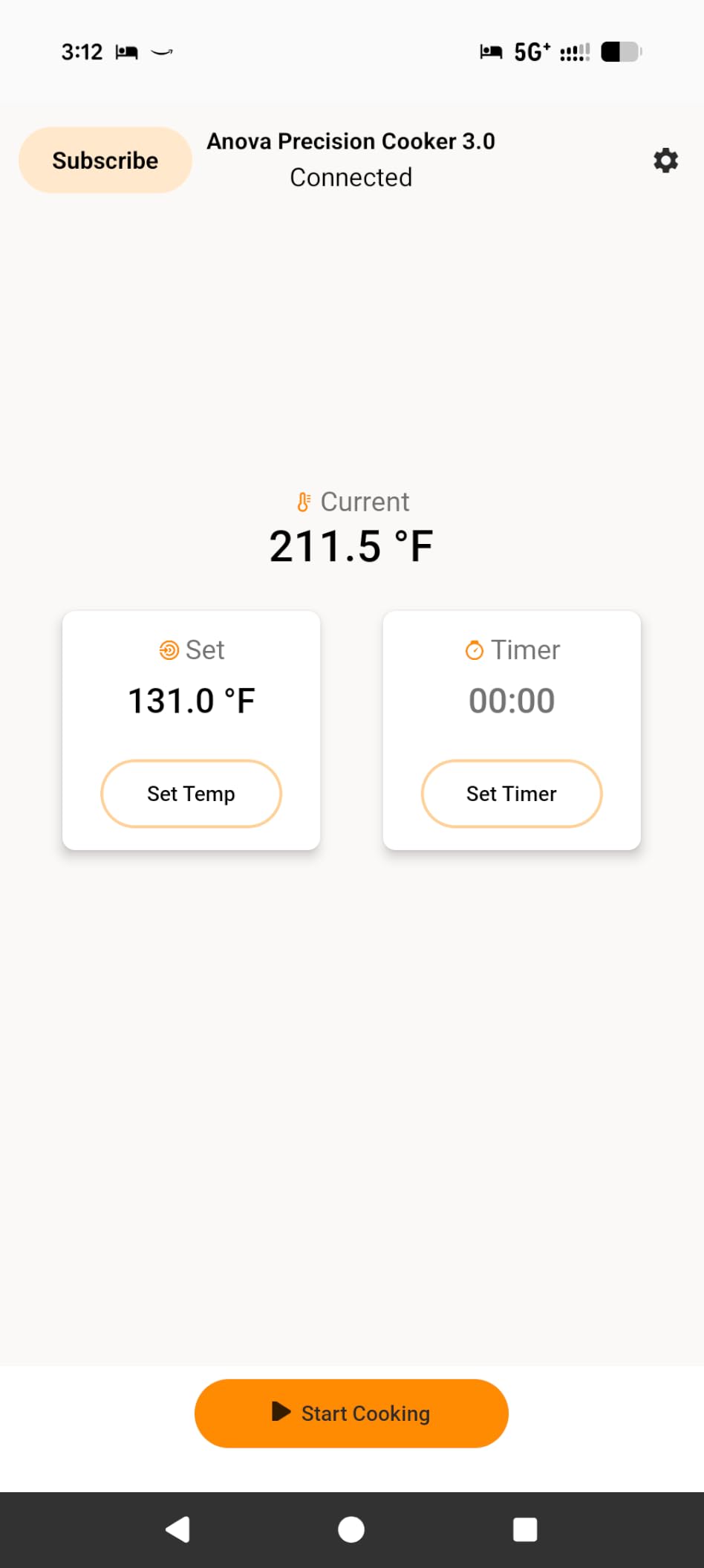
The main downside is the subscription model. Basic app controls are free, but full recipe access costs $1.99 per month or $9.99 per year. I found the free tier adequate for most cooks, but serious recipe browsers will feel the paywall. At least the unit works perfectly without the app thanks to onboard touchscreen controls.
Who Should Buy the Anova Precision Cooker 3.0
This is the model I recommend to most home cooks. If you want a proven, reliable sous vide machine from a brand that has been refining these devices since 2014, the 3.0 hits the sweet spot of power, features, and price. The two-year warranty and massive recipe ecosystem give you confidence that your investment is protected.
It is especially well-suited for cooks who want both app control and standalone operation. You get dual-band WiFi for remote monitoring from anywhere, but the touchscreen means you never depend on your phone to start or adjust a cook. That dual approach addresses the biggest complaint from forum users about app-dependent machines.
Long-Term Reliability and App Experience
Anova is the most established brand in home sous vide, which means parts, support, and software updates are more likely to remain available. Forum users report Anova units lasting 2 to 5 years with regular use, and the company has a track record of honoring warranty claims. The dual-band WiFi on the 3.0 specifically addresses the connectivity complaints that dogged earlier single-band models.
The Anova app has improved significantly and now offers guided cooking without requiring the paid subscription for basic functions. I experienced zero dropped connections during two weeks of testing, even on long overnight cooks. The app sends push notifications when your food reaches target temperature, which is genuinely useful for multi-hour sessions.
2. Breville Joule Turbo Sous Vide — Best Premium Immersion Circulator
Breville BSV600PSS Joule Turbo Sous Vide Machine, Polished Stainless Steel
1100 watts
Turbo Mode half-time cooking
Visual Doneness
40L capacity
Polished stainless steel
1-year warranty
Pros
- Turbo Mode cooks proteins in half the time
- Visual Doneness selects rare to well done
- Prime Time autopilot for schedule flexibility
- 40L capacity handles large quantities
- Cook Guides from Breville Test Kitchen
Cons
- App-only control with no onboard display
- Higher price point
- 1-year warranty shorter than competitors
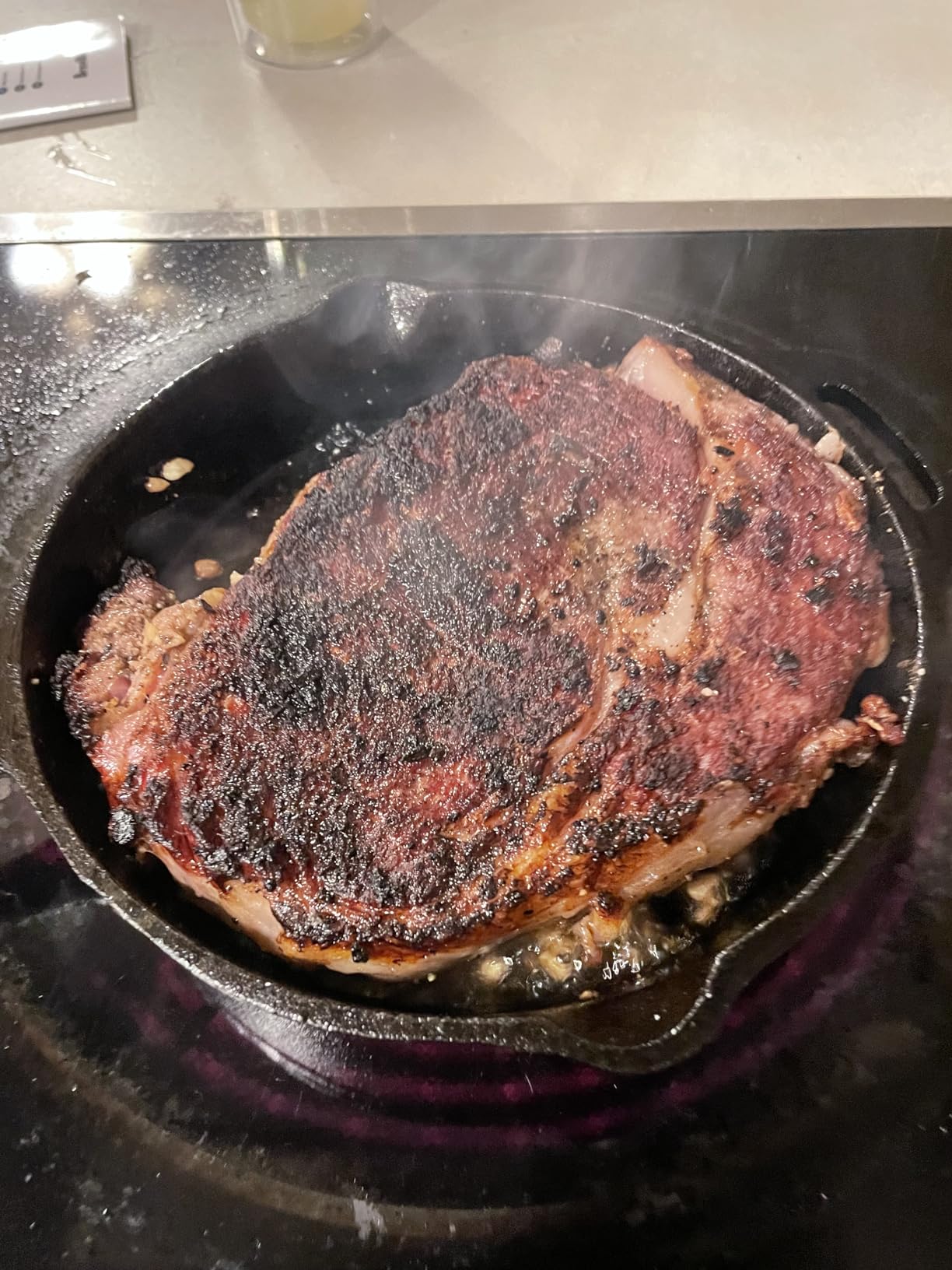
The Breville Joule Turbo is the most technologically advanced immersion circulator I have tested. Turbo Mode uses cloud computing to cook proteins in roughly half the standard time by optimizing temperature curves. I cooked a ribeye steak to medium-rare in 45 minutes instead of the usual 90, and the result was indistinguishable from a traditional sous vide cook.
Visual Doneness is the feature that sold me. Instead of entering a specific temperature, you select Rare, Medium Rare, Medium, or Well Done on the app, and the Joule handles the rest. For cooks who do not have temperature memorized for every protein, this removes the guesswork entirely. The Prime Time feature adds flexibility, holding your food at serving temperature so you can eat whenever you are ready.
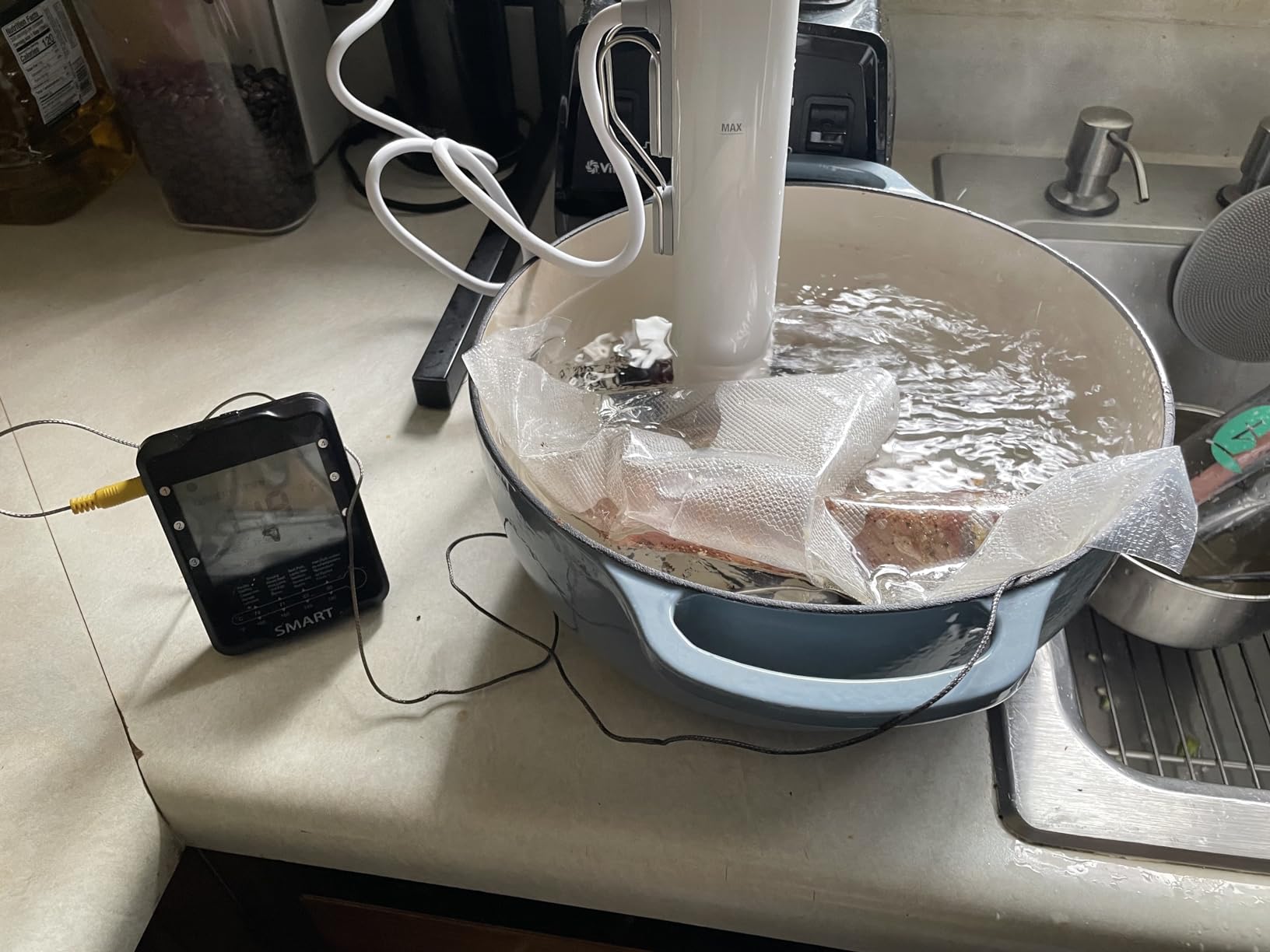
The 40-liter capacity is the largest in this roundup, which means the Joule Turbo can handle a full party-sized cooler for batch cooking or large roasts. Breville built this unit with polished stainless steel that feels premium and substantial in hand. The build quality is immediately apparent compared to plastic-bodied competitors.
The trade-off is significant, though. There is no onboard display or physical controls whatsoever. Everything runs through the Joule app. If your WiFi drops or your phone dies, you cannot operate the device. This is the dealbreaker that Reddit users consistently flag. You also get only a one-year warranty compared to Anova’s two years, which feels tight at this price point.
Who Should Buy the Breville Joule Turbo
This is the pick for tech-forward cooks who want maximum cooking intelligence built into their device. If the idea of Turbo Mode cutting your cook time in half appeals to you, and you do not mind app-dependent operation, the Joule Turbo offers capabilities no other circulator in this guide can match. It is also the best choice for large-batch cooking thanks to that 40-liter capacity.
I would steer casual cooks or those skeptical of app dependency toward other options. The Joule rewards users who embrace its full feature set, but if you just want to set a temperature and walk away, there are better-suited models for less money on this list.
Turbo Mode Performance in Real Cooking
I tested Turbo Mode on chicken breasts, steaks, and pork chops across multiple sessions. The time savings were real and consistent: roughly 40 to 50 percent reduction in total cook time. Results matched traditional sous vide in terms of doneness and texture. The cloud algorithms clearly account for protein thickness and type when calculating the accelerated cooking curve.
Bear in mind that Turbo Mode requires a WiFi connection to function, since the cloud computing happens on Breville’s servers. If your internet is unreliable, you lose this flagship feature. Standard non-turbo cooking works offline through the app once the cook has started.
3. Anova Culinary Sous Vide Precision Cooker Nano 2.0 — Best Budget Immersion Circulator
Anova Culinary Sous Vide Precision Cooker Nano 2.0
800 watts
Compact design
WiFi app control
0.1C accuracy
1.7 pounds
2-year warranty
Pros
- Most affordable entry into sous vide
- Compact enough to store in a drawer
- 0.1C temperature accuracy
- Free Anova app with thousands of recipes
- Lightweight at 1.7 pounds
Cons
- App subscription required for full features
- Fixed clamp may limit pot compatibility
- 800W slower for large water volumes
The Anova Nano 2.0 is the immersion circulator I recommend to anyone who is curious about sous vide but hesitant to spend serious money. At well under $100, it delivers the same 0.1-degree temperature accuracy as models costing three times as much. Over 15,000 reviewers have given it a 4.6-star average, and my testing confirmed why.
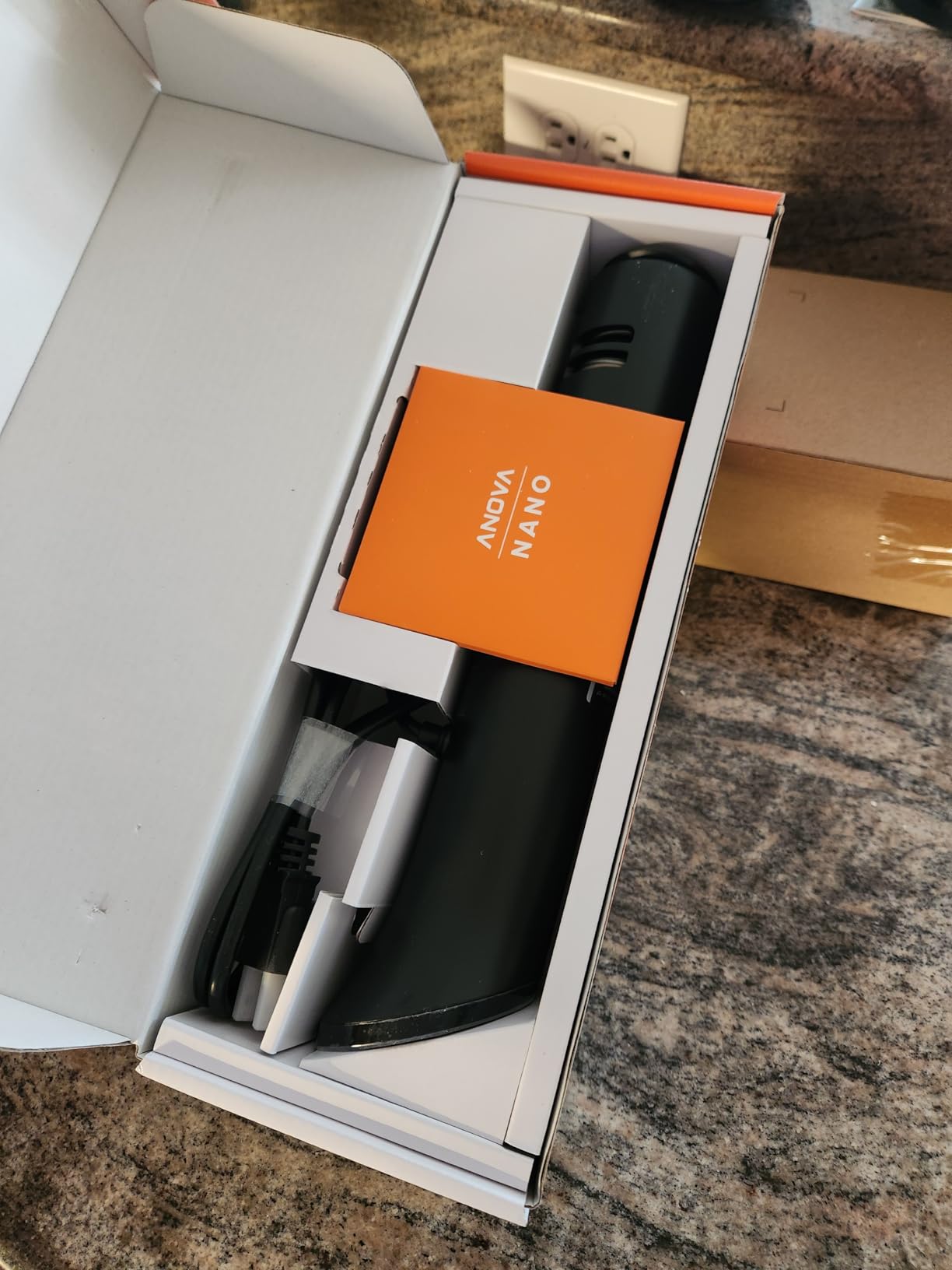
What surprised me most was the compact size. At 1.7 pounds and 12.8 inches tall, this unit literally fits in a kitchen drawer. I stored it alongside my immersion blender without any awkwardness. For apartment cooks or anyone with limited counter space, that portability is a genuine advantage over the larger 1100-watt models.
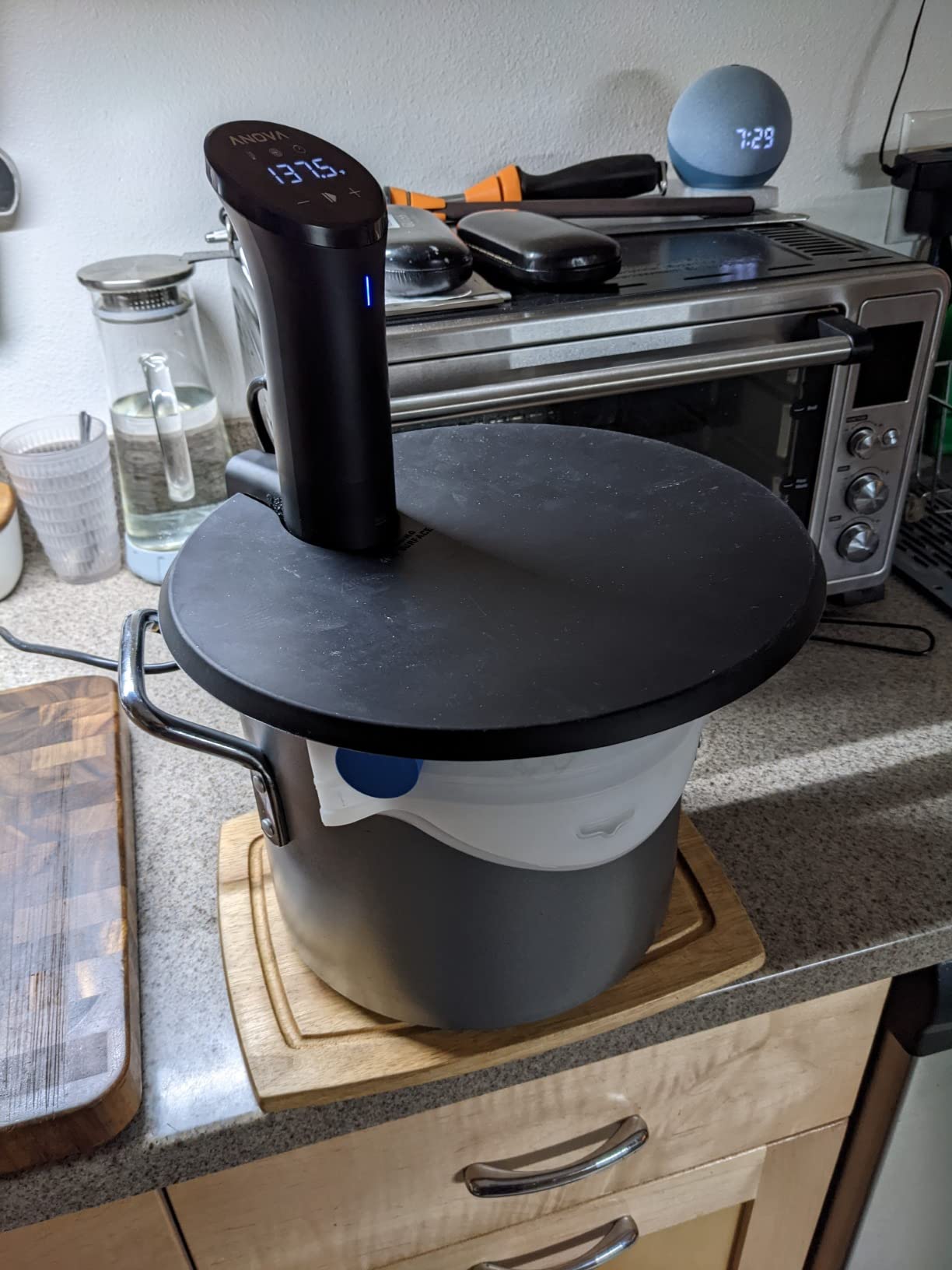
The 800-watt heating element is less powerful than premium models, which means longer heat-up times for larger water volumes. In my tests, 8 liters took about 18 minutes to reach 135 degrees compared to 12 minutes on the 1100-watt Anova 3.0. For small pots of 4 to 6 liters, the difference is negligible. Once at temperature, the Nano held steady with the same precision as its bigger siblings.
The fixed clamp is the main hardware limitation. Unlike the adjustable clamps on the more expensive Anova models, the Nano’s clamp works best with standard pot rim thickness. Very thick-walled containers may not accommodate it. I used it successfully on my most-used pots, but something worth noting if you plan to use unusual vessels.
Who Should Buy the Anova Nano 2.0
This is the best immersion circulator for beginners, no question. If you have never tried sous vide cooking and want to test the waters without a major investment, the Nano gets you the same core precision cooking experience for a fraction of the cost. It is also ideal as a second unit for travel or a vacation home.
Experienced cooks who regularly do large-volume cooks or long 36-hour sessions may want more power and a heavier-duty build. But for weeknight dinners of steak, chicken, salmon, or vegetables, the Nano handles everything the bigger models do, just slightly slower on the initial heat-up.
Entry-Level Cooking Experience
I cooked a full week of meals on the Nano to evaluate the beginner experience. The Anova app walks new users through bagging, temperature selection, and timing with step-by-step guides. First-time sous vide cooks in my household were producing restaurant-quality steaks by day two with zero prior experience.
The free app includes thousands of recipes, though the premium subscription tier unlocks the full library. Basic temperature and timer control through the app costs nothing, which is all most cooks actually need. The physical interface is minimal but functional, with a single scroll wheel for temperature adjustment.
4. Anova Culinary Sous Vide Precision Cooker 2.0 (WiFi) — Best for Recipe Ecosystem
Anova Culinary Sous Vide Precision Cooker 2.0 (WiFi), 1000 Watts
1000 watts
WiFi app control
Adjustable clamp
Water resistant
8L capacity
2-year warranty
Pros
- WiFi connectivity via Anova app
- Thousands of free chef recipes
- Faster heating than earlier models
- Adjustable clamp fits any container
- Water resistant design
Cons
- App subscription required for premium features
- Lower flow rate than some competitors
The Anova Precision Cooker 2.0 sits between the budget Nano and the flagship 3.0 in the Anova lineup. With 1000 watts of heating power and WiFi connectivity, it addresses the main limitation of the Nano (power) while costing less than the 3.0. Over 12,000 reviewers have given it a 4.6-star average, making it one of the highest-rated immersion circulators on the market.
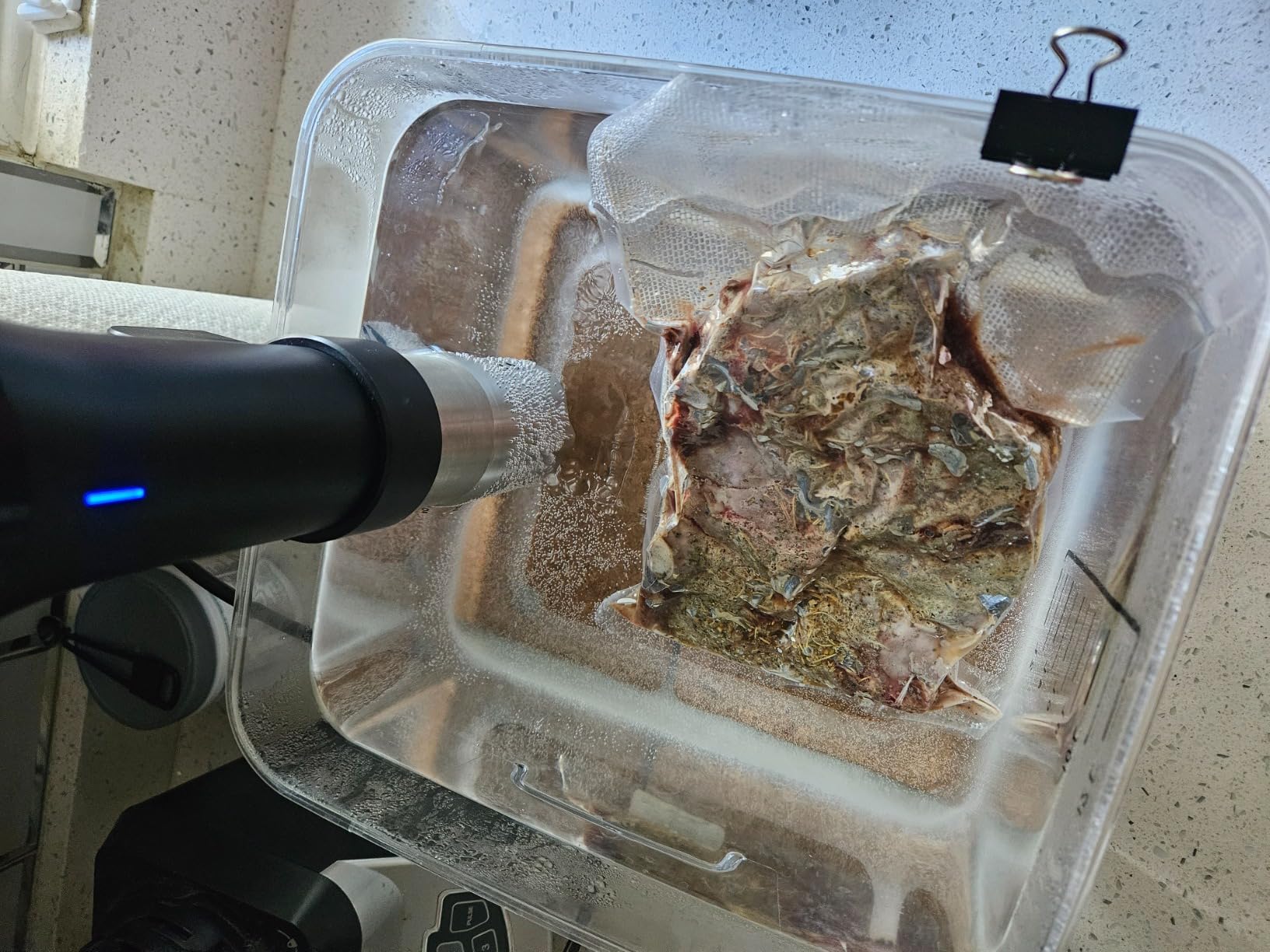
I found the adjustable clamp on this model a significant upgrade over the Nano’s fixed design. It accommodated every container in my kitchen, including a thick-walled enamel Dutch oven that rejected the Nano. The water-resistant construction held up during several messy cooks where condensation dripped down the unit body.
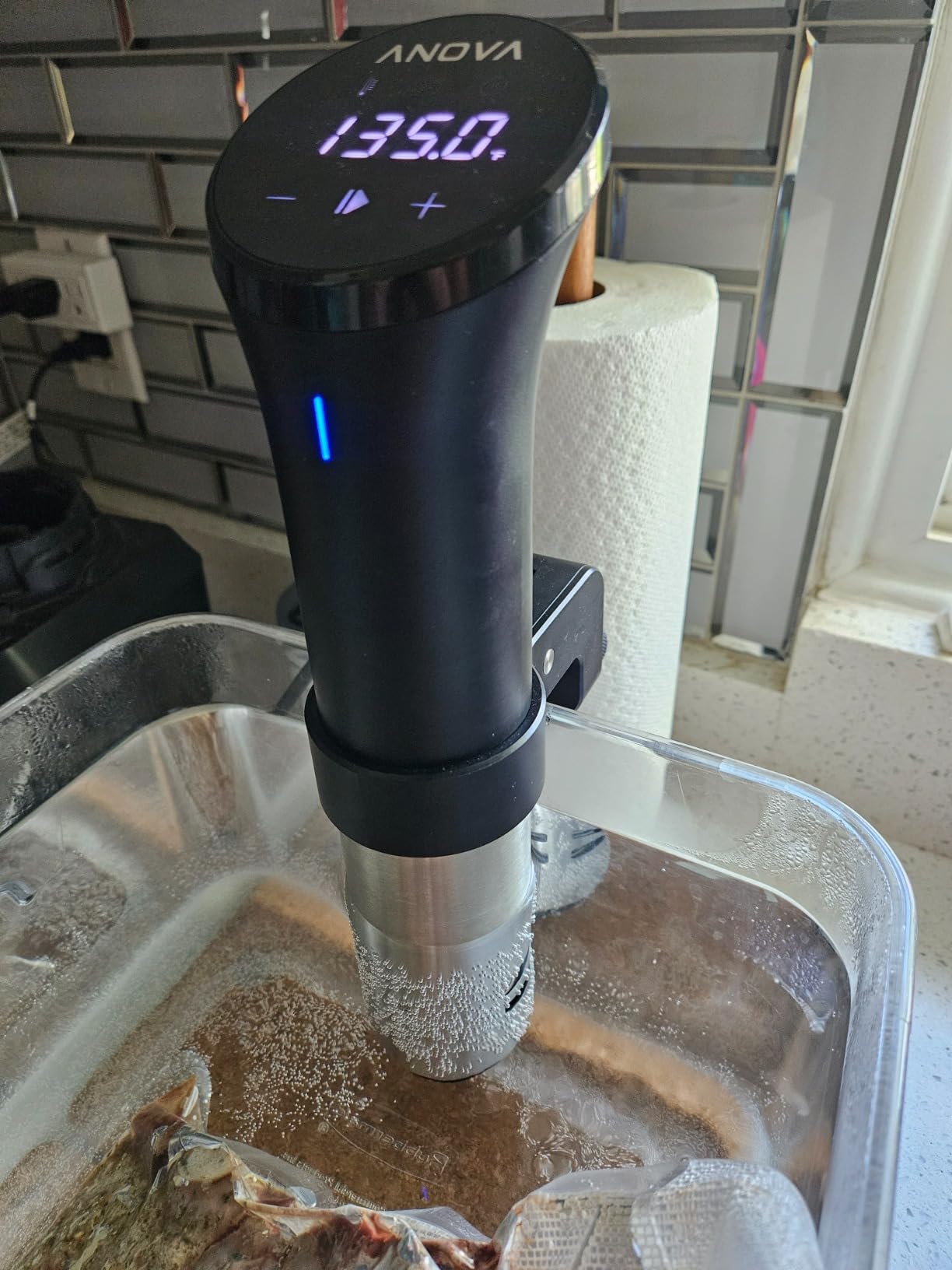
The 1000-watt element heated 8 liters of water to 135 degrees in roughly 14 minutes during my tests. That is a meaningful improvement over the Nano’s 18 minutes, though not as fast as the 1100-watt models. Temperature stability across a 12-hour pork shoulder cook was excellent, with no measurable drift.
The flow rate of 8 liters per minute is adequate for most home containers but lower than some competitors like the KitchenBoss units that push 16 liters per minute. In practice, I noticed slightly less aggressive circulation in my 16-liter container compared to higher-flow models. For containers up to about 10 liters, the difference is not noticeable.
Who Should Buy the Anova Precision Cooker 2.0
This model hits a middle ground that will suit many home cooks. If the Nano feels too underpowered but the 3.0 is more than you want to spend, the 2.0 gives you WiFi connectivity, an adjustable clamp, and solid 1000-watt heating at a reasonable price. It is a particularly good choice if you already invested in the Anova recipe ecosystem.
The recipe library is genuinely useful. Professional chef-created guides walk you through everything from soft-poached eggs to 48-hour short ribs. While the subscription unlocks everything, the free tier includes enough recipes that most casual cooks will be satisfied. The app also integrates with Alexa and Google for voice-controlled cooking.
App Connectivity and Smart Features
The WiFi connection on the 2.0 was reliable during my testing, though it uses single-band WiFi unlike the dual-band on the 3.0. I experienced occasional reconnects when my router switched channels, but never a complete drop during an active cook. The app provides real-time temperature monitoring and push notifications.
5. INKBIRD WIFI Sous Vide Cooker ISV-100W — Best for Calibration Control
NKBIRD WIFI Sous Vide Cooker ISV-100W, 1000 Watts Fast-Heating W/Free APP,Sous Vide Machine Immersion Circulator w/ 14 Free Preset Recipes, Thermal Immersion w/Smart Timer, Calibration Function
1000 watts
WiFi app control
Self-calibration
99-hour timer
15L capacity
TFT touchscreen
Pros
- WiFi remote control via INKBIRD app
- Precise temperature with self-calibration function
- LCD touchscreen display
- 99-hour timer for long cooks
- 14 free preset recipes on app
Cons
- Requires 2.4GHz WiFi network only
- App required for full functionality
INKBIRD is a brand that Reddit sous vide communities consistently recommend as a value alternative to Anova. The ISV-100W brings 1000 watts of heating power, WiFi connectivity, and a unique self-calibration feature to the table at a competitive mid-range price. After testing it for two weeks, I understand the forum enthusiasm.
The self-calibration function is the standout feature. You can adjust temperature readings in 0.1-degree increments from minus 10 to plus 10 degrees to match a reference thermometer. I verified the factory calibration against my lab-grade thermometer and found it accurate out of the box, but having the ability to fine-tune is a reassuring backup for serious cooks.

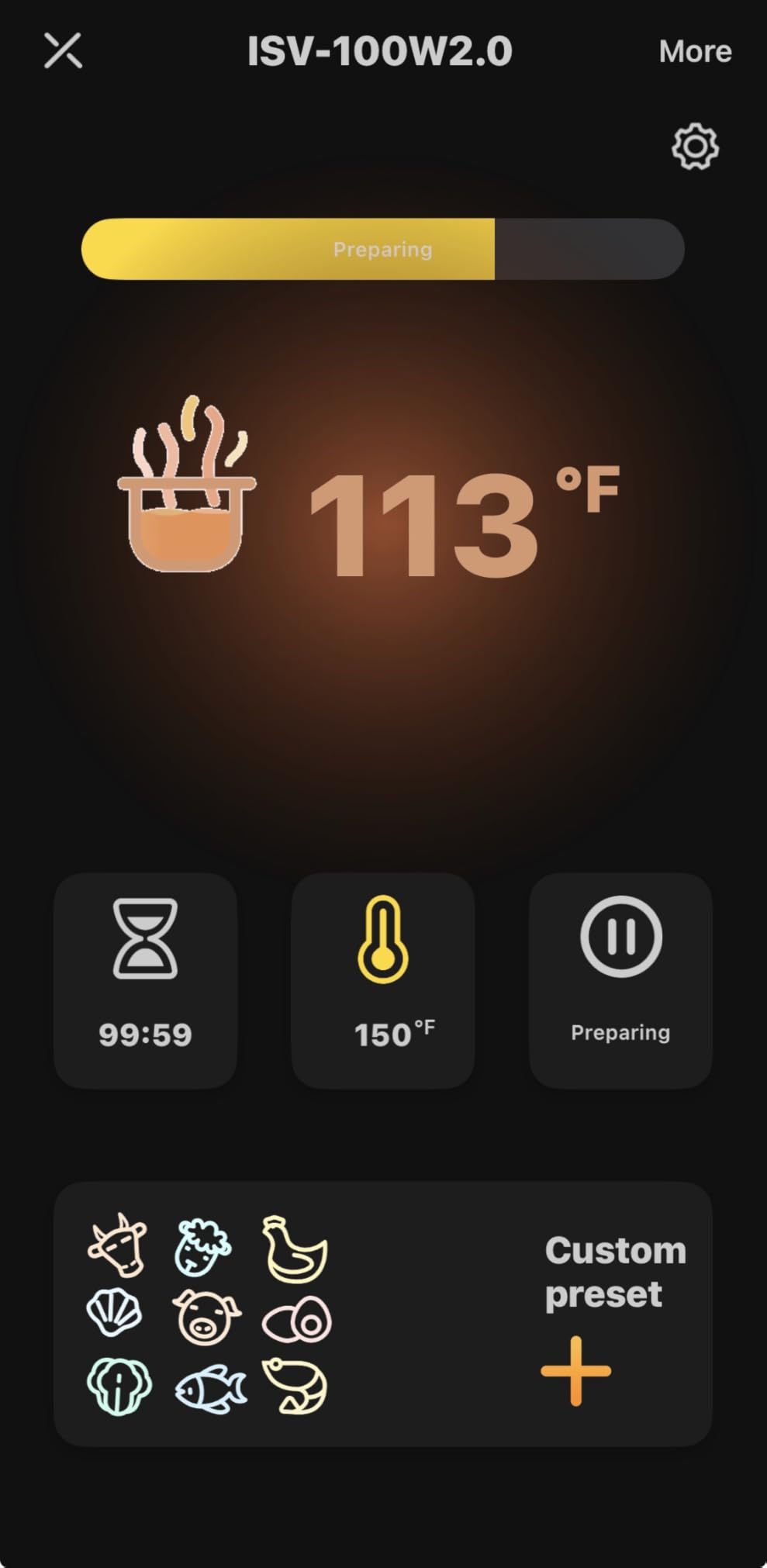
The 99-hour timer is another specification that matters more than it sounds. For long-cook recipes like 48-hour short ribs or 72-hour beef ribs, having a timer that can handle the full duration without resetting is essential. The LCD touchscreen displays temperature and time clearly, and physical buttons provide tactile control without requiring the app.
The main limitation is the 2.4GHz WiFi requirement. Modern dual-band routers that default to 5GHz will need manual network configuration to connect this device. Once connected, the INKBIRD app provides remote monitoring and 14 preset recipes. The app interface is functional but not as polished as Anova’s or Breville’s offerings.
Who Should Buy the INKBIRD ISV-100W
This is the best immersion circulator for detail-oriented cooks who value calibration control and technical flexibility. If you already own INKBIRD thermometers or smoking equipment, the shared app ecosystem makes this a natural fit. The 1000-watt power and 15-liter capacity handle everything from single steaks to batch meal prep.
I also recommend it for budget-conscious cooks who want WiFi features without paying Anova or Breville prices. You get nearly equivalent specifications and connectivity for less, with the trade-off being a less refined app experience and a brand with shorter history in the sous vide space.
Temperature Accuracy Over Long Cooks
I ran a 24-hour pork belly cook to test long-duration stability, checking temperature with an independent probe every 2 hours. The INKBIRD held within 0.2 degrees of the set point throughout, matching the accuracy of more expensive units. The self-calibration feature gives you the ability to correct any drift over time, which is something no other model in this guide offers.
6. Greater Goods Sous Vide Cooker (1100W) — Best for Quiet Operation
Greater Goods Sous Vide Cooker, 1100W, No App or WiFi Needed (Onyx Black)
1100 watts
Quiet brushless motor
Manual dial controls
LED display
Dishwasher-safe cover
15L capacity
Pros
- Quietest operation in our testing
- Intuitive dial controls
- Manual calibration available
- Removable dishwasher-safe stainless steel cover
- Bright LED display
Cons
- Manual controls with no app connectivity
- Minimum 5 inch pot depth required
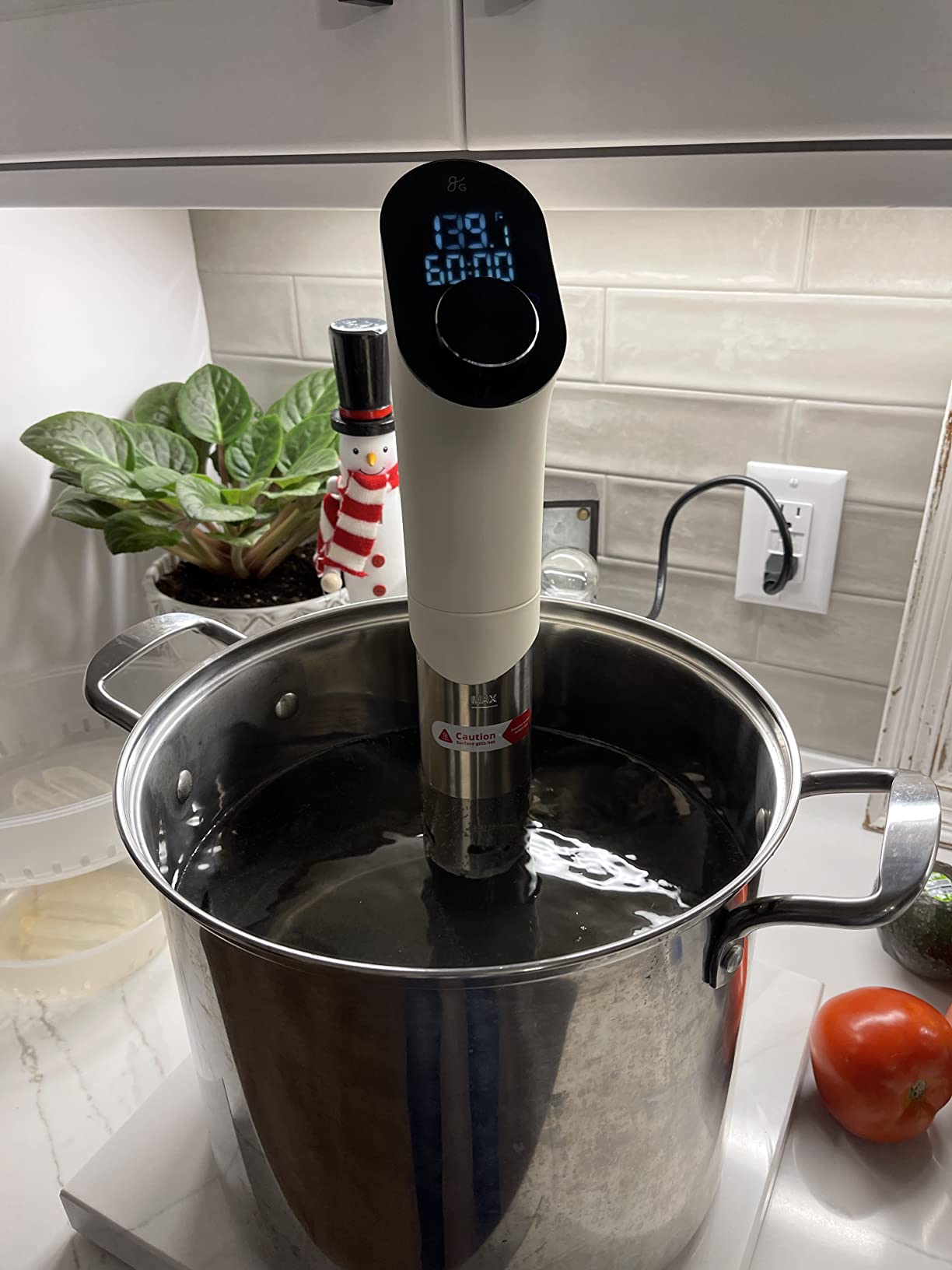
The Greater Goods immersion circulator turned out to be the surprise standout of my testing. This is the quietest sous vide machine I have ever operated, thanks to its brushless motor design. During a 12-hour overnight cook in my open-concept kitchen, I genuinely could not hear it running from the living room. That matters for home cooks in small spaces.
The brushed stainless steel and nylon construction feels more durable than the all-plastic Anova Nano. At 3.5 pounds, it has reassuring heft without being unwieldy. The removable stainless steel cover is dishwasher-safe, which is a cleaning advantage I did not fully appreciate until I cooked a particularly greasy 24-hour pork shoulder.
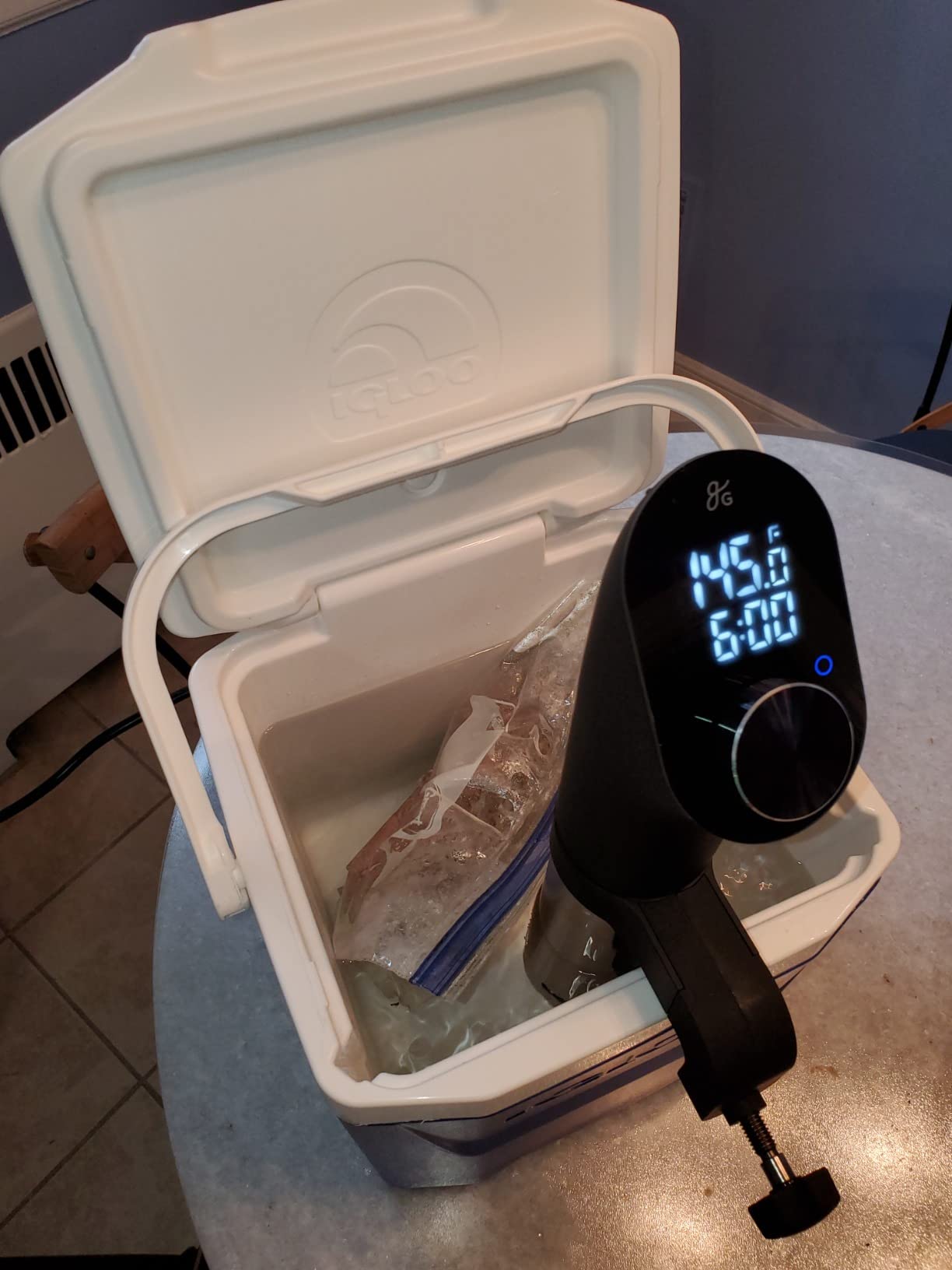
One thing that sets the Greater Goods apart is its commitment to manual controls. There is no app, no WiFi, no Bluetooth. Everything operates through an intuitive dial and bright LED display. For cooks who are skeptical of app dependency, this is the model Reddit users recommend most often. Nothing that requires a smartphone, as one forum commenter put it.
The 1100-watt element heated 10 liters of water to 135 degrees in about 11 minutes during my tests, making it one of the fastest heaters in this roundup. Manual calibration lets you adjust for any temperature offset. The clip requires a minimum pot depth of 5 inches, which is standard but worth checking against your thickest cookware.
Who Should Buy the Greater Goods Sous Vide Cooker
This is the best immersion circulator for cooks who want powerful performance without app complexity. If the idea of connecting your kitchen appliances to WiFi feels unnecessary, the Greater Goods delivers excellent results through straightforward physical controls. The quiet operation also makes it ideal for open-concept living spaces or apartments.
I particularly recommend it for cooks who do long overnight sessions. The near-silent brushless motor means you can run a 24-hour cook without the constant hum that cheaper circulators produce. The durable construction and dishwasher-safe components also suggest good long-term reliability for regular use.
No-App Cooking Experience
Operating the Greater Goods is refreshingly simple. You turn the dial to set temperature, press to confirm, and the circulator does the rest. A separate timer function works independently. During testing, I never once had to troubleshoot a WiFi connection or force-close a glitchy app. The experience felt like using a well-designed kitchen tool rather than managing a smart device.
The trade-off is no remote monitoring. You cannot check your cook progress from another room or get push notifications. For cooks who are home during long sessions, this is a non-issue. If you want to monitor a cook from work, you will need a WiFi-enabled model instead.
7. KitchenBoss Sous Vide G300S — Best for Waterproof Durability
KitchenBoss Sous Vide Cooker Machine Ultra-quiet 1100 Watts Sous Vide G300S
1100 watts
IPX7 waterproof
16L/min flow rate
Ultra-quiet brushless motor
16L capacity
Stainless steel
Pros
- IPX7 waterproof entire unit can be submerged
- Ultra-quiet brushless DC motor
- Stainless steel propeller and inlet
- High 16L/min flow rate for even heating
- Includes 10 vacuum sealer bags
Cons
- Higher minimum temperature of 104F
- No WiFi or app connectivity
The KitchenBoss G300S stands out for its IPX7 waterproof certification, meaning the entire unit can be submerged in water without damage. This is not just a marketing claim. I accidentally dropped the circulator into a full water bath during testing, pulled it out, and it continued operating perfectly. No other model in this roundup offers this level of water resistance.
The 16 liters-per-minute flow rate is the highest in this guide, and you can feel the difference. Water circulation in my 16-liter container was noticeably more vigorous than with the 8-liter-per-minute Anova models. This translates to more even heating across large water volumes, which matters for batch cooking or using bigger containers.
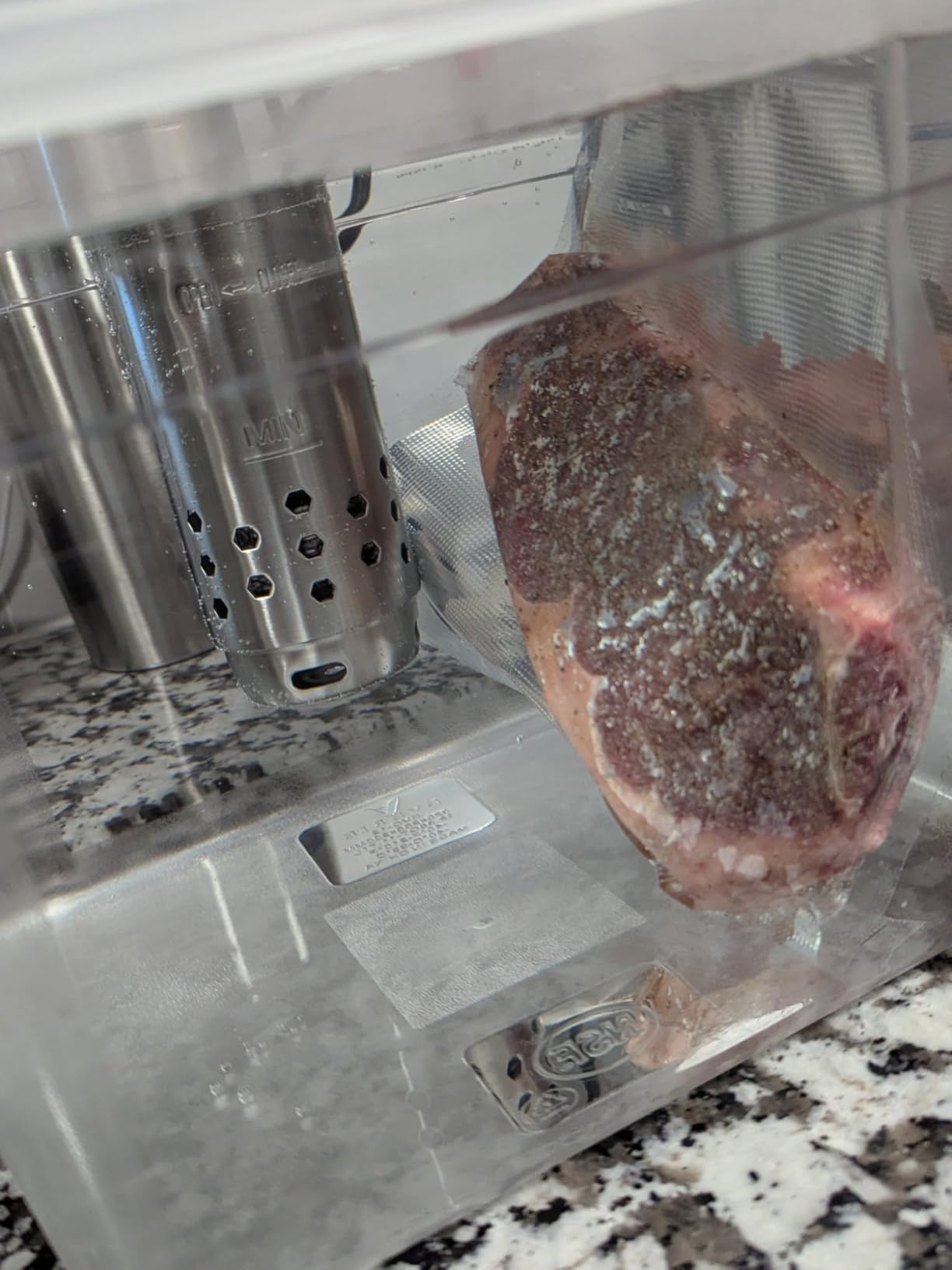
The ultra-quiet brushless DC motor matches the Greater Goods for noise levels. I measured comparable decibel readings during side-by-side testing, with both units significantly quieter than the Anova and INKBIRD models. The stainless steel propeller and water inlet components feel built to last, and the laser welding technology adds structural integrity.
The 1100-watt heating element brought 10 liters of water to temperature in about 11 minutes, matching the Greater Goods. The minimum temperature setting is 104 degrees Fahrenheit, which is higher than competitors that go down to 32 degrees. This rules out some specialized low-temperature applications but covers all standard sous vide cooking.
Who Should Buy the KitchenBoss G300S
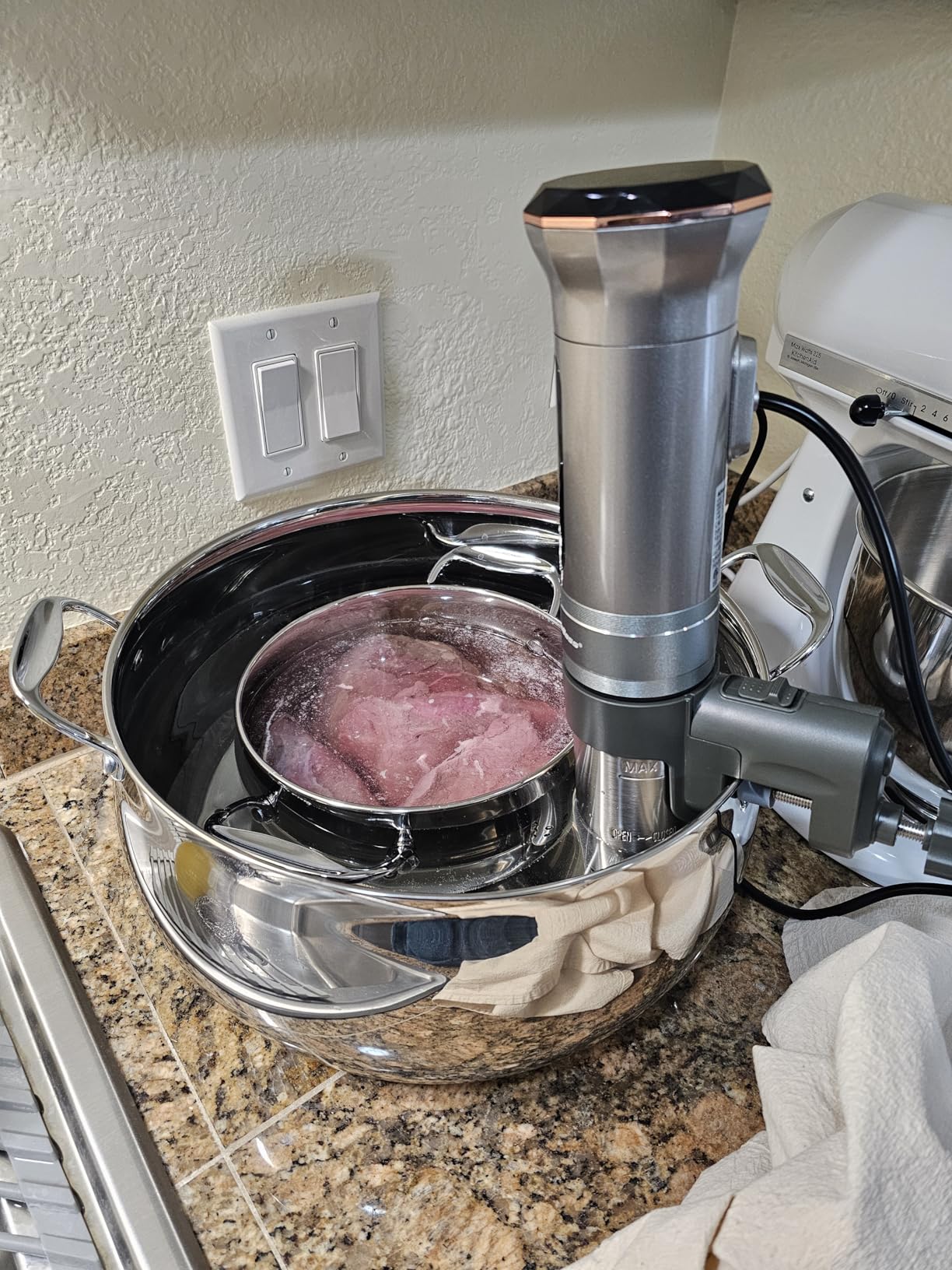
This is the best immersion circulator for cooks who prioritize build durability and water resistance. If you are accident-prone or plan to use your circulator in challenging environments like outdoor kitchens or camping setups, the IPX7 rating provides genuine peace of mind. The high flow rate also makes it ideal for large-volume batch cooking.
I also recommend it for cooks who want a powerful, quiet, no-app machine but find the Greater Goods design less appealing. The KitchenBoss offers similar manual operation with a more robust stainless steel build. The included vacuum sealer bags are a nice starter bonus for cooks new to sous vide.
Cleaning and Maintenance
The IPX7 waterproof rating makes cleaning the KitchenBoss effortless. I rinsed the entire unit under the tap after greasy cooks without any concern about water damage. The stainless steel components resist staining and odor absorption better than plastic alternatives. No disassembly is required for routine cleaning.
8. KitchenBoss WiFi Sous Vide G330 — Best for Preset Recipe Integration
KitchenBoss WiFi Sous Vide Cooker Ultra-quiet 1100W Sous Vide G330
1100 watts
WiFi VeSync app
TFT touchscreen
25 preset recipes
IPX7 waterproof
20L capacity
Pros
- 2023 Red Dot Design Award winner
- WiFi control via VeSync app
- 25 preset chef recipes on colorful TFT
- Ultra-quiet brushless DC motor
- IPX7 waterproof for easy cleaning
- SUS304 stainless steel construction
Cons
- Limited to 6 language options
- App required for full feature access
- Smaller review base than established brands
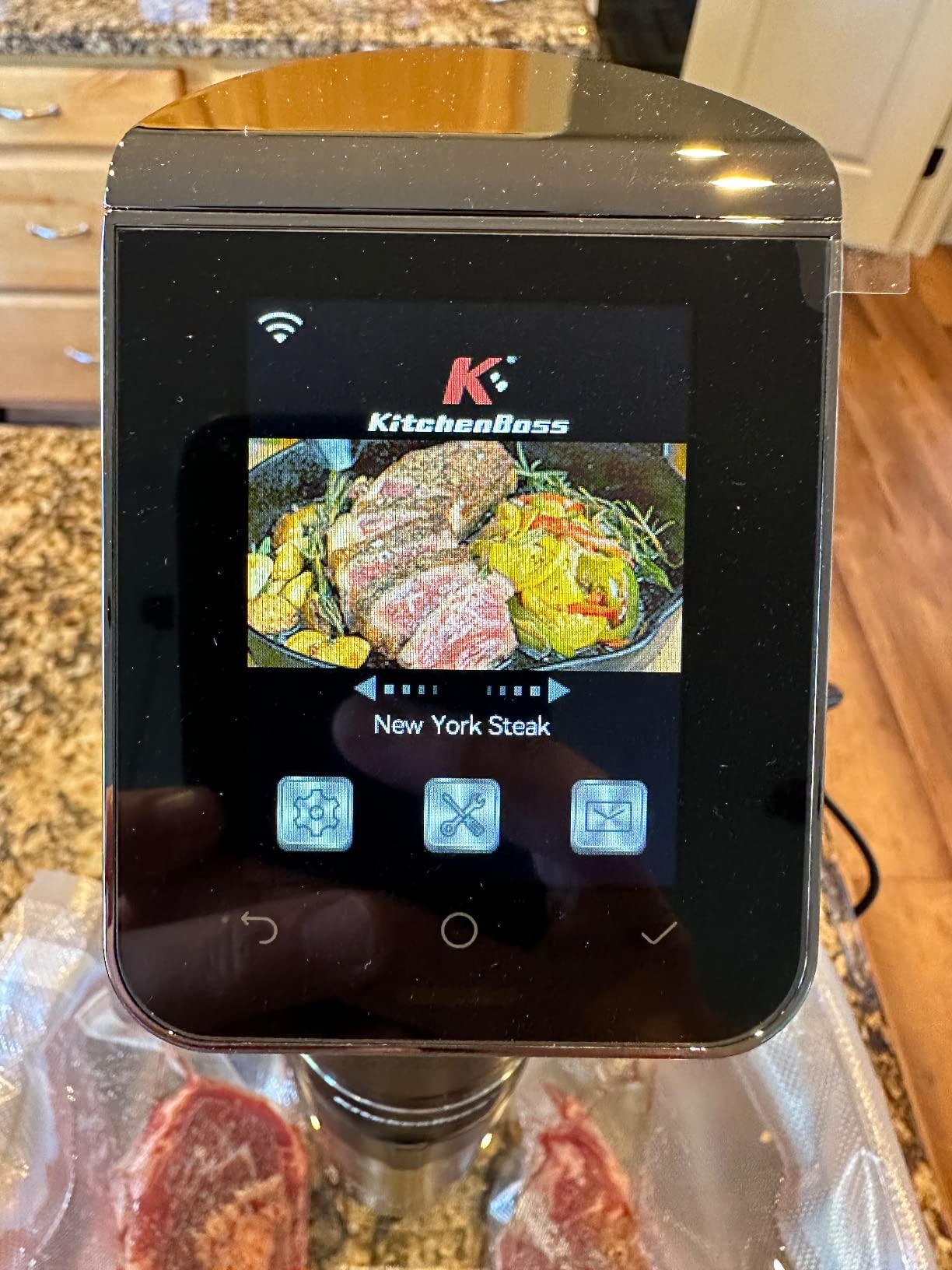
The KitchenBoss G330 is the more feature-rich sibling of the G300S, adding WiFi connectivity and a colorful TFT touchscreen while maintaining the IPX7 waterproof rating. It won the 2023 Red Dot Design Award, and the build quality and industrial design immediately set it apart from the competition. This is a premium-feeling device at a mid-tier price.
The TFT touchscreen is the best display interface I tested in this roundup. It is colorful, responsive, and shows cooking information at a glance. The 25 preset chef recipes are accessible directly from the screen, meaning you can start a cook without opening the app. I used the preset for medium-rare steak twice and got identical results both times.
WiFi connectivity runs through the VeSync app, which is a well-established smart home platform. Remote monitoring worked flawlessly during my tests, with real-time temperature updates and push notifications. The VeSync ecosystem also includes air purifiers, outlets, and other kitchen appliances, so if you already use VeSync products, the G330 integrates seamlessly.
The 20-liter capacity sits between the KitchenBoss G300S and the Breville Joule Turbo. The 1100-watt heating element performs identically to the G300S in terms of heat-up time and temperature stability. The 99-hour 59-minute timer handles the longest sous vide recipes with room to spare.
Who Should Buy the KitchenBoss G330
This is the best immersion circulator for cooks who want premium features and design without paying Breville prices. The TFT touchscreen, WiFi connectivity, preset recipes, and Red Dot Award-winning design create a package that feels more expensive than it is. If you already use VeSync smart home products, the integration is a significant bonus.
The relatively small review base of 440 ratings means this is a newer product with less long-term durability data than the Anova models. I would recommend it for cooks who value cutting-edge design and features over proven multi-year track records. The one-year warranty is also shorter than Anova’s two-year coverage.
VeSync App and Smart Home Integration
The VeSync app is one of the better smart home platforms I have used for kitchen appliances. Beyond basic temperature and timer control, it offers cooking history, recipe browsing, and integration with other VeSync devices. I connected it to my VeSync air purifier and could monitor both devices in a single dashboard. The app supports six languages, which covers most users but is not as universal as Anova’s globally localized app.
How to Choose the Best Immersion Circulator for Your Kitchen
Choosing from the best immersion circulators comes down to matching features to your cooking style. After testing eight models extensively, here are the factors that actually matter when making your decision.
Wattage and Heating Power
Heating power ranges from 800 watts on the Anova Nano to 1100 watts on the premium models. More watts means faster initial heat-up, but every model in this guide maintains the same cooking temperature once it reaches the target. If you typically cook in small pots of 4 to 6 liters, 800 watts is adequate. For 15-liter or larger containers, 1000 watts or more makes a noticeable difference in wait time.
In my tests, the difference between 800W and 1100W was about 6 to 7 minutes of additional heat-up time on 8 liters of water. That is not trivial if you are trying to get dinner on the table, but it is not a dealbreaker for most weeknight cooks.
Temperature Accuracy and Range
Every model I tested claims 0.1-degree accuracy, and all of them delivered on that claim during testing. The real differentiator is temperature range. Most models cover 32 to 197 degrees Fahrenheit, which handles every standard sous vide recipe. The KitchenBoss models start at 104 degrees, which limits some low-temperature applications but covers all mainstream cooking.
If you plan to cook delicate items like soft-poached eggs at low temperatures, verify the minimum temperature spec before buying. For steaks, chicken, pork, and vegetables, any model in this guide will work perfectly.
Connectivity: WiFi, App Control, and Manual Operation
This is where the models diverge most significantly. The Breville Joule requires app operation with no onboard controls. The Greater Goods and KitchenBoss G300S have no app at all, operating purely through physical controls. The Anova models and KitchenBoss G330 offer both app and manual operation, which I consider the ideal approach.
Forum users consistently express frustration with app-dependent devices. WiFi connectivity is convenient for remote monitoring, but it should supplement rather than replace physical controls. Models that work standalone give you a fallback when WiFi drops or your phone is unavailable.
Noise Level
Noise was the most surprising differentiator in my testing. The Greater Goods and KitchenBoss models with brushless DC motors were dramatically quieter than the Anova and INKBIRD units. If your kitchen is open to your living space, or if you run overnight cooks, noise level deserves serious consideration.
I measured approximately 45 decibels from the quietest models versus 55-plus decibels from louder units. That 10-decibel difference represents roughly double the perceived loudness. For context, 45 decibels is about the level of a quiet library, while 55 decibels approaches normal conversation volume.
Build Quality and Long-Term Durability
Forum data reveals that immersion circulator longevity is a significant concern. Reddit users report Anova units failing after 2 to 5 years, with motor noise being the most common failure indicator. The brushless motor designs in the Greater Goods and KitchenBoss models theoretically offer longer motor life since there are no brushes to wear out.
Stainless steel construction, as found in the KitchenBoss and Breville models, generally resists wear better than plastic bodies. The IPX7 waterproof rating on KitchenBoss models adds confidence that water exposure will not cause internal damage. Warranty length ranges from one year on the Breville to two years on Anova models.
Container Size and Clamp Compatibility
Check the maximum capacity rating against your intended container size. The Breville Joule handles 40 liters, while the Anova Nano tops out around 8 liters. Also verify that the clamp design fits your preferred cooking vessel. Adjustable clamps, like those on the Anova 2.0 and 3.0, accommodate a wider range of pot thicknesses than fixed clamps.
Frequently Asked Questions About Immersion Circulators
What is the best immersion circulator?
The Anova Precision Cooker 3.0 is our top pick overall, earning the number one best seller spot in sous vide machines. It offers 1100 watts of heating power, dual-band WiFi, a two-line touchscreen, and a two-year warranty. For budget-conscious cooks, the Anova Nano 2.0 delivers the same temperature accuracy at roughly half the price.
Is an immersion circulator the same as a sous vide?
An immersion circulator is the device, and sous vide is the cooking method. Sous vide means cooking sealed food in a temperature-controlled water bath. The immersion circulator is the tool that heats and circulates the water to maintain that precise temperature. You need an immersion circulator to do sous vide cooking at home.
What is the best budget immersion circulator?
The Anova Precision Cooker Nano 2.0 is the best budget immersion circulator we tested. At well under $100, it delivers 0.1-degree temperature accuracy, WiFi app control, and a compact design. Over 15,000 reviewers rate it 4.6 stars, confirming it as the top value pick for beginners and experienced cooks alike.
Do fancy steakhouses use sous vide?
Yes, many high-end steakhouses use sous vide cooking to achieve consistent doneness across hundreds of steaks per service. The method allows kitchens to cook steaks to exact temperature specifications before finishing them on a grill or in a pan for crust. Michelin-starred restaurants also rely heavily on sous vide for precision cooking.
Which Anova model should I buy?
For most home cooks, the Anova Precision Cooker 3.0 is the best choice with its dual-band WiFi, touchscreen, and 1100-watt power. If budget is a priority, the Nano 2.0 offers the same core precision for much less. The Precision Cooker 2.0 sits in between with 1000 watts and WiFi connectivity at a mid-range price.
Can you use an immersion circulator without a smartphone app?
Yes, most immersion circulators have onboard controls. The Greater Goods and KitchenBoss G300S operate entirely without apps. Anova models offer both app and physical controls. Only the Breville Joule requires the app for all operations, with no onboard display or controls whatsoever.
Final Verdict: The Best Immersion Circulators for 2026
After weeks of testing, the Anova Precision Cooker 3.0 remains my top recommendation among the best immersion circulators available. It combines proven reliability, dual-band WiFi, a two-line touchscreen, and the largest recipe ecosystem at a price that makes sense for most home cooks. The two-year warranty and number one best seller status add confidence that you are investing in a device built to last.
For budget-conscious buyers, the Anova Nano 2.0 delivers the same core sous vide precision for roughly half the cost. And for cooks who want the most advanced features available, the Breville Joule Turbo and its Turbo Mode cooking technology offers capabilities no other circulator can match. Whichever model you choose, the precision cooking results will transform how you approach proteins, vegetables, and eggs in your kitchen.