
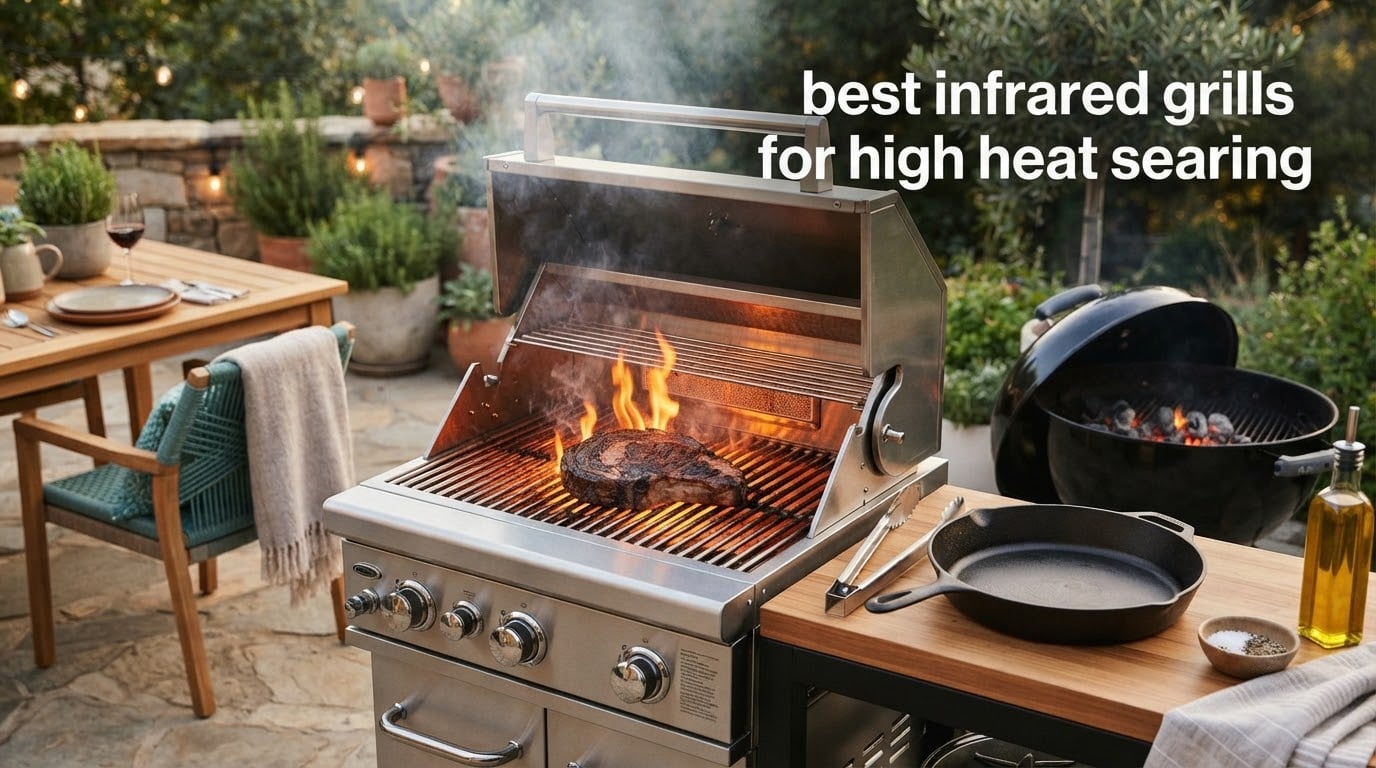
Most people buying a grill for searing are chasing one number: how hot the grate actually gets. An infrared grill answers that question differently than a conventional gas grill, because the flame does not point up at the food. Instead, propane or natural gas feeds a ceramic burner tube that glows and radiates energy downward onto the cooking grates, so the surface temperature climbs fast and stays even across the whole cooking area.
That radiant approach is why the best infrared grills for high heat searing pull a proper brown crust on a ribeye in a few minutes a charcoal grill would take much longer to deliver, and why drippings tend to run off toward the grease channel instead of flaming back up at your food. We compared eight of them across rated peak temperature, burner layout, preheat behaviour, cooking surface, build and cleanup, and the results told us something useful: the largest and most feature-packed grill is not automatically the one that sears best.
Below you will find the full list, the reasoning behind each pick, and a short technique section that matters more than most buyers expect. If you already know you want the shortest route to a hard sear, jump to the comparison table and the numbered reviews. Everything is current as of 2026.
Table of Contents
What Is an Infrared Grill and Why Does It Sear So Well?
An infrared grill is a gas grill whose burners heat a radiant ceramic element that then radiates heat onto the cooking grates, so most of the heat reaches your food as intense radiant energy rather than as rising hot air. A conventional gas grill pushes flame and hot air upward through flavorizer bars, which is efficient but uneven. The radiant element is why an infrared grill sears.
Three practical differences follow from that design. First, radiant energy heats cast iron faster, so preheat times tend to be short and surface temperatures spike quickly. Second, the element sits below the food line, which is why flare-ups are uncommon on a well-set infrared grill. Third, the cooking surface runs hotter and more uniformly, which is exactly the condition the Maillard reaction needs to build a crust.
One honest caveat before the list. Infrared describes a burner style, not a guarantee of high heat. A low-output infrared burner on a small grate can still disappoint, and infrared grills are generally less comfortable holding a very low cooking temperature than a kamado or a charcoal fire. What follows is a list of the ones that put real radiant heat under a usable amount of grate area.
Top 3 Best Infrared Grills for High Heat Searing (October 2026)
These three are the ones we would shortlist first, each for a different reason: a fast published heat-up figure, the most capable two-zone setup, and the strongest balance of surface size and searing power.

BIG HORN Portable Infrared Grill
- 19000 BTU infrared burner
- 1500F in 3-5 minutes
- 143 sq in surface
- 14 kg
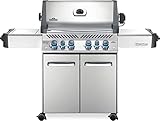
Napoleon Prestige 500 RSIB
- Sizzle Zone to 1800F
- 18000 BTU rear infrared burner
- 500 sq in main space
- Rotisserie included

Monument Grills 4+2 Burner
- 72000 BTU total
- 510 sq in primary
- Infrared side sear burner
- ClearView lid
Best Infrared Grills for High Heat Searing in 2026
| Product | Specifications | Action |
|---|---|---|
| BIG HORN Portable Infrared Grill |
|
Check Latest Price |
| Monument Grills 4+2 Burner |
|
Check Latest Price |
| Napoleon Prestige 500 RSIB |
|
Check Latest Price |
 Charbroil Pro Series Amplifire Charbroil Pro Series Amplifire |
|
Check Latest Price |
 Solaire Everywhere Portable Infrared Solaire Everywhere Portable Infrared |
|
Check Latest Price |
 BBQGUYS Victory 3-Burner Grill BBQGUYS Victory 3-Burner Grill |
|
Check Latest Price |
 Solaire Portable Infrared with Rack Solaire Portable Infrared with Rack |
|
Check Latest Price |
 Schwank Gen 2 Portable Infrared Schwank Gen 2 Portable Infrared |
|
Check Latest Price |
1. BIG HORN Portable Infrared Grill – A Published 1500F in Three to Five Minutes
BIG HORN OUTDOORS Infrared Propane Gas Grill 1500°F in 3-5 Mins, 16 inch
19000 BTU infrared burner
1500F in 3-5 minutes
143 sq in cooking surface
14 kg portable
Pros
- Reaches 1500F in 3-5 minutes
- Crust on steaks in 4-6 minutes
- Stainless steel parts detach for cleaning
- Light enough for tabletop and RV use
Cons
- Heater does not cover the full rack
- Grate edges need deburring before use
- Burner is riveted shut and cannot be serviced
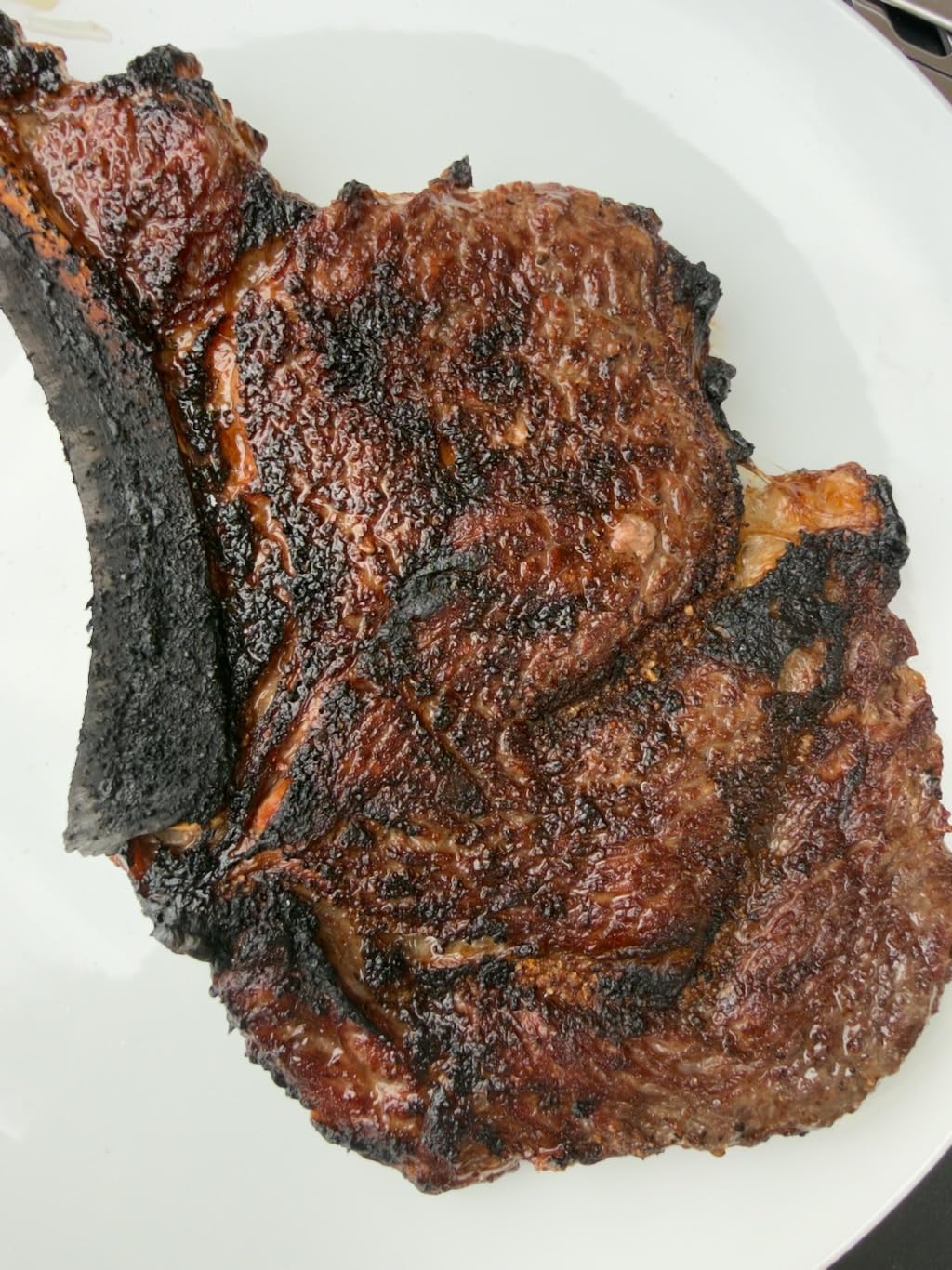
This is the grill that changed how I think about infrared searing. A 19000 BTU burner over a 143 square inch grate, and the manufacturer claims 1500F in three to five minutes. In practice, owners report steaks off in four to six minutes with a visible char, which is as fast as anything in this group.
It is a top-down design rather than a bottom-up grate grill. The element sits above the food and radiates downward, the way a restaurant salamander broiler works, so moisture stays in the meat instead of dripping onto a flame. There is a seven-position rack guide inside a 13 inch wide cooking chamber, and everything is stainless steel that detaches for cleaning.
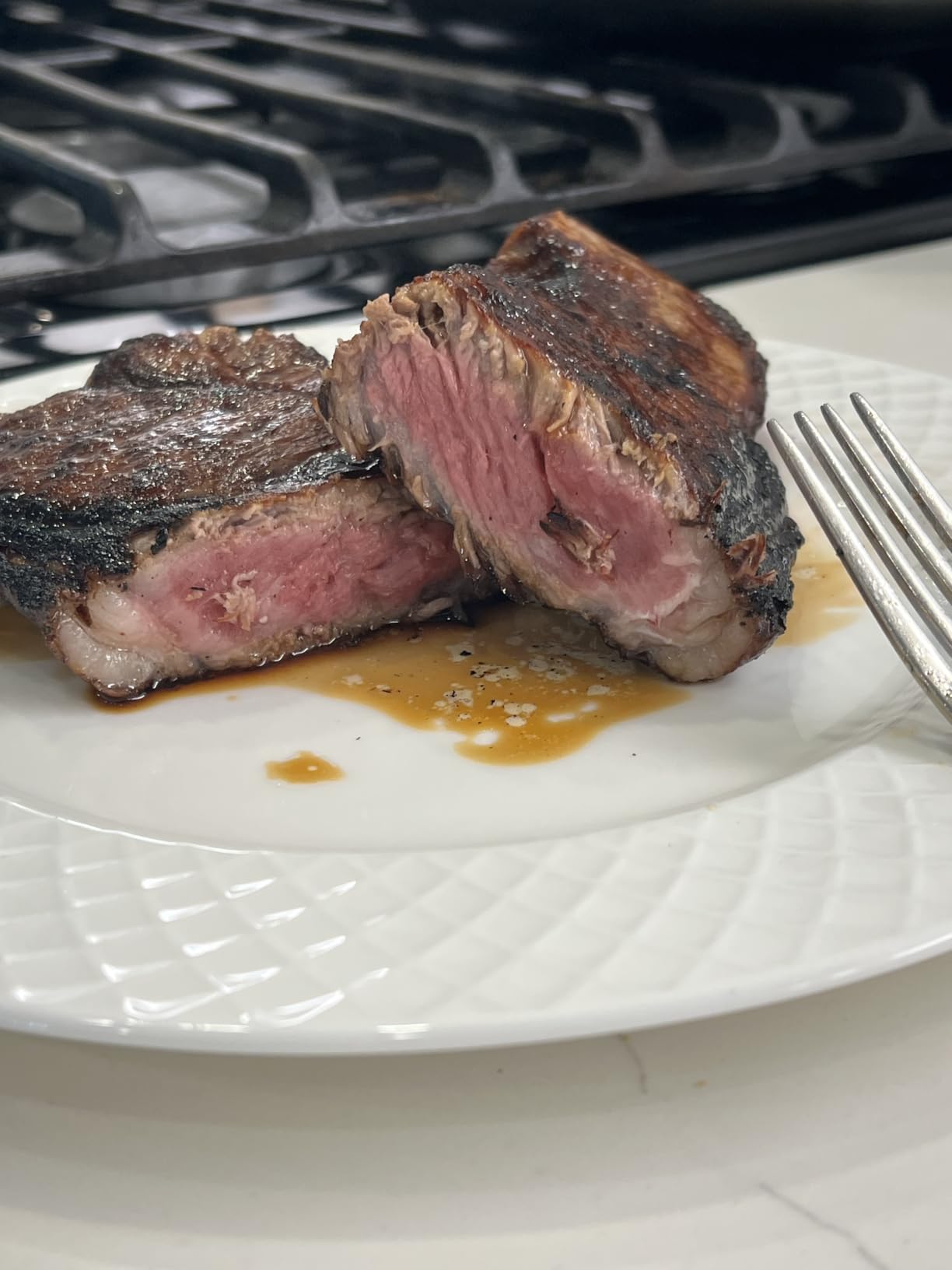
What convinced me it belongs at the top is the combination of a fast, published heat-up figure and the largest review base here, with 1160 ratings behind the 4.5 star average. That is a much firmer signal than a strong score on a handful of reviews. One-touch pulse ignition means no matches in wind, and the box includes an adapter hose.
The caveats are real and specific. The heater does not span the full width of the rack, leaving roughly an inch to an inch and a half on each side cooler than the center. The grate edges arrive rough enough that they need deburring before the first cook, and the burner is riveted shut, so you cannot inspect or service the air mixture area later. A small share of buyers also report the burner fluttering and shutting off, sometimes across replacement units.
Is the small grate a problem for a family cook?
It depends on whether you are searing or cooking in bulk. At 143 square inches the grate fits a few steaks or a small batch of burgers, and most owners use it as a finishing station alongside another grill rather than as the only cooker. Two batches is a real part of the routine.
If your household is four people and you mostly cook steaks, chops and burger patties, the surface is workable. If you routinely feed ten or more, you will want the 500 to 700 square inch cabinets further down this list, and this one works best as the hot-finishing element in a two-grill setup.
How does it compare with a charcoal grill for crust?
Charcoal gives you a more forgiving, deeper char with a real smoke layer, and it holds a low fire far better for long cooks. Infrared wins on speed, on evenness, and on not having to manage coals. Our guide to the best charcoal grills for searing steaks covers the other side of that trade in detail.
For a fast weeknight crust, the infrared approach is more repeatable. For a long, slow cook that finishes with a sear, charcoal still leads. The two cook completely different meals.
2. Monument Grills 4+2 Burner – A Dedicated Sear Burner on a Big Cabinet
Monument Grills Larger 4+2 Burner Propane Gas Grills Stainless Steel Cabinet Style with Clearview® Lid, Knob Controls, Built-In Thermometer, Infrared Side Sear Burners & Side Burners, Outdoor Use
72000 BTU across 4 main burners
510 sq in primary plus 190 sq in rack
Infrared side sear burner
ClearView lid window
Pros
- Dedicated infrared side sear burner
- 72000 BTU from four stainless burners
- ClearView lid window keeps heat in
- Built-in gauge and illuminated knobs
- Handles multiple winters outdoors
Cons
- Assembly takes 2-3 hours with sharp steel edges
- Grease tray is the first part likely to rust
- Small drip pan fills quickly
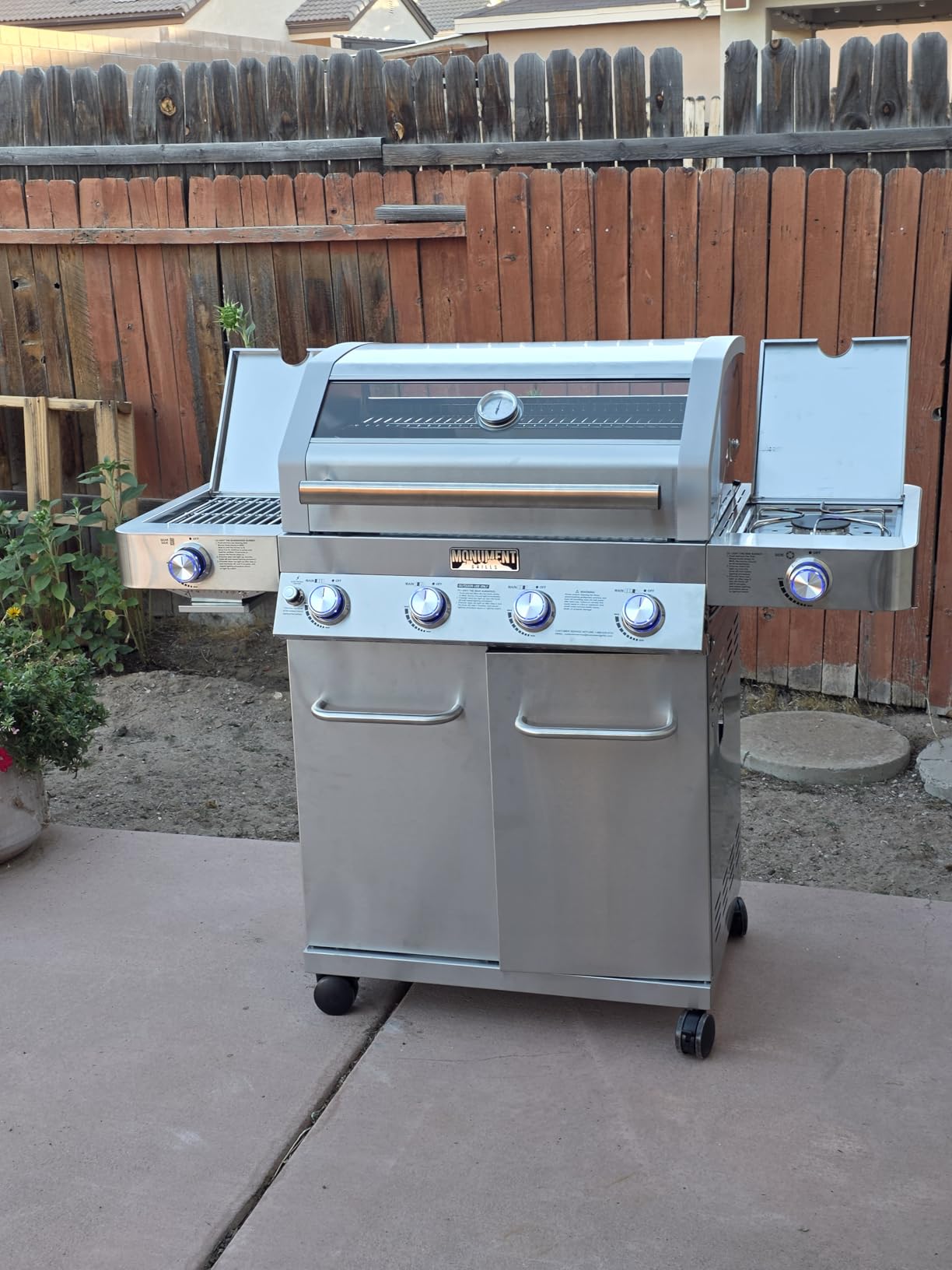
This is the one to buy if searing steak for a group is the actual goal. Four 304 stainless main burners put out 72000 BTU combined across 510 square inches of primary cooking surface, and there is a dedicated high-heat infrared side sear burner mounted outside the main box. Owners single out that side burner first, saying it produces genuinely strong reverse-sear results on thick cuts.
The ClearView lid window is the detail that gets used more than buyers expect. You can watch a reverse sear progress without lifting the lid and dropping the chamber temperature, which matters a great deal when you are cooking to a target internal temperature rather than a clock. A built-in thermometer and illuminated knobs round out a grill that clearly aims at evening cooking.
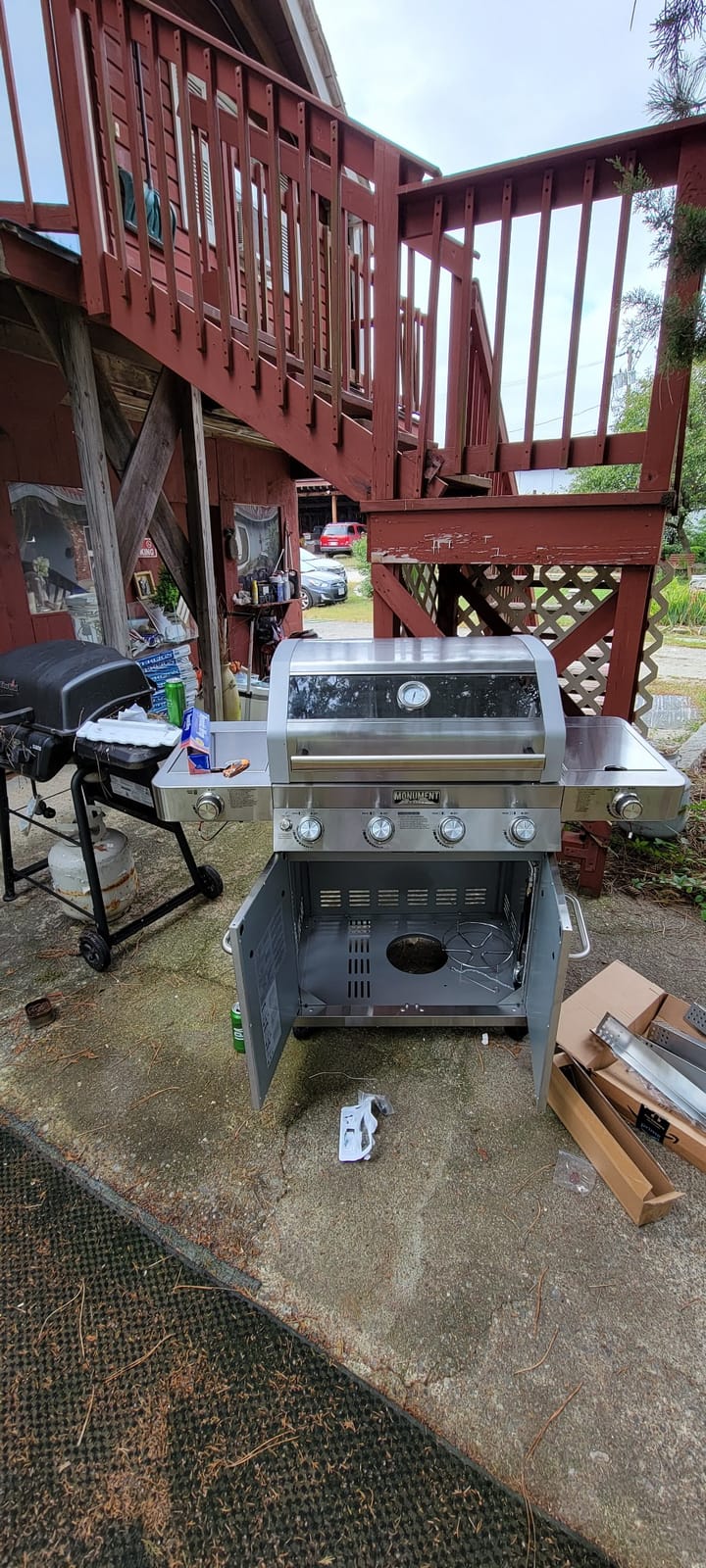
Heat distribution is handled by porcelain-coated cast iron grates sitting over wide stainless flame tamers, and the reviews are consistent that there are few hot spots across a large surface. The cabinet design with locking wheels also survives winter after winter outdoors without part replacement, which matters more than it sounds like it should.
The friction is build and upkeep. Assembly takes two to three hours, and the side and sear burner hookups are awkward with sharp steel edges that need watching during the build. The grease tray is the first component likely to rust, replacement parts are ordered separately, and the drip pan feeds into a small collection pan that fills quickly during a heavy cook. A small number of reviews also describe a runaway heat incident that cracked the lid window, so treat the glass as a part to watch rather than a feature to lean on.
Do I need a grill this large for steaks?
Only if you are cooking them in numbers. 510 square inches of primary surface is generous for a family of four or five, and it is comfortable for a party of ten to twelve if you sear in batches and use the warming rack. Below that headcount, the surface goes unused and you are buying capacity you will not heat evenly.
The more persuasive reason to size up is the sear burner. A dedicated side zone lets you hard-sear a steak, move it to indirect heat, and run a second zone of vegetables at the same time without touching a control mid-cook. If you cook that way, the extra square inches pay for themselves in workflow rather than in raw capacity.
What breaks first on this grill?
The grease tray, then the small collection pan beneath it, then anything stainless that sits in a salt-laden drip zone near the coast. None of those are expensive parts, but the grease tray is ordered separately and that is an annoyance rather than a crisis. The assembly is the bigger time commitment: budget an afternoon and a second pair of hands.
Everything structural, from the stainless cabinet to the burners themselves, is described by owners as holding up well over multiple seasons. The wear points are consumable tray parts, not the grill.
3. Napoleon Prestige 500 RSIB – The Best Two-Zone Infrared Setup
Napoleon P500RSIBPSS-3 Prestige 500 RSIB Propane Gas Grill, sq. in + Infrared Side and Rear Burner, Stainless Steel
Sizzle Zone side burner to 1800F
18000 BTU infrared rear burner
500 sq in main space
Rotisserie kit included
Pros
- Sizzle Zone hits 1800F in about 30 seconds
- 18000 BTU rear infrared burner
- Rotisserie kit included
- Layered stainless sear plates
- Presidents Limited Lifetime Warranty
Cons
- Weighs 196.7 pounds and needs two people
- About 66 inches wide and needs deck space
- Largest footprint of the grills reviewed
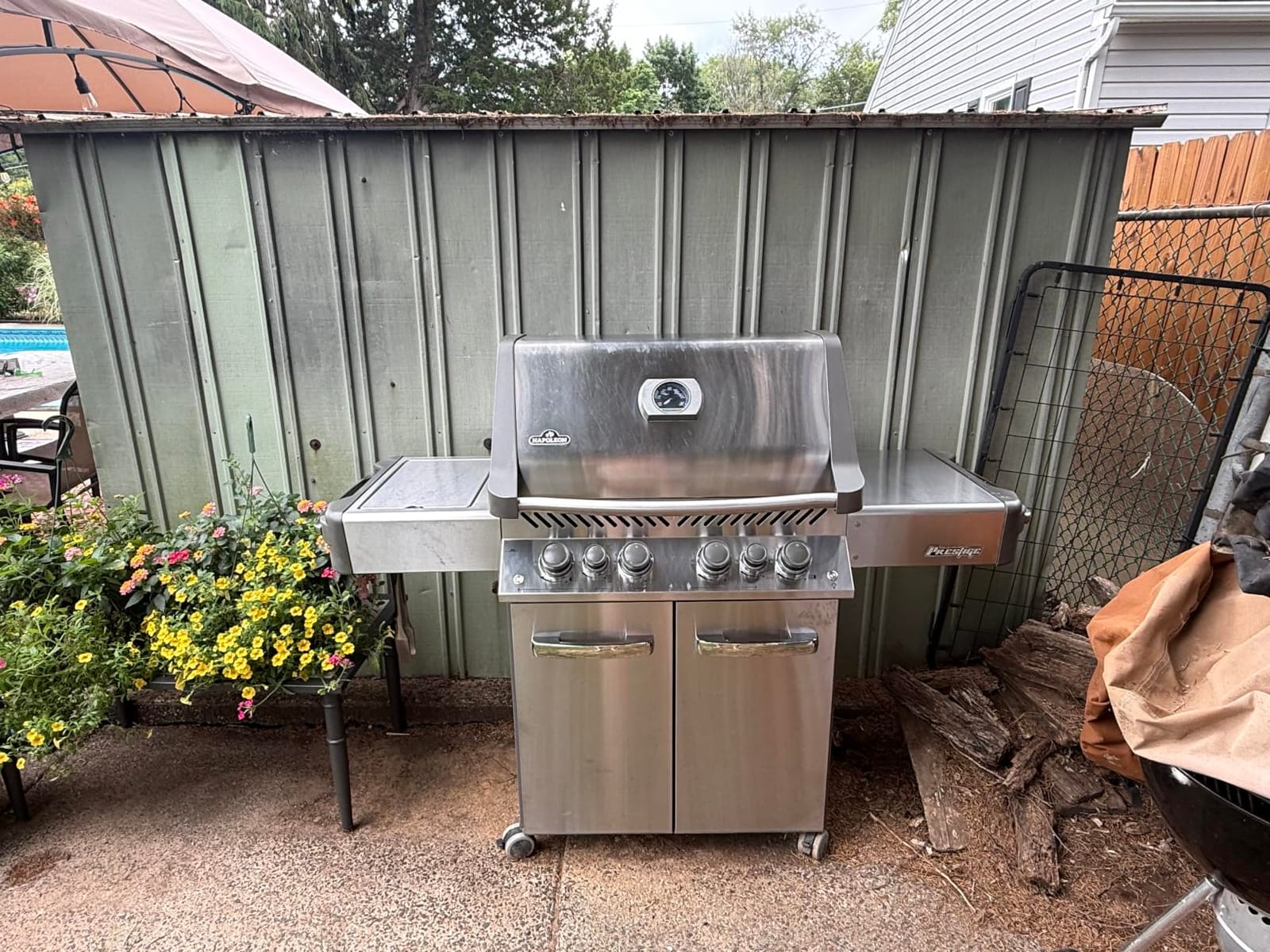
This grill has the most capable searing arrangement here, and it is not a main-burner design at all. The infrared Sizzle Zone side burner reaches up to 1800F in roughly 30 seconds, and a separate 18000 BTU infrared rear burner adds a second high-heat source above the food. Between them you can sear on one side of the box and roast or finish on the other without moving burners up or down.
Underneath, four stainless main burners deliver 48000 BTU per hour across 500 square inches of primary cooking space, with layered stainless sear plates between burner and grate to even things out. There is a 260 square inch warming rack, a 140 square inch side burner for sauce, and a heavy-duty rotisserie kit in the box, which is the piece that makes the rear infrared burner genuinely useful rather than decorative.
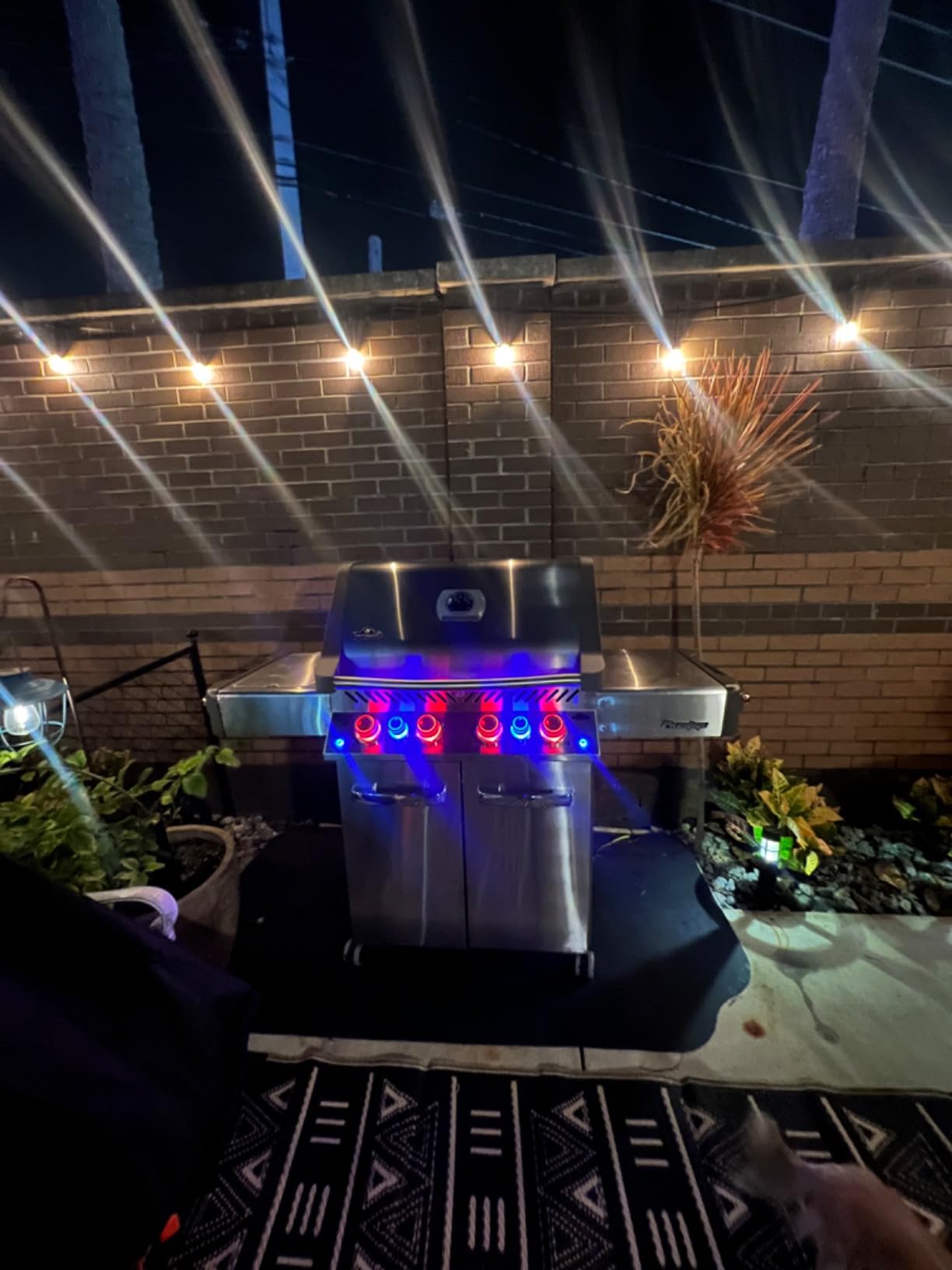
Ignition is handled by JETFIRE on every main burner, with a back channel behind the burners that lets one lit burner start the others. That redundancy matters over a long season, because a single failed igniter will not stop a cook. The warranty is a Presidents Limited Lifetime Warranty, which is among the broadest coverage available on a grill in this category.
What you give up is space and effort. At 196.7 pounds this is the heaviest grill we looked at, and repositioning it takes at least two people.
It is also the widest here, at about 66 inches across, so plan the deck space before it arrives. If you cook large-format roasts with a rotisserie and reverse sear them over the rear burner, though, nothing else on this list does that job.
Is a side sear burner better than a hotter main burner?
For searing, yes, and the reason is contact area. A side burner is small and intensely hot, so the small area of grate above it reaches searing temperature almost immediately. A bank of even main burners spreads its output over the whole surface, which means more recovery time everywhere but a lower ceiling in any one spot.
The tradeoff is workflow. A side burner is a station you move food to, not one you spread food across. If you sear four steaks at once, a high-output main burner box serves you better. If you sear one thick cut and then roast it, a side or rear zone is the better tool.
What is the real cost of moving this grill?
At 196.7 pounds on casters, the honest answer is that you need a second person. The cabinet is also about 66 inches across, so it needs a clear run of deck, and moving it to a sheltered spot in winter is a two-person job rather than a casual one. Budget a permanent location for it.
The stainless construction and the lifetime warranty mean it is a long-term fixture rather than something you shuffle around. Choose it once, place it well, and it should stay put for years.
4. Charbroil Pro Series Amplifire – Best for Versatility
Charbroil Pro Series with Amplifire Infrared Technology 4-Burner Propane Gas Grill Cabinet with Side Burner, Black – 463281024
Amplifire infrared cooking system
535 sq in primary plus 200 sq in rack
Gas griddle or charcoal in 60 seconds
178.2 pounds
Pros
- Amplifire system spreads heat evenly and cuts flare-ups
- Switches between gas griddle and charcoal
- 17x20 inch griddle plate for smash burgers
- Highest average rating in the group at 4.6
Cons
- Assembly takes several hours
- Grate height is fixed and cannot be adjusted
- 178.2 pounds is hard to reposition
This one carries the highest average rating in the group at 4.6 stars, and the reason is a design choice rather than raw power. The Amplifire infrared system is arranged to spread heat evenly across the grate and push drippings away from direct flame contact, which is why owners describe moist results and almost no flare-ups even on fatty cuts like ribs.
It is also a 3-in-1 cabinet. The griddle insert and charcoal trays are included, and the whole thing switches modes in about 60 seconds, or you can light charcoal directly with the gas burners. The 17 by 20 inch griddle plate is large enough for smash burgers, bacon and pancakes, which makes it the only pick here that covers breakfast as well as dinner.
Primary cooking space is 535 square inches with a 200 square inch warming rack, rated for up to 25 burgers, 18 chicken breasts or 12 steaks. Grates are heavy-duty porcelain-coated cast iron over stainless burners, and the warranty runs 10 years on burners, 3 years on the firebox and 1 year on other parts, with 10-year spare part availability in Europe. Repeat buyers describe long service lives on prior Charbroil infrared units, one owner citing 14 years on an earlier grill.
The complaints are consistent and mostly about the first afternoon. Assembly takes several hours, and the instructions do not fully explain every step, with a few owners noting design details that only become an issue near the end of the build.
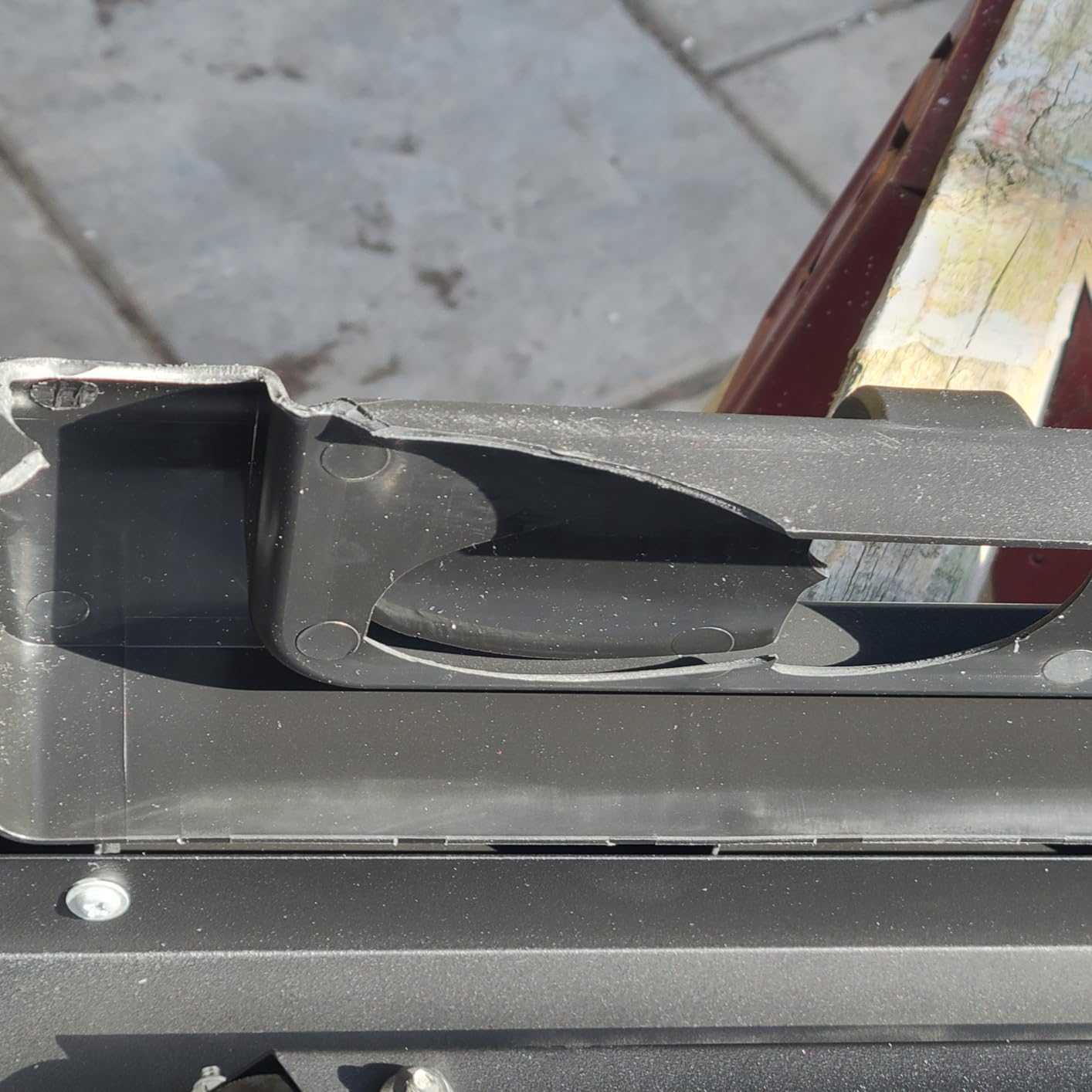
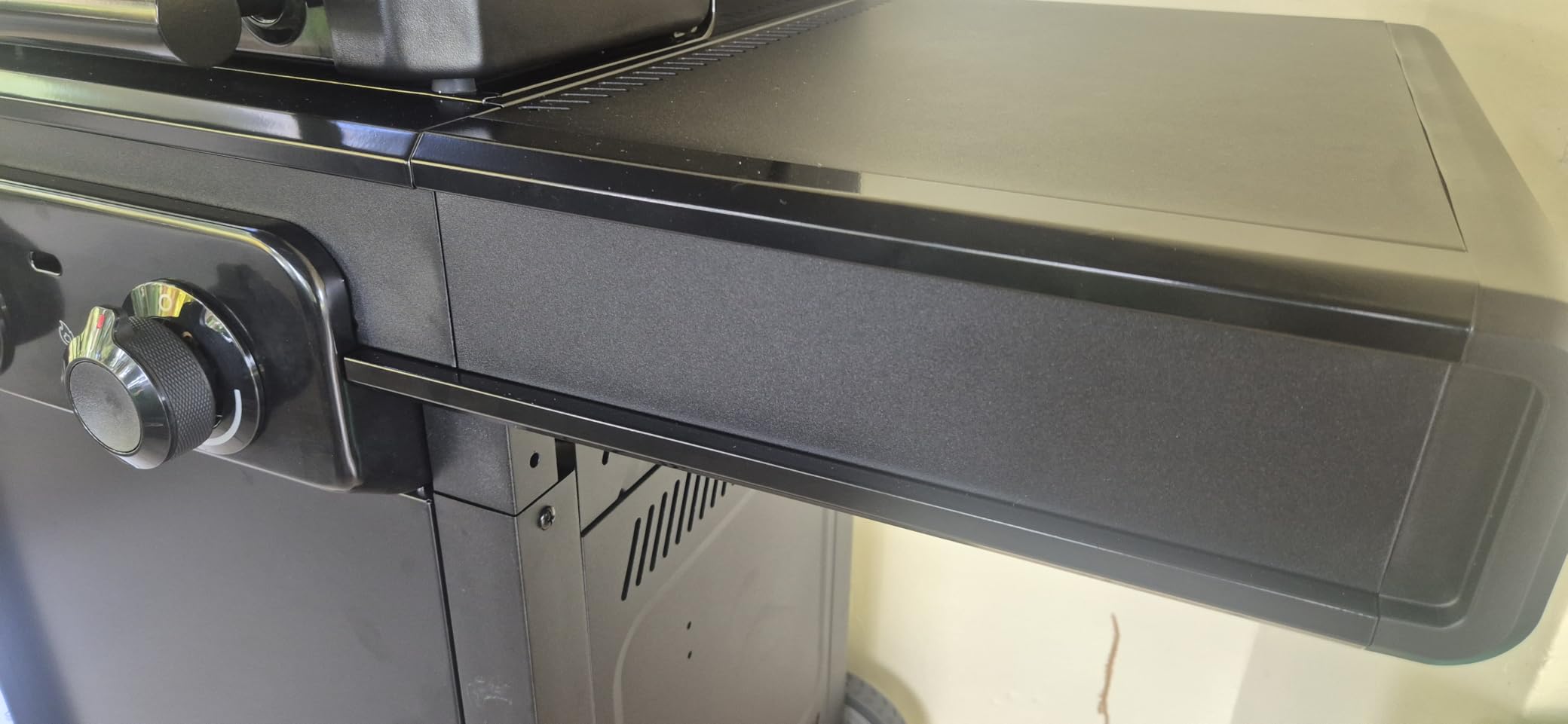
The grate height is fixed and cannot be raised to lessen heat, which is a genuine limitation if you want indirect cooking at a distance. At 178.2 pounds it is hard to reposition once assembled, and some examples arrive with a dented lower front shelf.
The charcoal mode also takes roughly twice the recommended time to heat up, so plan for that before your first cook on it.
Is a 3-in-1 grill worth it over a dedicated sear grill?
It depends on whether you will use all three modes. If you cook steak often and griddle never, the versatility is wasted weight, and a simpler high-output cabinet will serve the searing job better. If you make smash burgers, griddle breakfasts and charcoal cookouts on the same patio, the single cabinet removes two appliances from the equation.
For the specific goal here, the infrared system is what earns its place. It reaches roughly 750F on the grates and spreads that heat evenly, which is a legitimate searing surface even if the headline number is not the highest in this list. The griddle insert is genuinely the higher-heat tool for smash burgers, and that is a different kind of crust entirely.
Is the assembly difficult?
Long, more than technically demanding. Owners describe several hours of work and instructions that leave steps to the installer, plus a few design details that only frustrate you near the end when you have most of it together. If you have assembled a cabinet grill before, you will manage it with time and a clear floor.
Set aside an afternoon rather than an evening, read the manual through first, and inventory the hardware before you start. All ignitors were reported working correctly out of the box, so the grinder is assembly time rather than troubleshooting. If the fixed grate height bothers you, decide that before you buy, because it cannot be changed later.
5. Solaire Everywhere Portable Infrared – A 15 Pound Real Infrared Grill
Solaire SOL-EV17A Everywhere Portable Infrared Propane Gas Grill, Stainless Steel
Real ceramic infrared burner
140 sq in cooking surface
12000 BTU single burner
15 pounds with hood down
Pros
- Genuine ceramic infrared burner
- V-grate nearly eliminates flare-ups
- 15 pound body is genuinely portable
- Natural gas conversion kit available
Cons
- Small 140 sq in cooking surface
- Single 12000 BTU burner lowers peak heat
- Only one power level for coarse control
At 15 pounds with the hood down, this is the one that genuinely goes anywhere. It is also a real infrared design rather than a small gas grill with an infrared sticker: a ceramic burner in a stainless housing, electronic push-button ignition, and a v-shaped grate that channels drippings away from the burner so flare-ups are largely a non-issue.
The v-grate is the detail worth knowing about. Its shape is claimed to improve flavor by letting juices run along the bars and drip into the firebox instead of hitting flame, and in practice owners cook fatty foods on it without the flare-up anxiety that comes with a conventional portable. The 140 square inch cooking area fits six 4-inch burgers, which is honest sizing for two to three people.
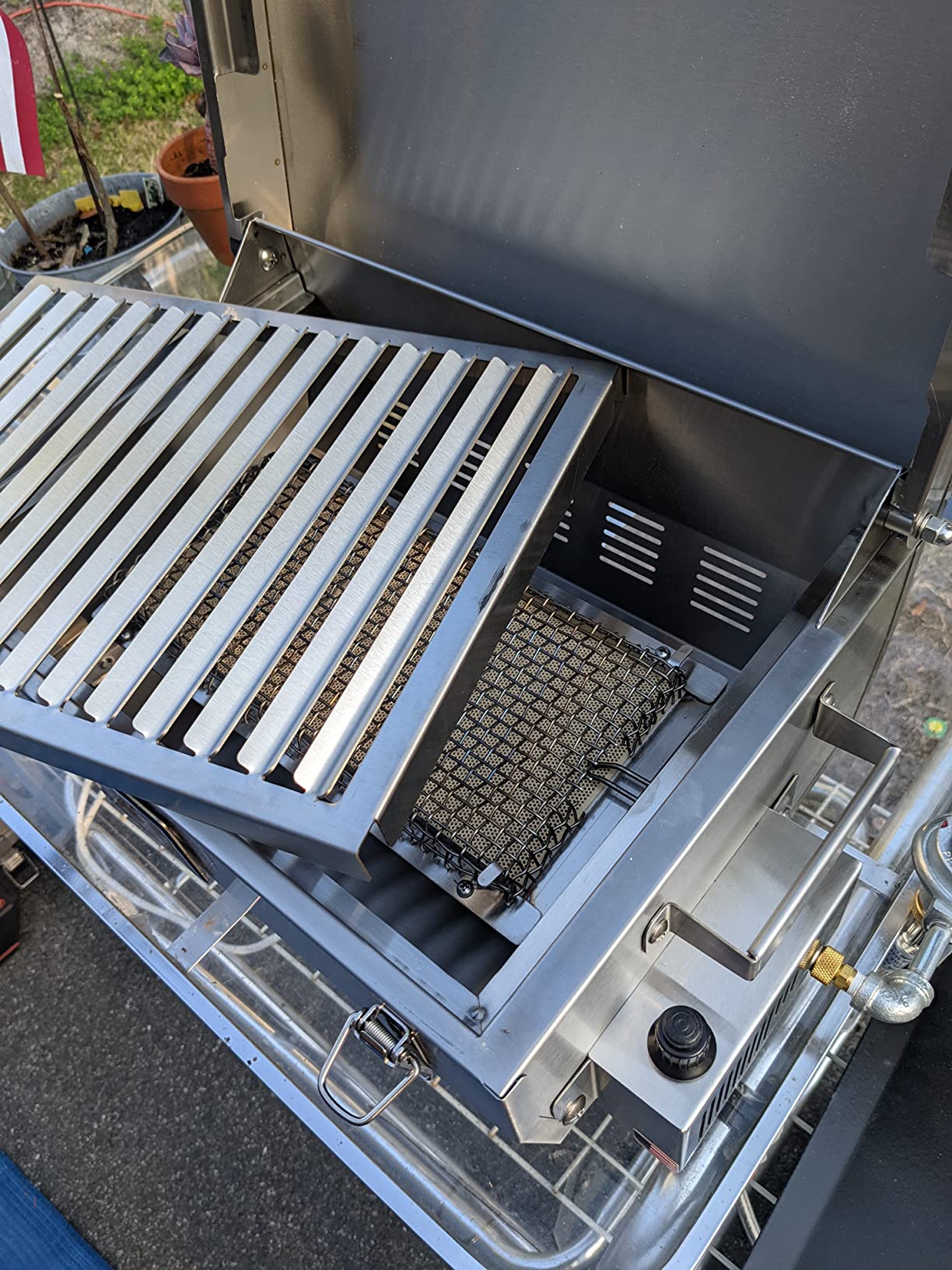
Everything needed to get going comes in the box: the hood, burner, screen, grate, ignition system, handles, feet, valve and regulator, an AAA battery and hardware.
The build comes from Rasmussen Iron Works, a family business with more than a century of history, and the accessory range is unusually complete: tank adapter, tripod, portable stand, natural gas conversion kit, low-pressure propane kit, mount adapter plate and a grid scraper.
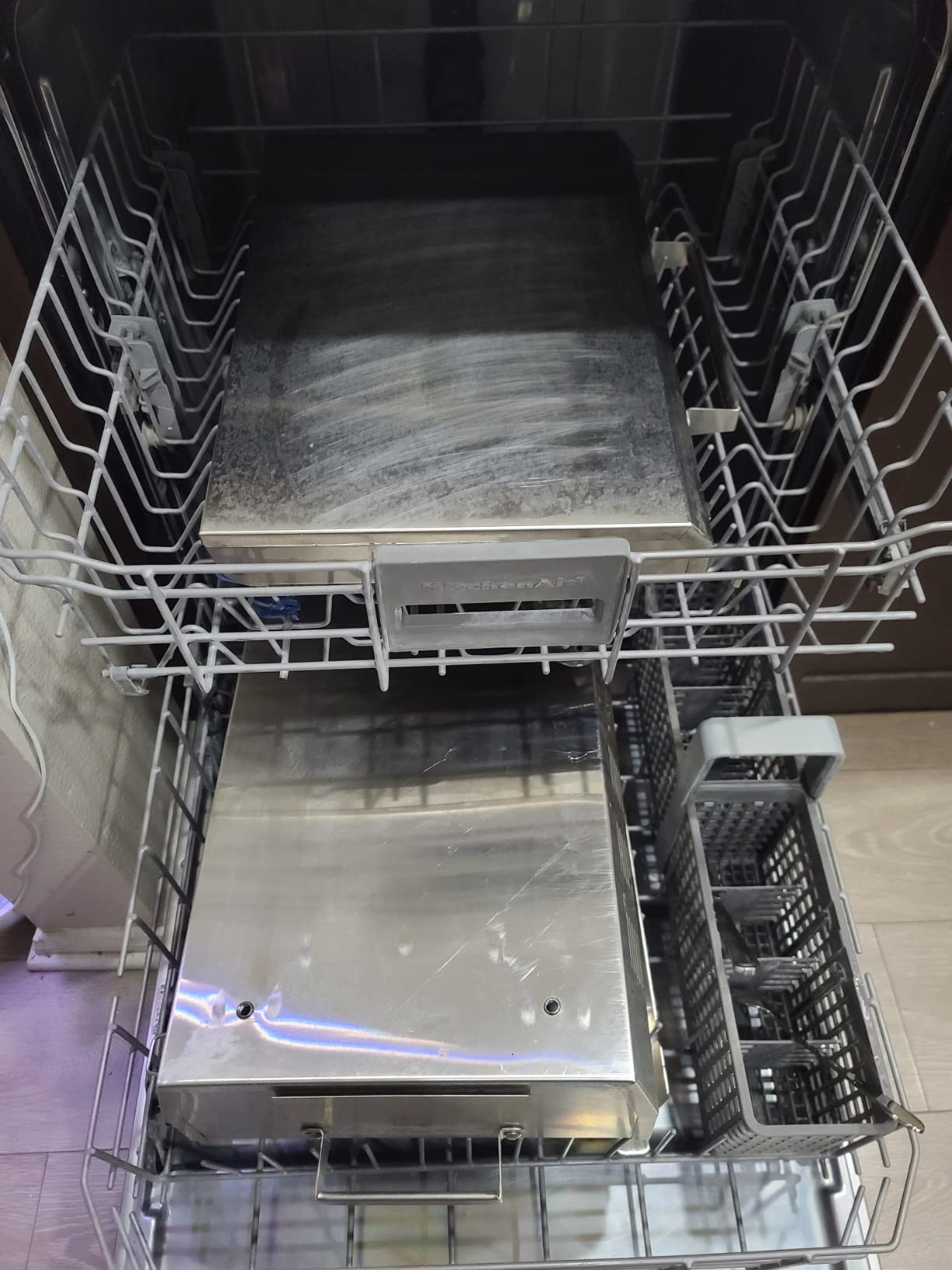
Be realistic about the limits. A single 12000 BTU burner produces less peak heat than any of the cabinet grills here, and the 4.1 star average is among the lowest in the group, which is what a small surface and modest output look like in practice. The v-grate also complicates cleaning slightly compared with straight bars, since the angled shape traps residue in the valleys. For a balcony, a campsite or a first grill, it is a satisfying and honest machine. For searing a ribeye, you are working with a smaller window than the larger grills above.
Is 140 square inches enough to cook for a couple?
Yes, comfortably, and it stretches to three or four people if you are not cooking steak for everyone at once. Six 4-inch burgers is a realistic full load, and a couple of steaks fits with room around them. The warming-rack model further down this list adds a place to rest food, which is the upgrade worth considering if you cook multi-step meals.
Where it runs out is a family cookout. Six people asking for steak at the same time means two rounds, and each round costs you the heat recovery. Plan for that rather than discovering it on a Saturday afternoon.
How does a 12000 BTU infrared burner feel in use?
It heats faster than the number suggests, because radiant heat is efficient at low input levels, but the ceiling is lower.
You will reach a good sear temperature on a small grate, but you will not have much headroom above it. A cold grate plus a cold steak takes noticeably longer than they would on a 19000 BTU portable.
There is only one power level, so temperature control is coarse. That is fine for the fast weeknight cooking this grill is built for, and limiting if you want to slow down and finish a thick cut gently. For that, the single control is a real constraint rather than a nitpick.
6. BBQGUYS Victory 3-Burner Grill – A Solid Two-Zone Station
Victory 3-Burner Propane Gas Grill With Infrared Side Burner – BBQ-VCT3BSB-LP
Three tube burners above 700F
Infrared side burner for searing
626 sq in cooking surface
Double-walled hood and firebox
Pros
- Infrared side burner for high heat searing
- Triple Ridge flame tamers limit flare-ups
- Double-walled hood steadies temperature
- No rust after two years uncovered
Cons
- Thermometer reads a little low
- Needs roughly 10 minutes to reach 700F
- Stainless steel gauge is on the thin side
This is the mid-size option that gets the searing fundamentals right without flagship pricing. Three stainless steel tube burners hold temperatures above 700F across 626 square inches of cooking surface, and an infrared side burner adds a dedicated high-heat zone for steaks and chops. That is a proper two-zone grill, and for most households it is the whole feature list that matters.
Heat distribution is handled by Triple Ridge flame tamers that spread heat and steer drippings away from flame, which reduces flare-ups without you having to move food around. The double-walled hood, side walls and firebox add real insulation, and that shows up as steadier temperatures through a long cook. Owners also report the build and grate heft exceeding similarly priced big-box grills, and stainless steel that showed no rust after two years of uncovered patio use.
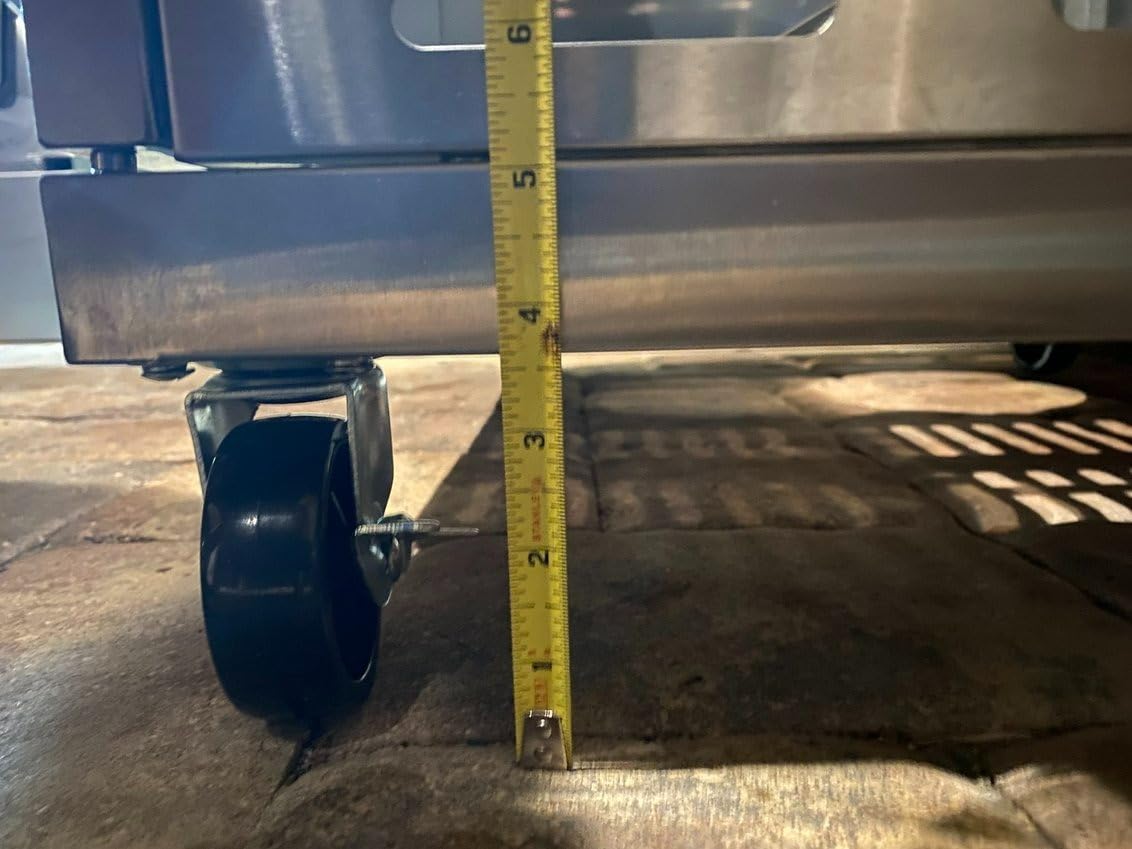
The warranty is advertised as best-in-class lifetime, which is a genuine advantage over the time-limited coverage on several others here. At 119 pounds it is lighter than the Napoleon and Charbroil cabinets, so repositioning is closer to a one-person job than a two-person one.
What holds it back is measurement and patience. The built-in thermometer appears to read a little low, and the back of the grill runs hotter than the front, so trust an independent probe over the lid gauge.
It needs roughly a 10 minute preheat before hitting 700F on high, which is slower than the compact top-down grills in this list. Some owners report it not reaching the stated maximum in certain use.
The stainless gauge is thin despite a good finish, and the warranty covers parts but the parts supply chain is slow, with third-party replacements hard to find. Owners also report it arriving with a damaged part that blocks assembly, and chat support responses were slow. At a 4.0 average, this is the lowest-rated pick here, but the searing hardware underneath is still right.
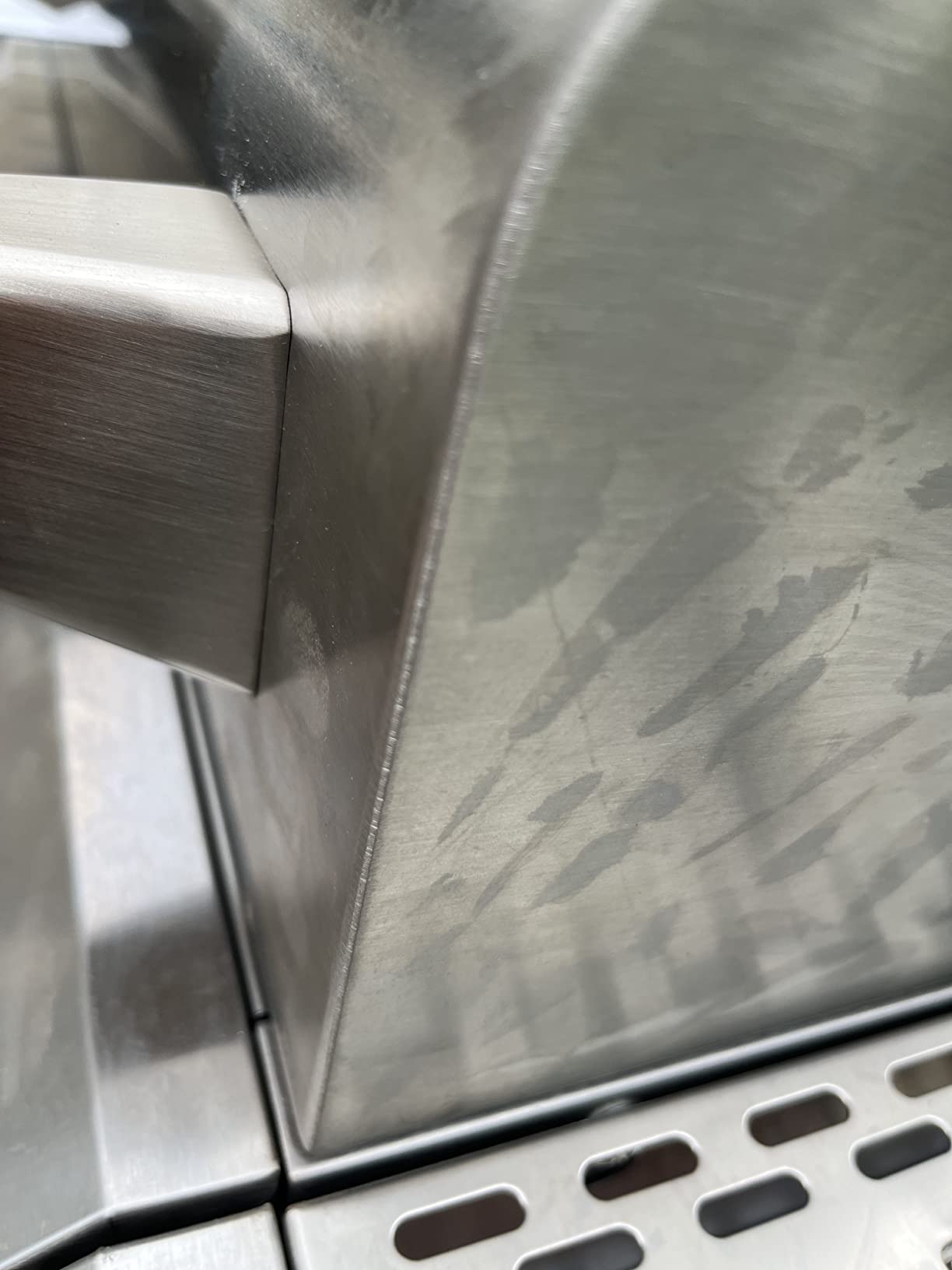
Is a 10 minute preheat a real problem?
Not if you plan for it. It is a small annoyance in summer and a genuine one in winter, when you want food on the table the moment you get home. If you sear often, preheat is something you start while you season and rest the meat, not something you wait on with an apron tied.
The bigger question is whether the temperature holds. Owners report it holding above 700F, with the double-walled construction helping once it gets there. The low-reading thermometer is the part that actually needs compensating for, so budget for a probe.
What is the weakest part of this grill?
Consistency, not durability. The thin stainless gauge, the back running hotter than the front, and a slow parts supply chain are the recurring themes. None of them will end the grill’s life, and the lifetime warranty covers the structural parts, which is the part that matters over a decade of outdoor storage.
Expect to spend a little more effort managing it than a heavier cabinet. Keep it under cover when you can, check the connections seasonally, and do not rely on the lid thermometer to tell you when the grate is ready. Use a probe and the sear burner will do its job.
7. Solaire SOL-IR17BWR – Best for Small Spaces With a Warming Rack
Solaire SOL-IR17BWR Portable Infrared Propane Gas Grill with Warming Rack, Stainless Steel, with Carrying Bag
Infrared ceramic burner
140 sq in grilling area
67 sq in warming rack
20-23 pounds with carrying bag
Pros
- Warming rack lets food rest off the heat
- Carrying bag included for grab-and-go use
- Real ceramic infrared burner
- V-grate nearly eliminates flare-ups
Cons
- Same 140 sq in surface as the base model
- Single burner caps peak heat and throughput
- Only one power level for coarse control
This is the Solaire portable with the addition that changes how you cook on it: a 67 square inch warming rack above the main grill. That sounds minor until you are searing a steak hard and want it to rest off the heat while still cooking, or warming sides alongside the protein. The main v-grate stays free instead of being occupied by food that has already finished.
The core design is the same proven one as the Solaire Everywhere: a real ceramic infrared burner in a stainless housing, electronic push-button ignition, and a v-shaped grate that channels drippings away from the burner. The primary cooking area is 140 square inches, which fits six 4-inch burgers, and the hood measures 20 inches wide by 13 inches deep with the rack in place.
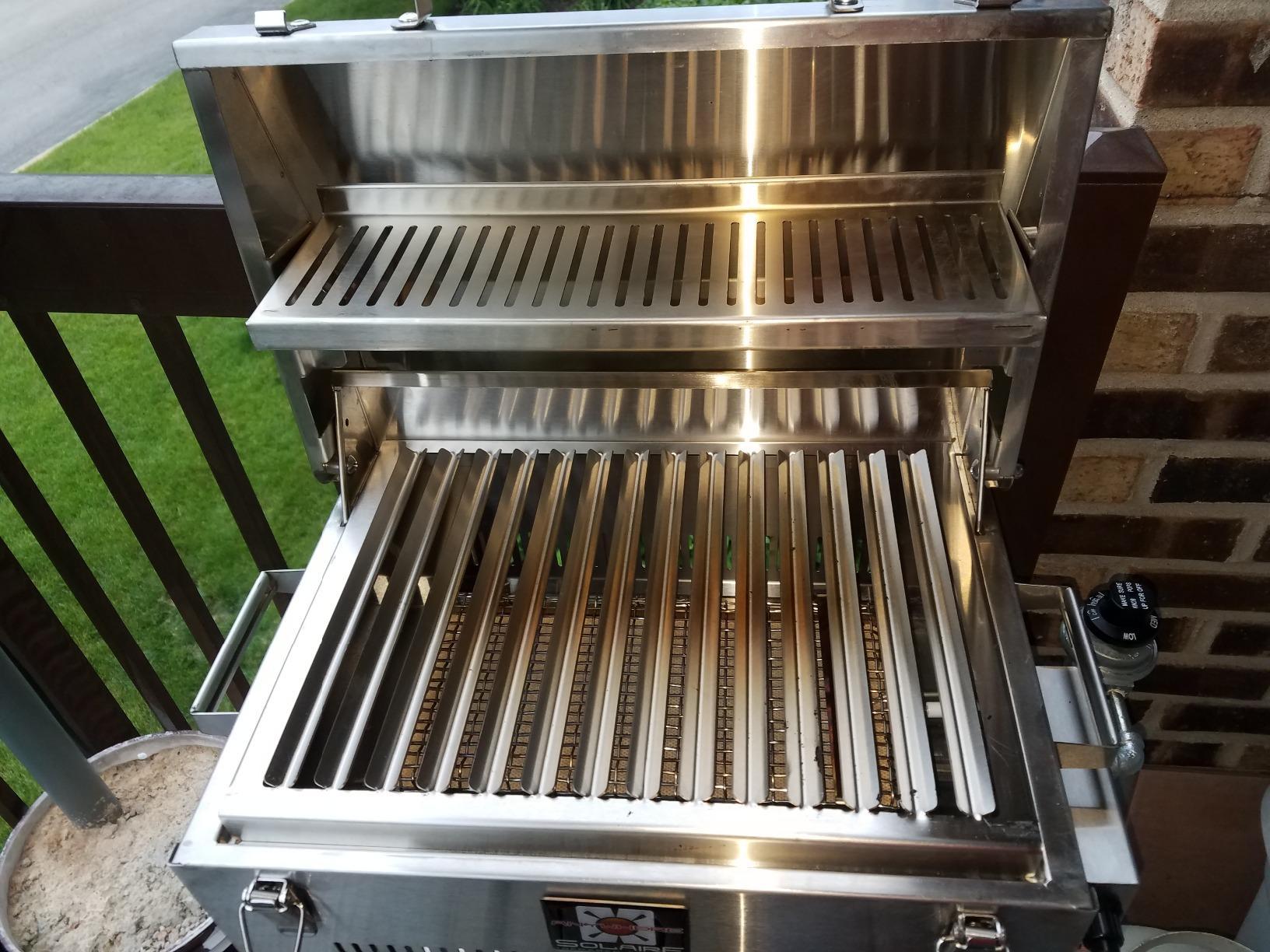
What it adds over the base model is convenience. It weighs 20 to 23 pounds and comes with a carrying bag, so moving it from a closet to a tailgate is a one-person job. The accessory list matches the base unit: tank adapter, tripod, portable stand, natural gas conversion kit, low-pressure propane kit, mount adapter plate and a grid scraper. The AAA battery and valve and regulator come in the box.
The honest limitation is the 50-review base. At 4.4 stars with 78 percent five-star ratings, sentiment is clearly positive, but there is far less long-term history behind it than the picks above, and a small sample says less about how a grill ages over a decade. The 140 square inch surface and single-burner ceiling are the same limits as the model above, and the same single power level applies, so temperature control stays coarse. The warming rack also steals a little headroom under the hood, which is worth knowing if you cook tall items.
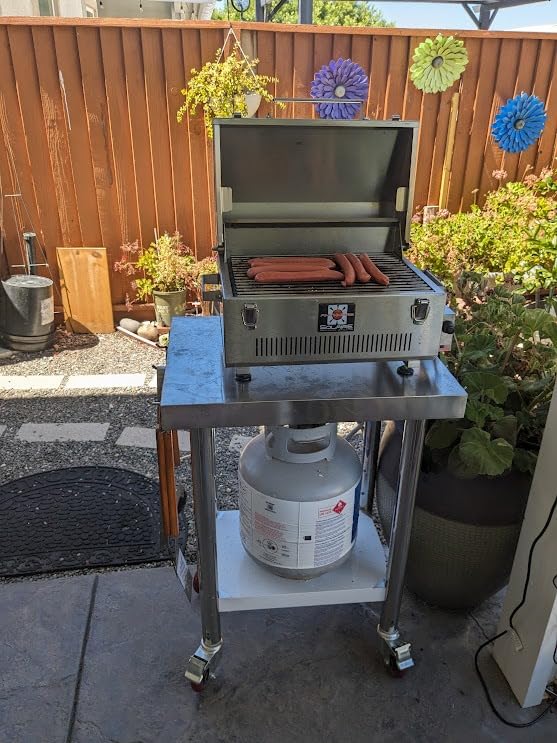
Does a warming rack matter on a portable grill?
More than it sounds, if you cook in more than one step. A steak that has finished searing can rest on the rack while the grate is still clean enough for vegetables, and a warming rack keeps bread or rolls from going cold while the main surface works. On a 140 square inch grate, freeing that space matters more than it would on a 500 square inch cabinet.
It does not help with throughput. If your problem is that you cannot cook six steaks at once, more grate area is the answer, not more rack. The rack solves sequencing, not capacity.
Is this better for a balcony than the base Solaire?
Marginally, and only if you cook courses rather than a single protein. The footprint and the burner are the same, so the searing ceiling is identical, and a balcony cook still faces the 140 square inch limit on how many people can eat at once. What you gain is somewhere to put finished food that is not the searing surface.
For a very small patio where every inch counts, the 20 inch width is a genuine advantage over any cabinet grill on this list. Check the local rules on grill use near apartments and railings before you buy, and keep a clear path for the door and the tank.
8. Schwank Gen 2 Dual Burner Portable – Two Burners, 1500F
Schwank 1500°F Portable Infrared Propane Grill, Stainless Steel LP Gas with Dual Burners – Made in USA, Steakhouse Maillard Tech for Quick Juicy Steaks, Ideal for Camping & Tailgating.
Dual infrared burners rated to 1500F
Thick steaks in about 3 minutes
Made in USA stainless steel
62 pounds with lift handle
Pros
- Reaches 1500F for a fast golden crust
- Dual overhead burners for even top-down heat
- Removable grate and pull-out drip tray
- Propane and natural gas variants
Cons
- 62 pounds is heavy for a portable grill
- Smallest review base at 39 reviews
- Smallest cooking surface among the portable models
The Schwank takes the top-down searing idea from the first pick in this list and doubles the burner count. Two infrared burners sit overhead and radiate downward rather than up, which gives more even top-down coverage than a single-burner portable and, by the maker’s claim and owner reports, hits 1500F quickly enough to cook a thick steak in roughly three minutes from flame to plate.
It is made in the USA from stainless steel, with a lift handle, rugged side handles, a push-button igniter, a removable grill grate and a pull-out drip tray on a drawer. The overhead layout is why the cleanup story is simple: the grate lifts out, the tray slides out, and there is no firebox floor to scrub. Both propane and natural gas variants exist, which is unusual for a portable.
There is one significant problem, and it is weight. At 62 pounds this is the heaviest portable grill in the group by a wide margin, which undercuts the grab-and-go positioning considerably. Two people can lift it comfortably and it moves fine in a car with a lift handle, but it is not a one-person carry across a campsite the way a 15-pound tabletop unit is.
It also has the smallest cooking surface among the portable models here and the smallest review base in the group at 39 ratings behind a 4.1 star average. Owners love the crust and the speed, and also report the USA construction and removable grate and tray. What the small sample cannot tell you is how the burners and seals age. If you want dual-burner top-down infrared and can move 62 pounds, this is the only one here that does it. If you are moving it alone or over long distances, a 15-pound unit serves you better.
Is dual-burner top-down better than a single burner?
For even crust, yes. Two overhead burners spread radiant energy across the whole grate instead of concentrating it in a band, so you get browning on the full surface rather than a hot line through the middle. That difference shows up on large flat items like burger patties and thin steaks more than on thick roasts.
The single-burner top-down grills are faster to preheat and lighter to carry, and on a small grate the concentration is not much of a disadvantage. Dual burners buy evenness. Whether the extra evenness is worth the extra weight depends entirely on how you move the grill.
Is 62 pounds a real problem for camping?
It depends on the trip. For a tailgate in a parking lot or a backyard that is twenty steps from the door, the weight is an inconvenience you absorb once. For a car trunk, a pickup bed, or a site at the far end of a campground, it becomes the thing you think about every single time.
Consider the lift handle rather than the marketing. It is designed to make a two-person carry manageable, and the pull-out drip tray means you can drain and pack the grill without tipping it. If the alternative is a 15-pound tabletop that cooks two people rather than four, the honest comparison is weight against surface area, and there is no clean answer.
How to Actually Sear on an Infrared Grill
A grill that reaches searing temperature will still underperform if you hand it a wet steak. The technique matters as much as the hardware, and the good news is that the method is simple once you accept that you are managing moisture rather than adding flavor to the pan.
Get the grate properly hot first. Do not start cooking during preheat. On the compact top-down grills in this list that means three to five minutes, and on the cabinets it can be closer to ten. A grate that has not fully heated will tear the crust instead of forming it.
Dry the surface of the meat thoroughly. This is the single biggest lever you control. Moisture on the surface has to boil off before browning starts, and the steam interferes with the Maillard reaction. Pat the whole cut dry, especially the edges.
Oil the grate, not the meat. A high smoke point oil on hot cast iron prevents sticking. Oiling the meat burns off and does nothing for the release.
Salt early and season simply. Salt applied well before cooking draws moisture to the surface and then reabsorbs it, which is the opposite of what you want. Use salt at the start of cooking, not immediately before.
Lay the steak down and leave it. Do not touch it, do not flip it early, and do not start basting. A single confident flip, once the crust has set, is all a good sear needs.
Rest properly. Moving the steak to a warming rack or a cool part of the grate for several minutes lets the juices redistribute instead of running out onto the board. A grill with a warming rack earns its place here.
Respect the smoke point. Above roughly 575F, ordinary cooking oils smoke and go bitter. Use a high smoke point oil, and keep a glass of water nearby rather than reaching for water on a flare-up.
If your cookware needs the same treatment, our guides to the best cast iron woks for high heat stir frying and the best carbon steel woks for high heat stir fry cover the same temperature and seasoning logic in a different vessel.
Infrared Grill Buying Guide
Most buyers lose time comparing total BTU figures, which is the least useful number on the spec sheet. Heat output matters only in relation to the surface it has to heat and the way it is distributed. These six factors are what actually determine how well a grill sears.
What temperature you actually need for searing
Roughly 500F to 600F on the cooking surface is the practical target for a good crust, and you want to be able to overshoot that when the steak hits. The Maillard reaction produces hundreds of aromatic compounds and needs a dry surface above about 300F, but the browned, hard crust people mean by searing wants the 500F range and above. A grill that tops out at 450F will cook a steak, but it will not give you the hard caramelized shell.
That is why the top-down grills in this list claim 1500F and why the cabinet grills describe burners holding above 700F. The number is the ceiling, not the average. What matters is having a wide zone you can hold at the high end while a second zone stays at a cooking temperature, and that is a layout question rather than a spec-sheet question.
Main infrared burners, sear burners and rear burners
There are three distinct layouts, and they are not interchangeable. A main infrared system is a set of burners under the grates covering the whole cooking surface, which gives even heat and good searing but a lower ceiling in any single spot. A sear burner is a separate small high-output zone, usually on the side, that reaches searing temperature fast over a limited area. A rear burner sits above the food and is intended for roasting and rotisserie cooking as much as for searing.
Which one to prioritize depends on how you cook. Thick cuts and reverse sears favor a dedicated sear or rear zone. Lots of steaks at once, or a large surface you want evenly hot, favors a strong main system. Grills that combine them, like the two larger grills further up this list, give the most flexibility at the cost of deck space.
BTUs per square inch of cooking surface
Divide total burner output by the primary cooking area and you get a rough density figure. As a practical guide, roughly 100 BTU per square inch is comfortable for steady grilling, and higher density means faster heat-up and more recovery when you open the lid. One compact grill in this group sits near 130 BTU per square inch, because a small grate needs concentrated power. Large cabinets spread their total across a much bigger surface, so total output still climbs into the tens of thousands per hour.
Never compare a cabinet grill to a portable on total BTU alone. The cabinet will always win that comparison and the portable will always win on heat-up speed, because they are solving opposite problems. Compare density instead, and think about how much food you are putting down at once.
Cooking surface size
About 300 square inches serves 10 to 12 burger patties, and 450 to 500 square inches handles roughly two dozen. For steak specifically, plan on two steaks per 100 square inches of primary surface, since thick cuts need room around them to avoid steaming each other. Anything under 140 square inches is a grill for two people, not a group cookout.
Do not count the warming rack. It is measured in the marketing and it is genuinely useful for resting and warming, but it will not sear anything. Judge a grill on primary cooking area only, and check whether that area is flat or divided into zones, because a divided grate gives you two-zone cooking at the cost of a smaller hot spot.
Grate material and heat retention
Bare cast iron has the highest heat mass and the best recovery, which means it keeps searing temperature through a lid opening better than anything else. It needs seasoning care and it will rust if you leave it wet, but it will also outlast almost everything else here. Porcelain-coated cast iron keeps the cast iron behaviour with far less maintenance and will not rust, at the cost of a coating that can chip if you use metal tools or drop something on it. Stainless steel is durable and easy to clean but has the lowest heat mass, so it recovers slowest and sears with slightly less consistency.
For pure searing, cast iron in either form is the better choice. Top-down grills in this list use stainless grates and get away with it because the radiant element is above the food, not below it, so recovery is less of an issue.
Propane versus natural gas
Both fuel types produce the same heat energy and neither sears better than the other. Propane is portable, stores indefinitely and needs no hookup, which is why every grill in this group except the convertible natural gas options runs on it. Natural gas saves money over heavy use and never runs out mid-cook, but it requires a permanent line and a code-compliant install.
If you already have a natural gas line at your outdoor kitchen, the fuel decision is made for you. If you do not, propane is the answer, and several picks here also support a natural gas conversion kit so the grill is not tied to one fuel forever.
Who Should Skip an Infrared Grill
If your cooking is mostly low and slow, an infrared grill is the wrong tool and no amount of searing capability will fix it. The radiant burners here are built to climb quickly and hold high. Holding a steady 225F for four hours while smoke wraps around a rack of ribs is much easier on a kamado or a charcoal offset, and the coarse single-knob control on several of the portable grills makes low-temperature work worse still.
There is a second group who should pass. If you dislike maintaining cast iron, or you have nowhere sheltered to store a grill between seasons, a porcelain-coated or stainless cabinet will age more calmly. Infrared grills reward a little attention: grates need to stay dry and clean, grease management parts need replacing, and an uncovered infrared burner in a wet climate is a corrosion risk over a decade.
If you sear steak a few times a week and cook most other meals fast, you are in exactly the group these eight are built for.
Frequently Asked Questions
What is an infrared grill and how does it work?
An infrared grill is a gas grill whose burners heat a radiant ceramic element that then radiates heat onto the cooking grates, so most of the heat reaches the food as radiant energy rather than rising hot air. The flame never points directly at the grate, which is why flare-ups are uncommon and surface temperatures climb fast and evenly.
Are infrared grills better for searing than regular gas grills?
For searing, usually yes. A radiant element under the grate reaches higher, more even surface temperatures and pushes drippings away from flame contact, so you get a harder crust with less flare-up handling. The trade-off is low-temperature control, which is easier on a kamado or charcoal fire than on infrared.
How hot can an infrared grill get?
It depends on the layout. Top-down infrared models in this group are rated to 1500F and reach searing temperature in three to five minutes, and one side burner claims 1800F in about 30 seconds. Cabinet grills with main infrared burners generally hold above 700F across the grate. For a good crust, 500F to 600F on the surface is the practical target.
How long does an infrared grill take to preheat?
Compact top-down infrared units reach temperature in roughly three to five minutes, while cabinet grills with larger cooking surfaces typically need about ten minutes. Plan for the longer number in cold weather and start preheating while you season and rest the meat rather than waiting on the grill.
How do I clean and season infrared grill grates?
Brush the grates after every cook while they are warm, then wipe them with a damp cloth and dry them fully. Never store them wet, since bare cast iron rusts and porcelain coating chips. A thin coat of high smoke point oil on bare cast iron between uses is enough seasoning, and a wire grill brush is the right tool for the v-shaped grates on the portable grills.
How many BTUs do I need for high heat searing?
Look at density rather than total output. Roughly 100 BTU per square inch of primary cooking surface is comfortable for steady grilling, and compact grills in this group sit far above that because a small grate needs concentrated power. Large cabinets reach the same effect with much higher totals spread across 500 or more square inches.
The Bottom Line on High Heat Searing
Our Editor’s Choice is the BIG HORN portable infrared grill. A 19000 BTU rated burner that reaches 1500F in three to five minutes, a top-down design that suppresses flare-ups entirely, and the largest review base of anything we looked at at 1160 ratings. If your searing happens for two to four people and you value speed and even crust over square inches, that is the grill to buy.
If you cook for a group, step up to the Monument Grills 4+2 for 510 square inches of primary surface and a dedicated infrared side sear burner, or the Napoleon Prestige 500 RSIB if you want a rear infrared burner and a rotisserie for large-format roasts. The Charbroil Pro Series Amplifire earns its place for anyone who wants griddle and charcoal in the same cabinet, and the Solaire pair remains the answer for balconies, campsites and tailgates.
The grill is half the result. Dry the meat, oil the grate, preheat fully and flip once. That is the whole difference between a good sear and a great one, and it is why the best infrared grills for high heat searing still reward the cook as much as the hardware. Our picks and the comparison table above are current as of 2026.