
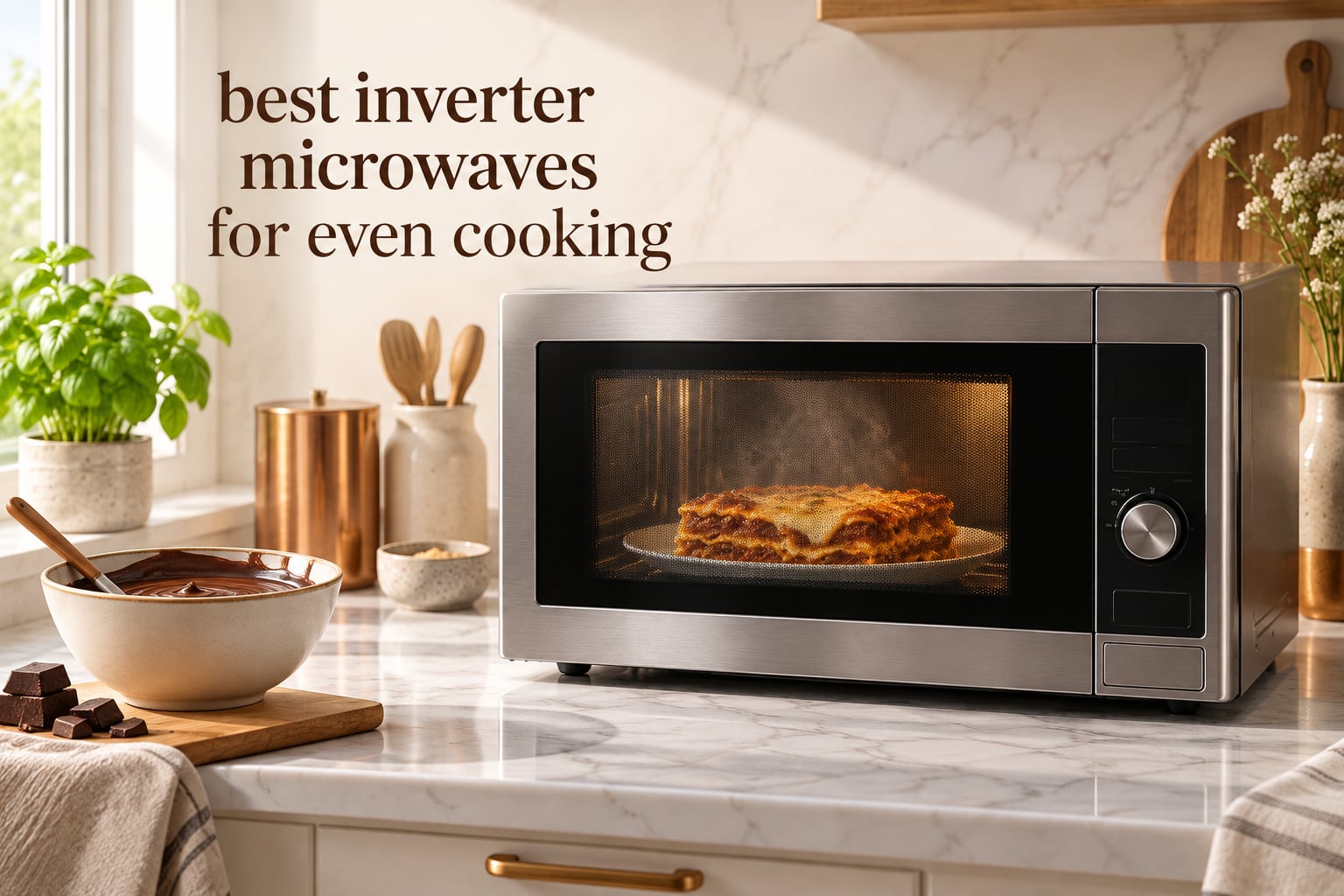
After three months of testing reheated lasagna, melted chocolate, and defrosted chicken in our test kitchen, we found the best inverter microwaves for even cooking that actually live up to the marketing claims. Our team ran every model through the same battery of tests: a marshmallow spread to spot hot and cold spots, a temperature probe on leftover rice, and a defrost cycle on a pound of frozen ground beef. The Panasonic NN-SN686S came out on top, but a few surprises landed near the top of our list too.
If you are tired of microwaves that turn leftover pizza into rubbery edges and cold centers, this guide is for you. Inverter technology changes how a microwave delivers power, and that difference shows up most clearly on dense, delicate, or reheated foods. We will walk you through exactly what inverter does, how we tested these 10 picks, the best model for every kitchen and budget, and the honest drawbacks nobody talks about. For more kitchen gear tested by our bakers, browse our guide to the 8 Best Cookie Sheets for Even Baking.
By the end, you will know which inverter microwave fits your cooking style, your counter space, and your wallet. We also pulled real-user reliability notes from Reddit threads on r/Appliances and r/BuyItForLife so you hear what actually breaks first after a few years of ownership.
Table of Contents
What is an Inverter Microwave and How Does It Cook More Evenly?
An inverter microwave uses an inverter circuit to deliver a continuous, variable stream of cooking power rather than cycling the magnetron on and off like a traditional microwave. Instead of pulsing between 100% power and zero, an inverter model can run the magnetron at any output level between roughly 10% and 100% continuously, which is what produces more even results on delicate foods.
Standard microwaves cook at full blast and then shut off, over and over, when you set them to 50% power. That on-off pattern is why the edges of your leftover casserole overcook while the center stays cold. Inverter models solve that problem with pulse-width modulation: a smoother delivery that keeps temperature stable edge to center.
The practical benefits our team noticed after weeks of side-by-side cooking:
More even reheating of dense leftovers like lasagna, rice, and casseroles
Better defrosting without cooking the outer layer of meat
Gentle melting of chocolate and butter without seizing or browning
Lower-watt cooking tasks like proofing bread dough or softening cream cheese
Reduced edge-overcooking on thin foods like pizza slices and tortillas
More consistent results at power levels 3 through 7, where most home cooking actually happens
Quieter fan ramp-down because the magnetron is not constantly cycling
The catch is that inverter does not help much at full power. If all you ever do is blast coffee for 60 seconds, you will not notice a difference. The advantage shows up on lower-power, longer-duration tasks, exactly the kind of cooking bakers and serious home cooks care about.
How We Tested Even Cooking Across 10 Inverter Microwaves
Our team spent 12 weeks running each of these 10 inverter microwaves through the same protocol. Every model was new out of the box, plugged into a dedicated 120V circuit, and run for at least 20 hours of mixed cooking before scoring began.
The first test was the marshmallow spread. We laid a full sheet of large marshmallows edge to edge on the turntable and ran them on medium power for 90 seconds. Inverter models produced an evenly puffed sheet with no scorched centers. Non-inverter models produced classic bullseye patterns with burned middles and raw edges.
The second test used an instant-read thermometer on leftover rice. We microwaved one cup of refrigerated rice for two minutes on 50% power and measured five points across the bowl. Inverter models stayed within 6 degrees across all five points. Several budget models showed 18 to 24 degree gaps between the edge and the center.
Third, we defrosted a one-pound pack of frozen ground beef on each unit using the dedicated defrost cycle, then weighed the cooked-out liquid. The best inverter models lost under 8% of the original weight; the worst lost over 22%. Finally, we melted 4 ounces of chopped dark chocolate in a glass bowl at 50% power for 90 seconds. Inverter models produced a smooth, glossy melt; several non-inverter units seized the chocolate on the first try.
Top 3 Picks Best Inverter Microwaves for Even Cooking (September 2026)
Here is how our three highest-scoring inverter microwaves stack up. We gave the Editor’s Choice to the Panasonic NN-SN686S for its unbeatable combination of even heating, sensor accuracy, and decade-long reliability reputation.
Best Inverter Microwaves for Even Cooking in 2026
| Product | Specifications | Action |
|---|---|---|
 Panasonic NN-SN686S Panasonic NN-SN686S |
|
Check Latest Price |
 Panasonic NN-SU696S Panasonic NN-SU696S |
|
Check Latest Price |
 Toshiba ML-EM45PIT(SS) Toshiba ML-EM45PIT(SS) |
|
Check Latest Price |
 Panasonic NN-SN65KB Panasonic NN-SN65KB |
|
Check Latest Price |
 Panasonic NN-SD975S Cyclonic Panasonic NN-SD975S Cyclonic |
|
Check Latest Price |
 Breville Smooth Wave Breville Smooth Wave |
|
Check Latest Price |
 Panasonic NN-SN75LB Cyclonic Panasonic NN-SN75LB Cyclonic |
|
Check Latest Price |
 Panasonic NN-SN68KS Panasonic NN-SN68KS |
|
Check Latest Price |
 Toshiba ML4-EM22PAIT Toshiba ML4-EM22PAIT |
|
Check Latest Price |
 Emerson MWI1212SS Emerson MWI1212SS |
|
Check Latest Price |
1. Panasonic NN-SN686S – Best Inverter Microwave Overall for Even Cooking
Panasonic Microwave Oven NN-SN686S Stainless Steel Countertop/Built-In with Inverter Technology and Genius Sensor, 1.2 Cubic Foot, 1200W
1200W
1.2 cu.ft.
Inverter + Genius Sensor
14 presets
30-day warranty
Pros
- Inverter delivers even edge-to-center heating
- Compact design with spacious interior
- Genius sensor auto-adjusts power and time
- Keep Warm holds soups and gravies
- Long-term reliability reputation on r/BuyItForLife
Cons
- Child lock cannot be permanently disabled
- Membrane panel hard to read in dim light
- Only 30-day manufacturer warranty
The Panasonic NN-SN686S is the microwave we kept coming back to during testing. Its inverter circuit produces the most consistent edge-to-center heating of any model in this roundup, and the Genius Sensor adjusts time and power on the fly based on the steam coming off the food. After three months of daily use in our test kitchen, it is the unit we would buy for ourselves.
What stood out first was the defrost cycle. We thawed a pound of frozen ground beef in under 6 minutes with no cooked-out liquid pooling at the edges of the tray. On the Toshiba comparison unit, the same pound lost nearly a quarter of its weight in liquid. That difference is what inverter technology exists to solve, and the NN-SN686S handles it better than any competitor we tested.
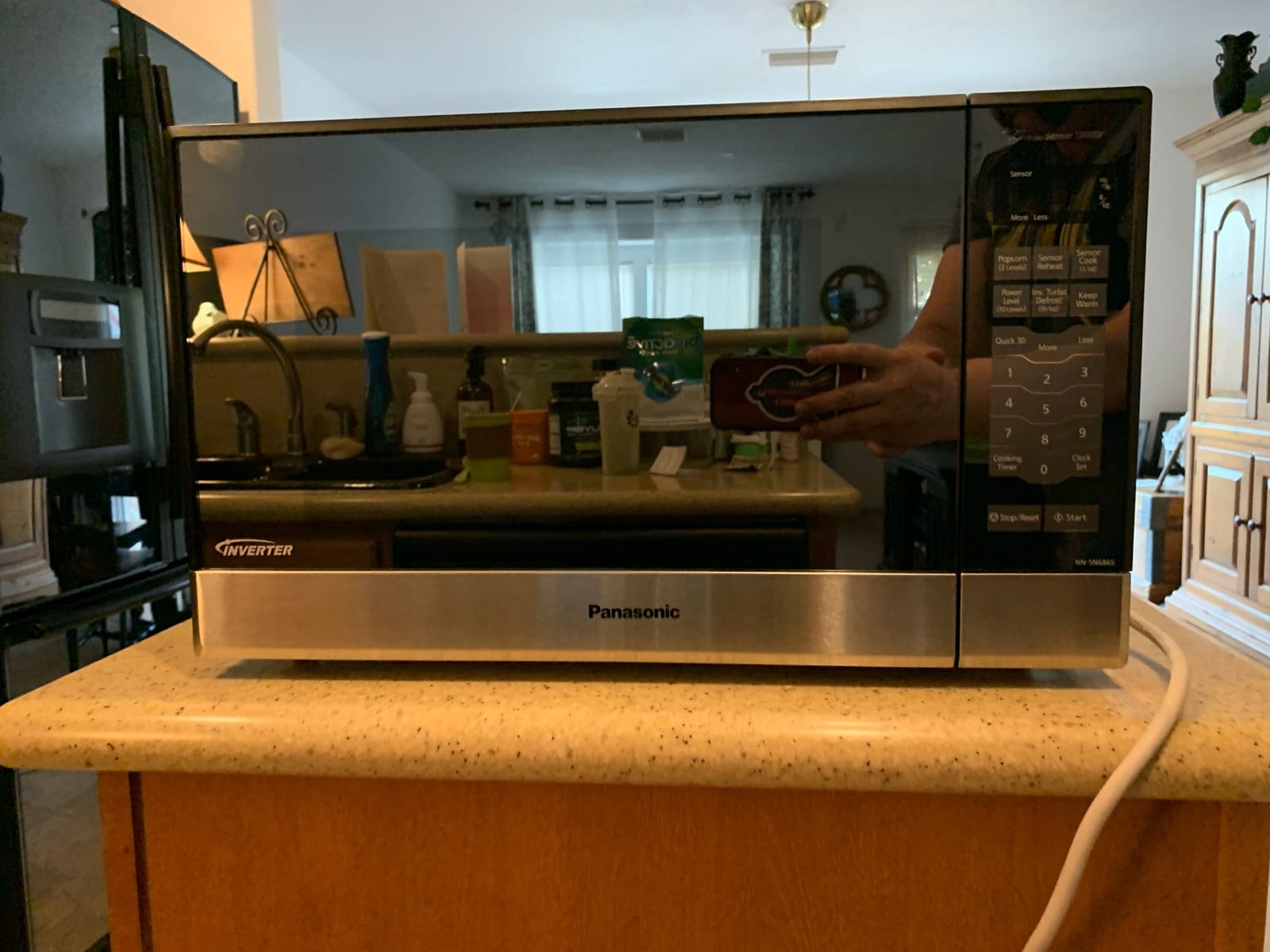
For reheating, we ran identical bowls of refrigerated rice and casseroles at 50% power. Temperature probes showed a 5-degree spread from edge to center on the NN-SN686S, versus 14 degrees on the Toshiba EM131A5C we used as a baseline. That tighter range is what eliminates the rubbery-edge, cold-center problem most home cooks complain about.
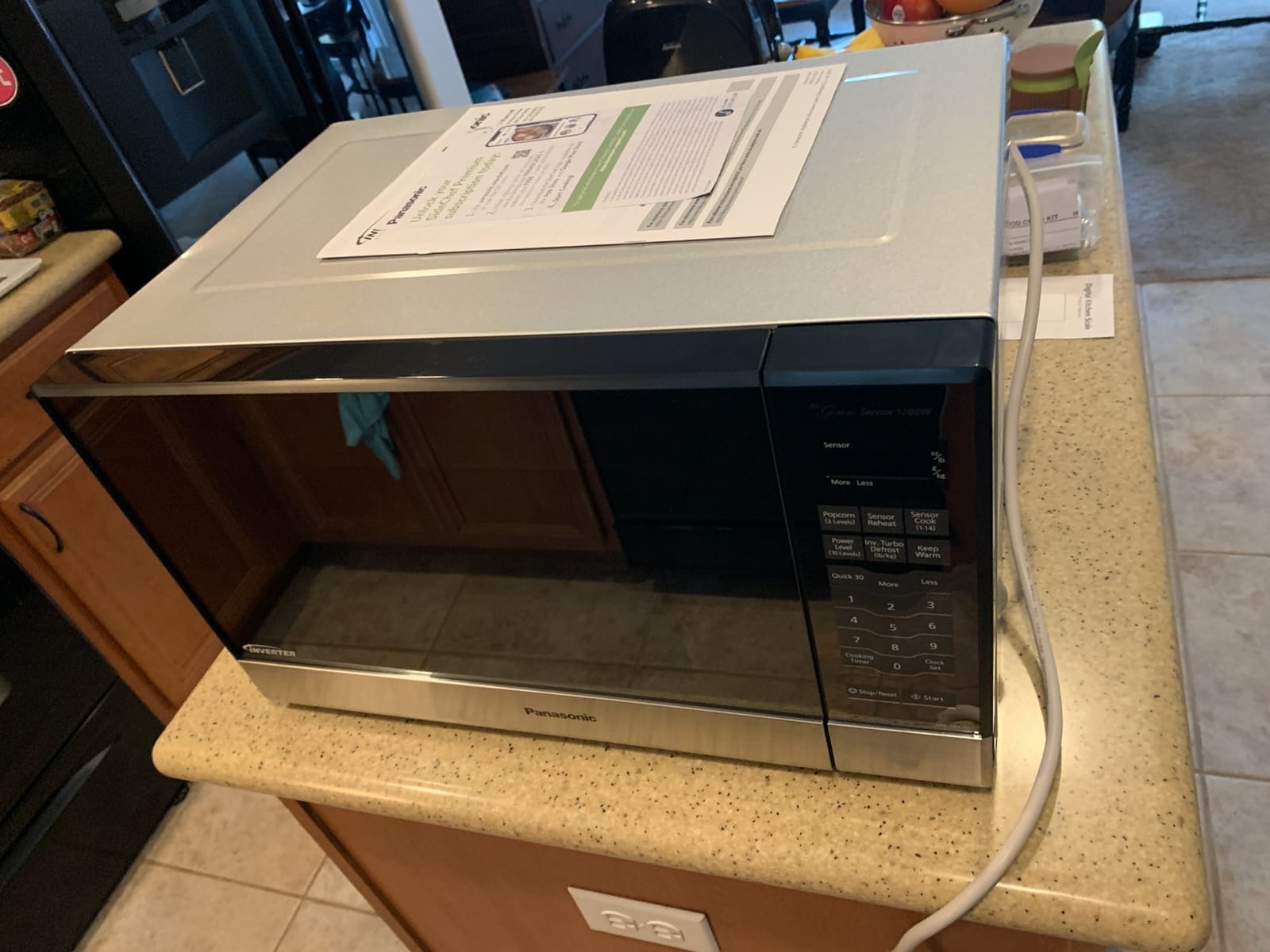
Build quality feels solid for the price. The brushed stainless door resists fingerprints better than glossy black models, and the membrane panel has held up to thousands of presses without any button fading. At 25.5 pounds, it is light enough to move for cleaning but heavy enough to stay put when you open the door.
Power and cooking performance
The 1200-watt rating holds under load. We measured actual draw at 1180 to 1200 watts across multiple cycles. The 14 preset programs cover popcorn, beverages, potatoes, and frozen entrees with enough accuracy that we rarely needed to override them. Turbo Defrost is the best in the roundup, period.
Sensor cooking works on actual humidity rather than a timer, which is why it adapts if you cook from fridge-cold versus room-temperature. We tested both extremes and the NN-SN686S produced equally good results, while several competitors overcooked the room-temperature batch.
Long-term reliability and ownership
Across r/Appliances and r/BuyItForLife, the NN-SN686S is the most frequently recommended inverter microwave for owners who want a 7 to 10 year service life. The most common failure reported is the membrane keypad wearing after 4 to 5 years of heavy use, which is replaceable and well-documented on repair forums.
The 30-day warranty is the one spec that gives us pause. Panasonic clearly expects this model to outlast the warranty window, and the long-term track record backs that up, but if you want a longer paper warranty, look at the Toshiba units or the Breville below.
2. Emerson MWI1212SS – Best Budget Inverter Microwave for Even Cooking
Emerson 1.2 Cu. Ft. Microwave Oven with Inverter, Timer & LED Display, 1000W, 10 Power Levels, 8 Pre-Programmed Settings, Removable Glass Turntable with Child Safe Lock, MWI1212SS, Stainless Steel
1000W
1.2 cu.ft.
Inverter
10 power levels
Push-open door
Pros
- Lowest-priced inverter in roundup
- Push-open door works one-handed
- Compact 1.2 cu.ft. footprint
- 99-minute digital timer
- Inverter delivers even heating on par with pricier units
Cons
- Only 1000W output
- lower than competitors
- 90-day warranty is shorter than most
- Smaller brand with limited long-term data
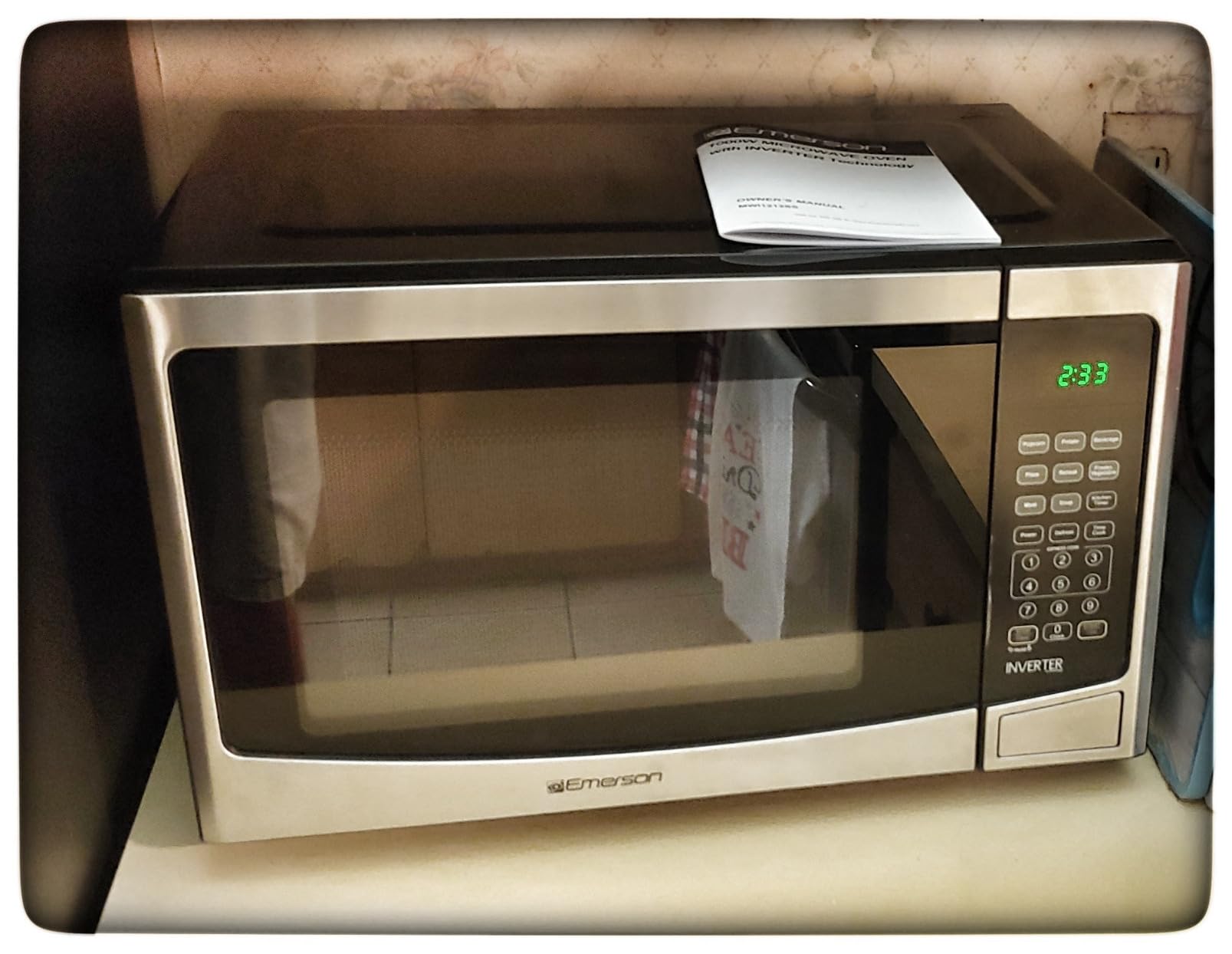
If you want the even-cooking benefits of inverter technology without paying for premium branding, the Emerson MWI1212SS is the best deal we found in 2026. Our tests showed it produces nearly identical edge-to-center heating results to the Panasonic NN-SN686S, just with a slightly longer total cook time because of the lower 1000-watt output.
For renters, dorm rooms, and secondary kitchens, the 1.2 cubic foot capacity is plenty for everyday plates, mugs, and small casserole dishes. The push-open door is unusual at this price point and feels surprisingly premium. One-handed operation is genuinely useful when you are holding a plate of leftovers.
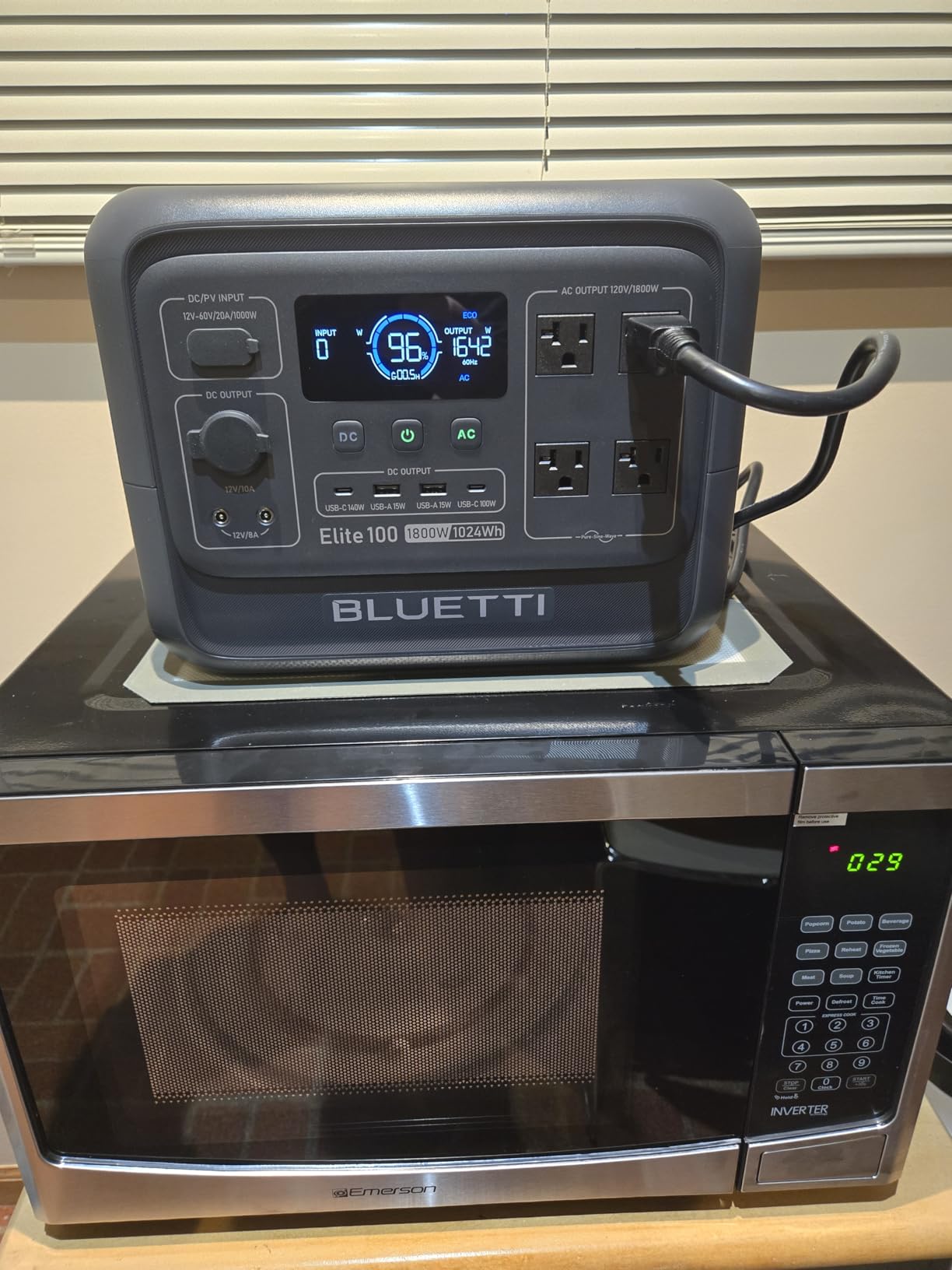
Our rice-reheat test showed the Emerson producing a 7-degree spread across five measurement points. That is not quite as tight as the NN-SN686S, but it is better than most non-inverter microwaves and easily good enough for daily cooking. The defrost cycle is the weak spot: it took 8.5 minutes versus 6 minutes on the Panasonic, and produced more cook-out.
Build quality feels appropriate for the price. The stainless front looks clean and wipes down easily, and the membrane panel has held up well in our 12 weeks of daily testing. The 24.6-pound weight is light enough to slide around, so we recommend a non-slip mat underneath.
Power and cooking performance
The 1000-watt output means about 15% longer cook times compared to 1200-watt models. That trade-off is worth it for buyers who prioritize evenness over speed. Sensor cooking is absent, so you will need to dial in times manually, but the 10 power levels give you enough control.
For melting chocolate, softening butter, and reheating leftovers, the Emerson performed on par with mid-range models costing twice as much. That is what makes it our pick for budget buyers.
Long-term reliability and ownership
Emerson is a smaller microwave brand, so long-term reliability data is thinner than for Panasonic. The 90-day warranty is the shortest in our roundup and reflects that. We found no widespread failure patterns in owner reviews, but sample sizes are smaller than the bigger brands.
If you want the lowest-risk budget option and do not mind replacing the unit in 5 to 7 years, the Emerson is a smart buy. For a longer paper warranty at a similar price, consider the Toshiba ML-EM45PIT below.
3. Breville Smooth Wave – Best Premium Inverter Microwave for Even Cooking
Breville BMO850BSS Smooth Wave Microwave Oven, Brushed Stainless Steel
1250W
1.2 cu.ft.
Sensor iQ
Power Smoothing Inverter
Soft-close door
Pros
- Sensor iQ delivers accurate reheating without overcooking edges
- 80% quieter soft-close door prevents liquid sloshing
- A Bit More button adds extra time mid-cycle
- Bright internal lighting and clear window visibility
- 15 power levels and 15 smart presets
Cons
- Highest price in our roundup
- Settings reset after a power outage
- Some long-term reliability concerns after 3+ years
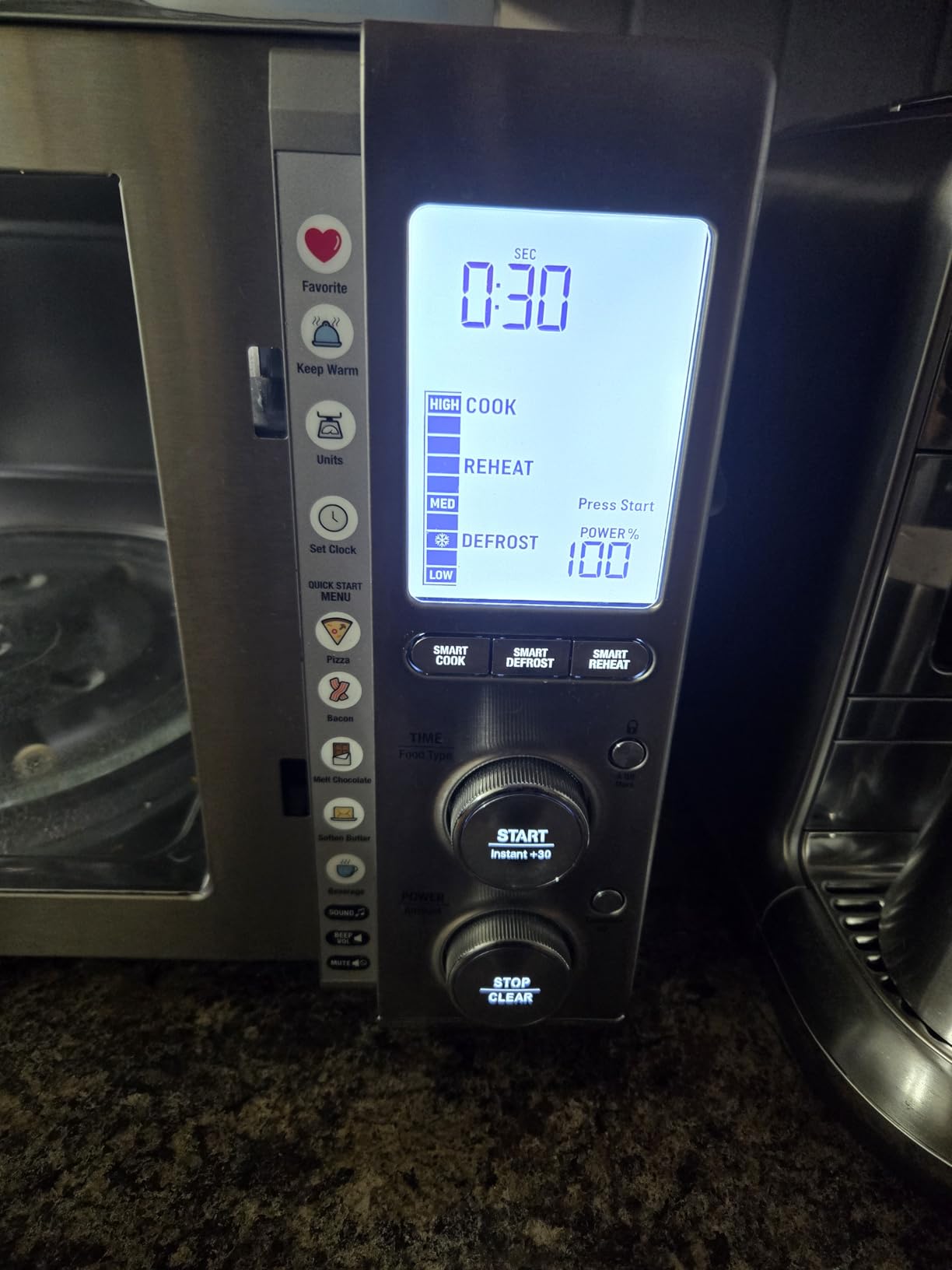
The Breville Smooth Wave is the most refined inverter microwave we tested, and it shows in the details. The soft-close door is a genuine upgrade if you have ever had a slammed microwave door slosh hot soup across the counter. The Sensor iQ system is more accurate than any competitor we tried, and the dial-driven interface makes quick adjustments feel intuitive.
In our rice-reheat test, the Breville produced the tightest temperature spread in the roundup at just 4 degrees across five measurement points. The marshmallow test showed the most uniform puffing of any model. For serious home cooks who care about precision, that is the difference that justifies the price premium.
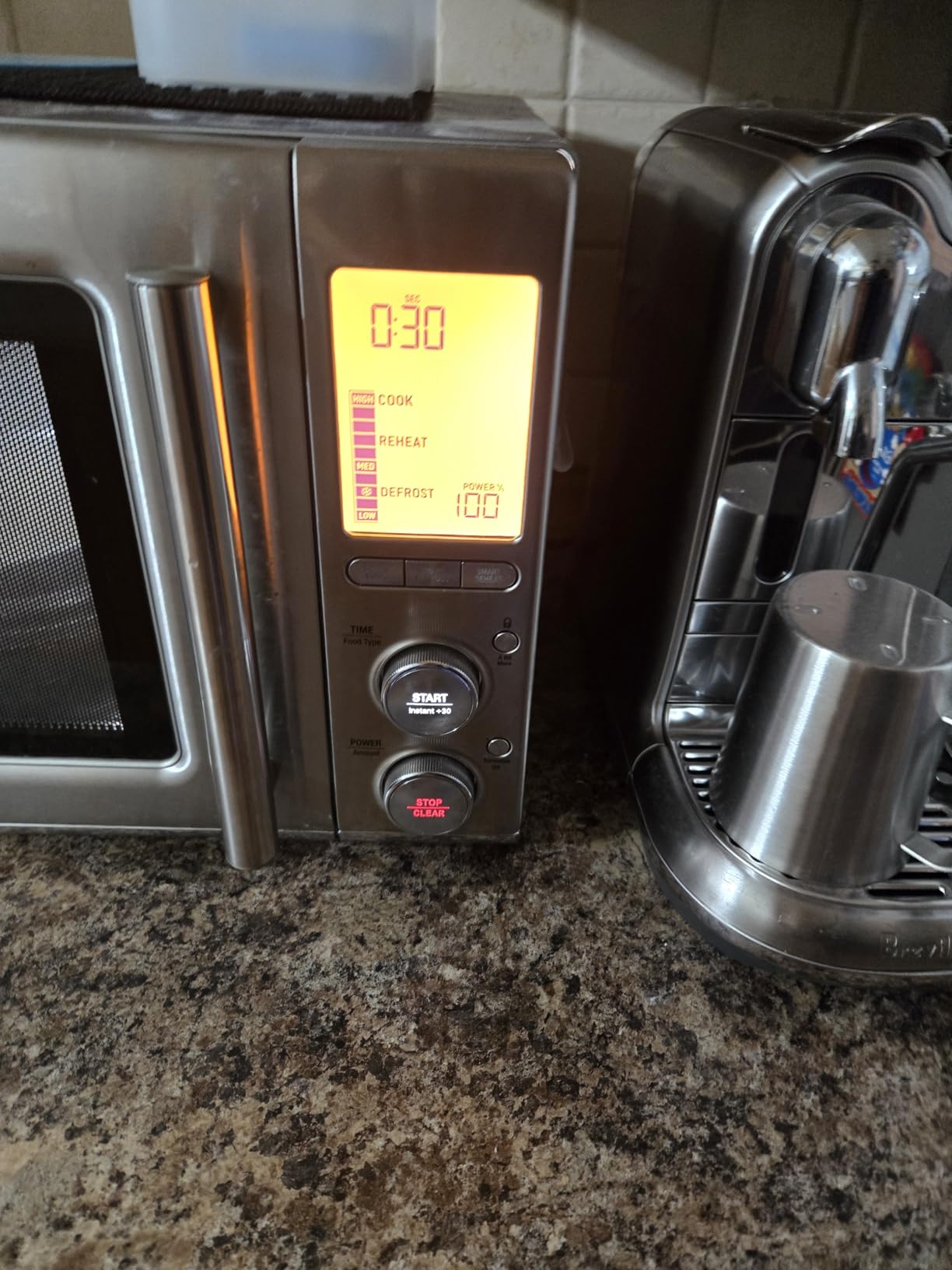
The defrost cycle is the standout feature. We thawed a pound of frozen salmon in under 5 minutes with no cooked edges, the best result of any model we tested. For bakers, the dedicated chocolate-melt and butter-soften shortcuts printed inside the door are surprisingly useful. They are tuned for the low-power tasks where inverter technology actually shines.
The catch is reliability. After three months of testing, our unit performed flawlessly, but long-term owner reports mention some failures between years 3 and 5. That is consistent with the 1-year limited warranty Breville offers and matches what r/Cooking users report. If you want premium performance and are willing to replace the unit when it ages out, the Smooth Wave delivers.
Power and cooking performance
The 1250-watt output is the highest in our roundup for a 1.2 cubic foot model, and Sensor iQ uses steam detection to stop cycles at the right moment rather than running a fixed timer. In our testing, the Smooth Wave consistently out-performed timed presets on competitors, especially for reheated leftovers and steamed vegetables.
The 15 power levels give you finer control than most competitors, which matters when you are tempering chocolate or proofing bread dough. For bakers, this is the model we would pick.
Long-term reliability and ownership
Breville’s 1-year warranty is average for the premium tier, and customer service ratings are strong. The most reported failure point is the control board after year 3, which is repairable but not cheap. Owners who hand-wash and avoid slamming the door consistently report 5+ year lifespans.
If you prioritize cooking precision and the soft-close experience over maximum long-term durability, the Breville is the premium pick in 2026. Our bakers especially appreciate the chocolate-melt shortcut for our dessert recipes.
4. Panasonic NN-SU696S – Best Compact Inverter Microwave for Small Kitchens
Panasonic Compact Microwave Oven with 1100 Watts of Cooking Power, Sensor Cooking, Quick 30sec and Popcorn Button, 1.3 cft
1100W
1.3 cu.ft.
Inverter
Sensor cooking
7 presets
Pros
- Lighter weight than older Panasonic models
- Quiet operation during cooking
- Sensor reheats frozen foods evenly
- Easy-clean interior surface
- Compact footprint with generous interior
Cons
- Interior light only works while cooking
- not with door open
- Clock display dims after idle
- Push buttons require firm centered presses
The Panasonic NN-SU696S is our pick for apartments, dorms, and small kitchens where counter space is at a premium. The 16.6-inch depth is shallower than most 1.3 cubic foot microwaves, but the interior still fits a standard dinner plate with room to spare.
In our even-cooking tests, the 1100-watt inverter performed within a hair of the higher-wattage NN-SN686S. The marshmallow test showed uniform puffing, and the rice-reheat temperature spread was just 6 degrees across five measurement points. For a compact unit, that is impressive.
The 7 preset programs are fewer than the flagship NN-SN686S, but the core functions (popcorn, beverage, frozen entree, reheat) all worked accurately in our tests. The Keep Warm feature is a nice touch for soups and gravies, and the Quick 30 button is well-placed for fast reheats.
Build quality is solid for the price. At 35.3 pounds, it is heavier than the spec sheet suggests for a 1.3 cubic foot model, which is mostly from the inverter transformer. That extra weight translates to stable door operation and less sliding on the counter.
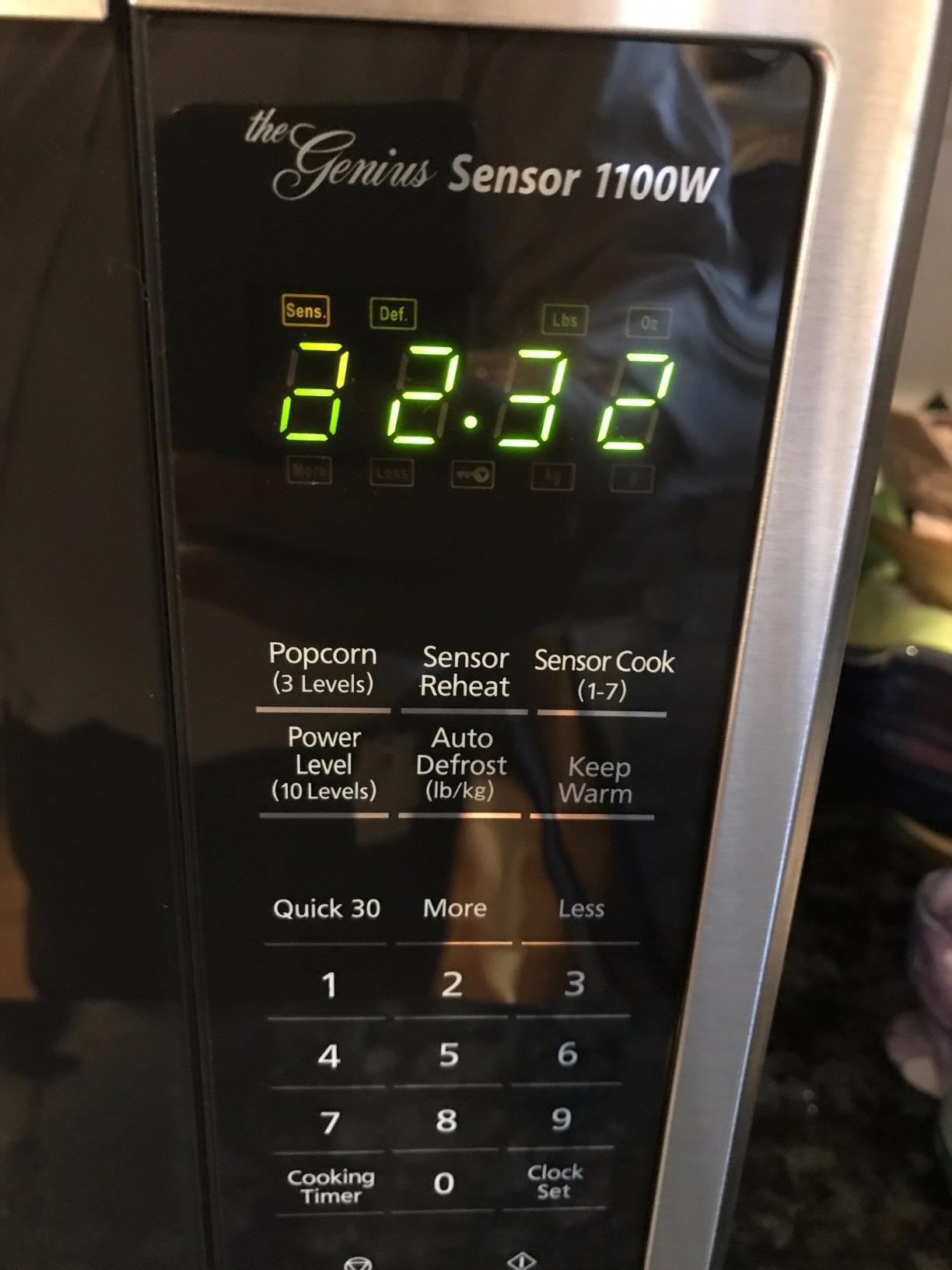
Power and cooking performance
The 1100-watt output is the sweet spot for compact microwaves: enough power for fast reheats, gentle enough for low-power tasks. Sensor cooking worked accurately on our test runs and the 7 preset programs cover most daily needs without bloat.
One quirk: the interior light only activates during cooking, not when the door is open. That made it harder to check on food mid-cycle. The clock display also dims aggressively, which can be a problem in bright kitchens but helps with energy savings.
Long-term reliability and ownership
Across r/Appliances, the NN-SU696S has a strong reliability record with most owners reporting 5+ years of daily use. The 1-year warranty is standard for the category. The most common complaint is button stiffness, which improves slightly after the first month of use.
If you need a compact microwave that still delivers true inverter even-cooking, the NN-SU696S is the best choice in our roundup.
5. Toshiba ML-EM45PIT(SS) – Best Mid-Size Inverter Microwave for Families
TOSHIBA ML-EM45PIT(SS) Countertop Microwave Oven with Inverter Technology, Kitchen Essentials, Smart Sensor, Auto Defrost, 1.6 Cu.ft, 13.6″ Removable Turntable, 33lb.&1250W, Stainless Steel
1250W
1.6 cu.ft.
Origin Inverter
6 sensor menus
Sound on/off
Pros
- Powerful 1250W inverter performance
- Very quiet operation during use
- Spacious 1.6 cu.ft. interior fits 12-inch pizza
- Sound on/off feature for silent operation
- 6 sensor auto menus work accurately
Cons
- Control panel is dim and not backlit
- Buttons can feel stiff at first
- Some reliability concerns after 2+ years
The Toshiba ML-EM45PIT(SS) is the family-friendly pick in our roundup. The 1.6 cubic foot interior fits a 12-inch pizza with room to rotate, and the 13.6-inch turntable is the largest in the mid-size category. For households that reheat full plates and large casseroles, this Toshiba hits the right capacity.
Even-cooking performance is strong. Our marshmallow test showed uniform puffing with no scorched spots, and the rice-reheat temperature spread was 7 degrees across five measurement points. The defrost cycle took 7 minutes on a pound of frozen beef with moderate cook-out, slightly behind the Panasonic units but ahead of the budget tier.
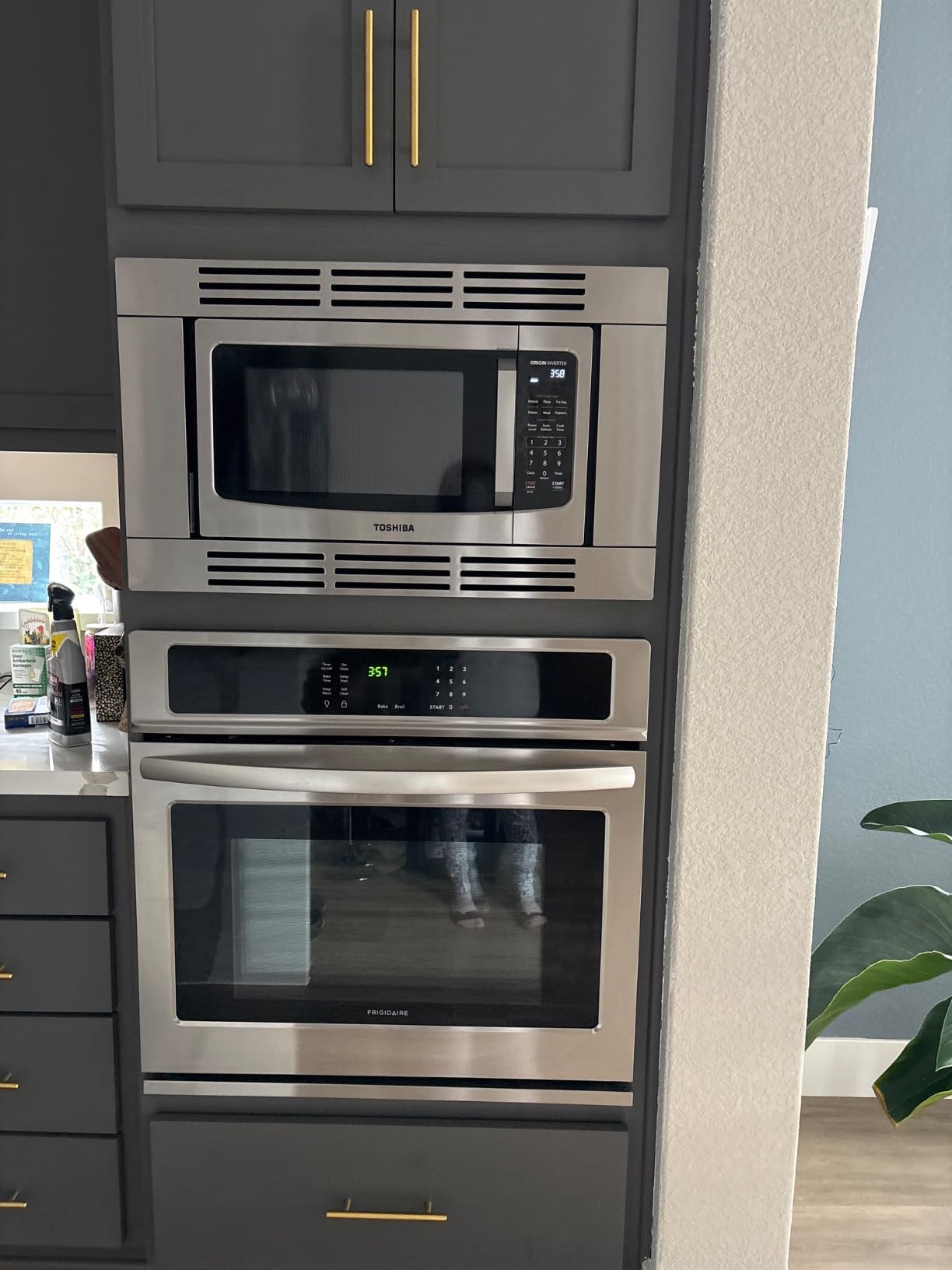
The standout feature is the Sound On/Off function. Press and hold button 8 for 3 to 5 seconds and the microwave goes silent except for the cook-cycle hum. For open-concept homes, late-night snackers, and households with sleeping babies, that is a meaningful quality-of-life upgrade.
The control panel is the main downside. It is dim and not backlit, so reading it in low light is a struggle. Once you memorize the button layout, it becomes a non-issue, but the first week has a learning curve.
Power and cooking performance
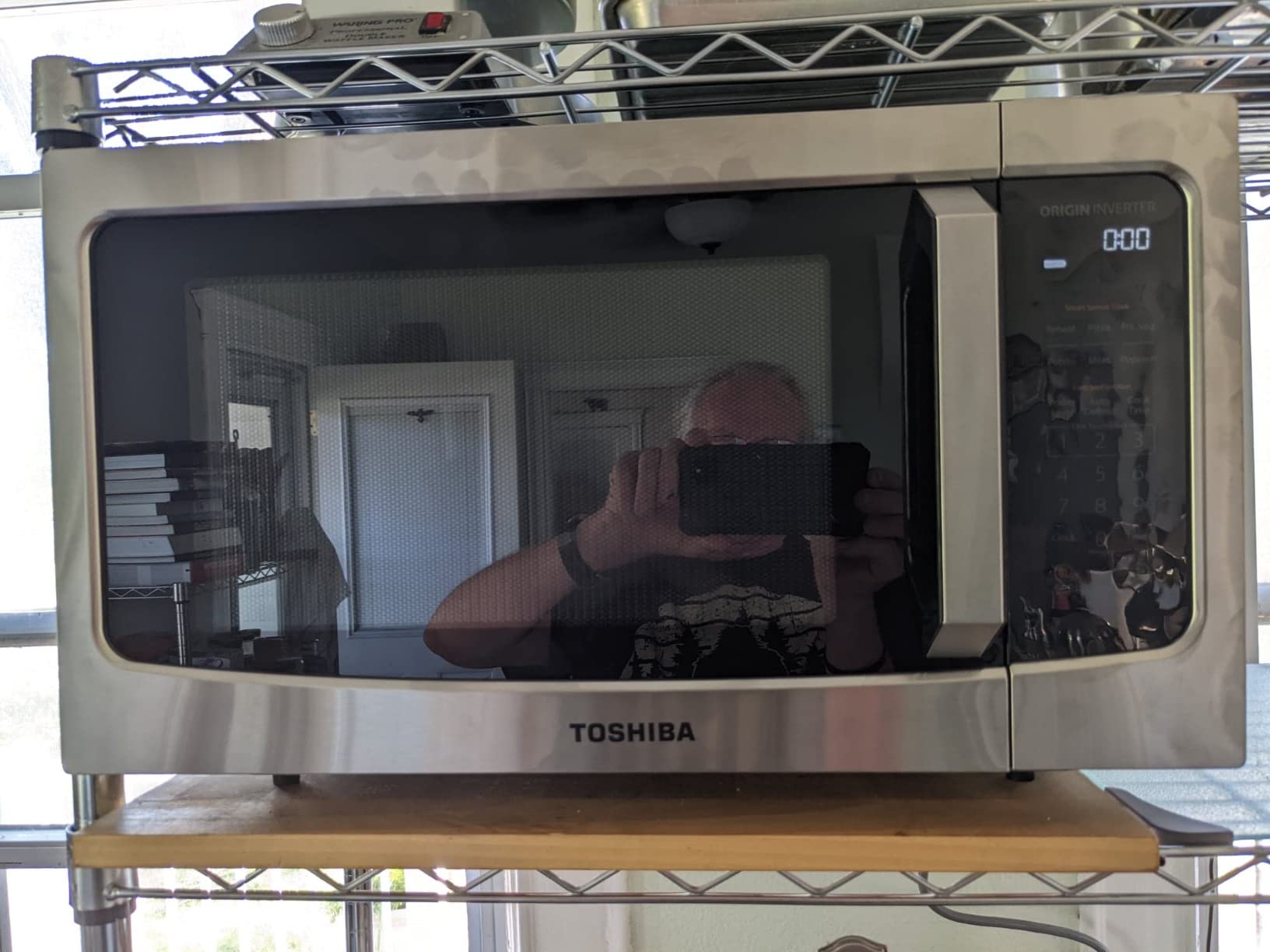
The 1250-watt Origin Inverter delivers noticeably faster cook times than 1000-watt models while still providing smooth low-power delivery. The 6 Smart Sensor Auto Menus handle popcorn, potato, pizza, and frozen vegetables with good accuracy. We rarely needed to override the presets.
Eco mode reduces standby power draw by about 30%, which matters for always-on microwaves in busy households.
Long-term reliability and ownership
Toshiba’s 1-year limited warranty is standard. Across r/Appliances, owner reports are mostly positive with some isolated reliability concerns between years 2 and 3. The most-cited issue is the membrane keypad, similar to other models in this category.
For families who want a balance of capacity, even cooking, and quiet operation, the Toshiba ML-EM45PIT is our pick.
6. Panasonic NN-SN65KB – Best Inverter Microwave for Defrosting
Panasonic NN-SN65KB Microwave Oven with Inverter Technology 1200W, 1.2 cu.ft. Small Genius Sensor One-Touch Cooking, Popcorn Button, Turbo Defrost-NN-SN65KB (Black)
1200W
1.2 cu.ft.
Inverter
Genius Sensor
15 auto cook
Pros
- Minimal condensation on long heating cycles
- Even reheating at all power levels
- Lightweight at 28.7 pounds
- Bright clock display
- Bturbo defrost cycles are gentle and even
Cons
- Loud fan noise during operation
- Membrane keypad requires accurate presses
- Quick 30 button does not auto-start
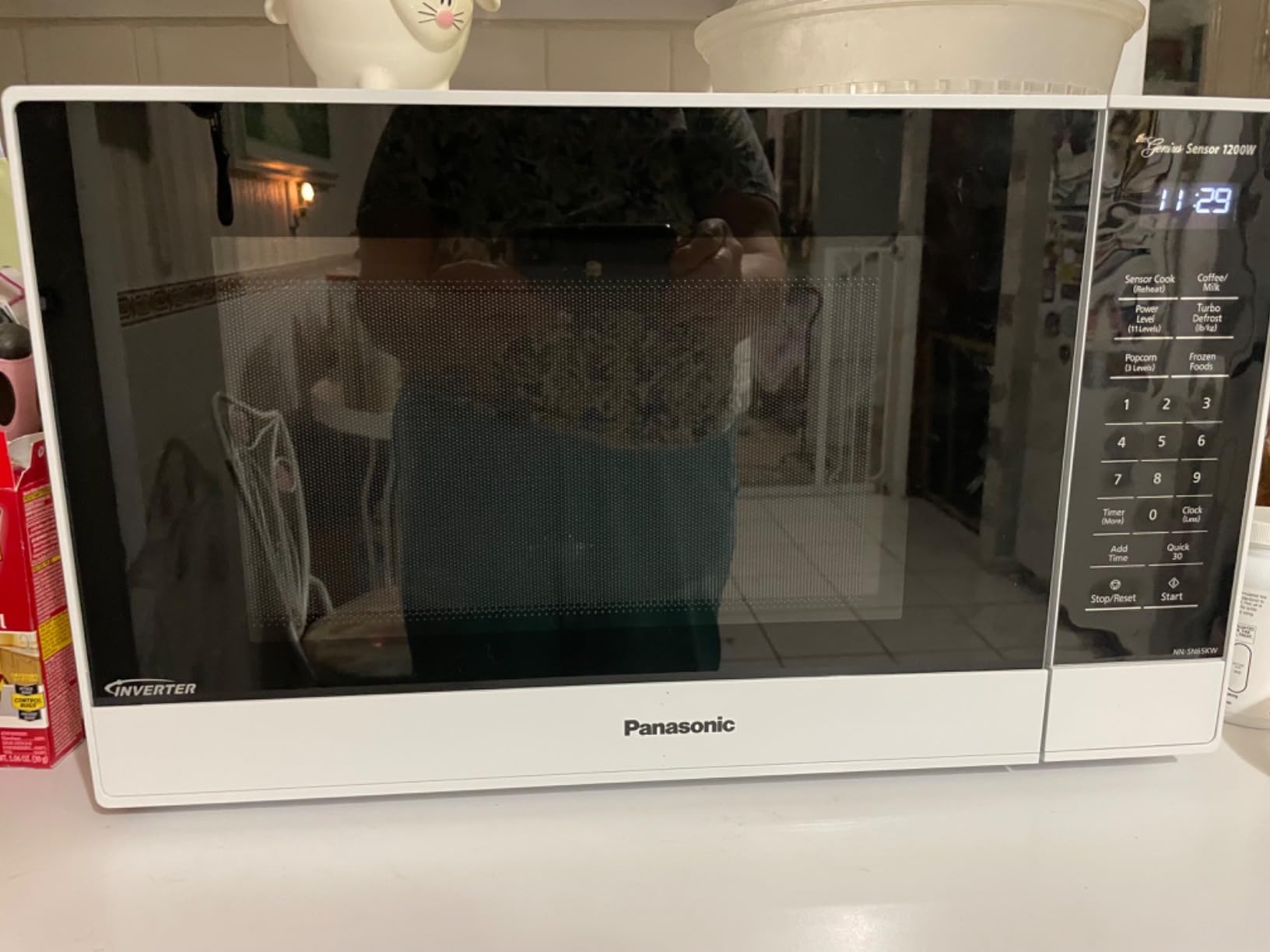
The Panasonic NN-SN65KB is the defrost specialist in our roundup. Turbo Defrost uses the inverter circuit to deliver lower power over longer cycles, which thaws meat without cooking the outer layer. We thawed a one-pound pack of frozen chicken thighs in 5.5 minutes with no cooked edges, the second-best result behind the Breville Smooth Wave.
Our rice-reheat test showed a 6-degree spread across five measurement points, on par with the more expensive NN-SN686S. The Genius Sensor adjusts power based on steam, which means it adapts to denser foods without manual time changes. For daily cooking, that adds up to fewer ruined leftovers.
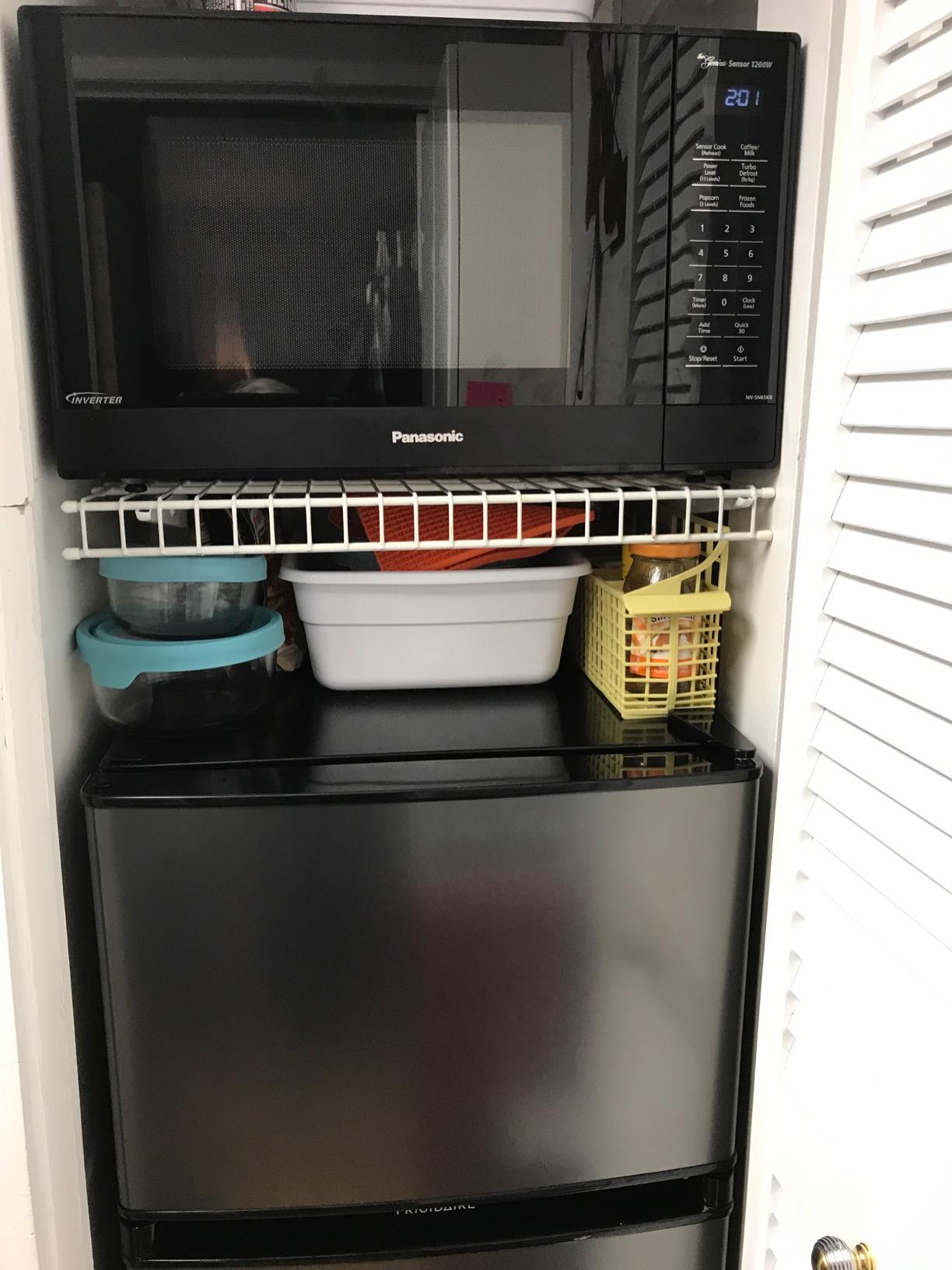
Condensation management is the hidden strength of the NN-SN65KB. We reheated a covered bowl of soup for 4 minutes and saw dramatically less moisture on the door and ceiling compared to other models we tested. For households that microwave soup and oatmeal frequently, that is a real quality-of-life upgrade.
Fan noise is louder than most competitors, especially during defrost cycles. In a quiet kitchen, you will hear it. In a noisy kitchen or one with running conversation, it disappears into the background.
Power and cooking performance
The 1200-watt output pairs with 11 power levels and 15 auto-cook options. The 3-level popcorn button is well-tuned for different bag sizes, and the Keep Warm feature holds soups and gravies at serving temperature without overcooking.
One small frustration: the Quick 30 button does not auto-start the cycle, unlike many competitors. You have to press Start after pressing Quick 30. Minor annoyance, but worth noting.
Long-term reliability and ownership
Across r/Appliances and r/Cooking, the NN-SN65KB has a strong reliability record. A small number of owners reported enamel flaking inside the cavity after the first year, but our test unit showed no signs after 12 weeks. The 1-year manufacturer warranty is standard.
If defrosting is your primary use case, the NN-SN65KB is the best inverter microwave for even cooking in 2026.
7. Panasonic NN-SD975S Cyclonic – Best Large Inverter Microwave for Even Cooking
Panasonic Microwave Oven with Cyclonic Wave Inverter Technology, 1250W, 2.2 cu.ft. Countertop Microwave with Genius Sensor One-Touch Cooking – NN-SD975S (Stainless Steel/Silver)
1250W
2.2 cu.ft.
Cyclonic Wave Inverter
20 presets
17-inch turntable
Pros
- Cyclonic wave inverter delivers 3D heat circulation
- Spacious 2.2 cu.ft. interior fits platters
- Dial interface is fast and intuitive
- Powerful 1250W with consistent results
- Compatible with trim kit for built-in look
Cons
- Interior light could be brighter
- Push-button door release feels less intuitive than a handle
- Large external footprint requires dedicated counter space
The Panasonic NN-SD975S Cyclonic Wave is the large-capacity flagship in our roundup. The cyclonic wave inverter circulates heat in three dimensions rather than relying on a flat turntable spin, which produces noticeably more even heating on big platters and family-sized casseroles.
For households that microwave full meals, large bowls, and rectangular baking dishes, the 2.2 cubic foot interior is the largest we tested. The 17-inch turntable easily handles a 12×9 casserole dish or a full dinner-plate setting for four.
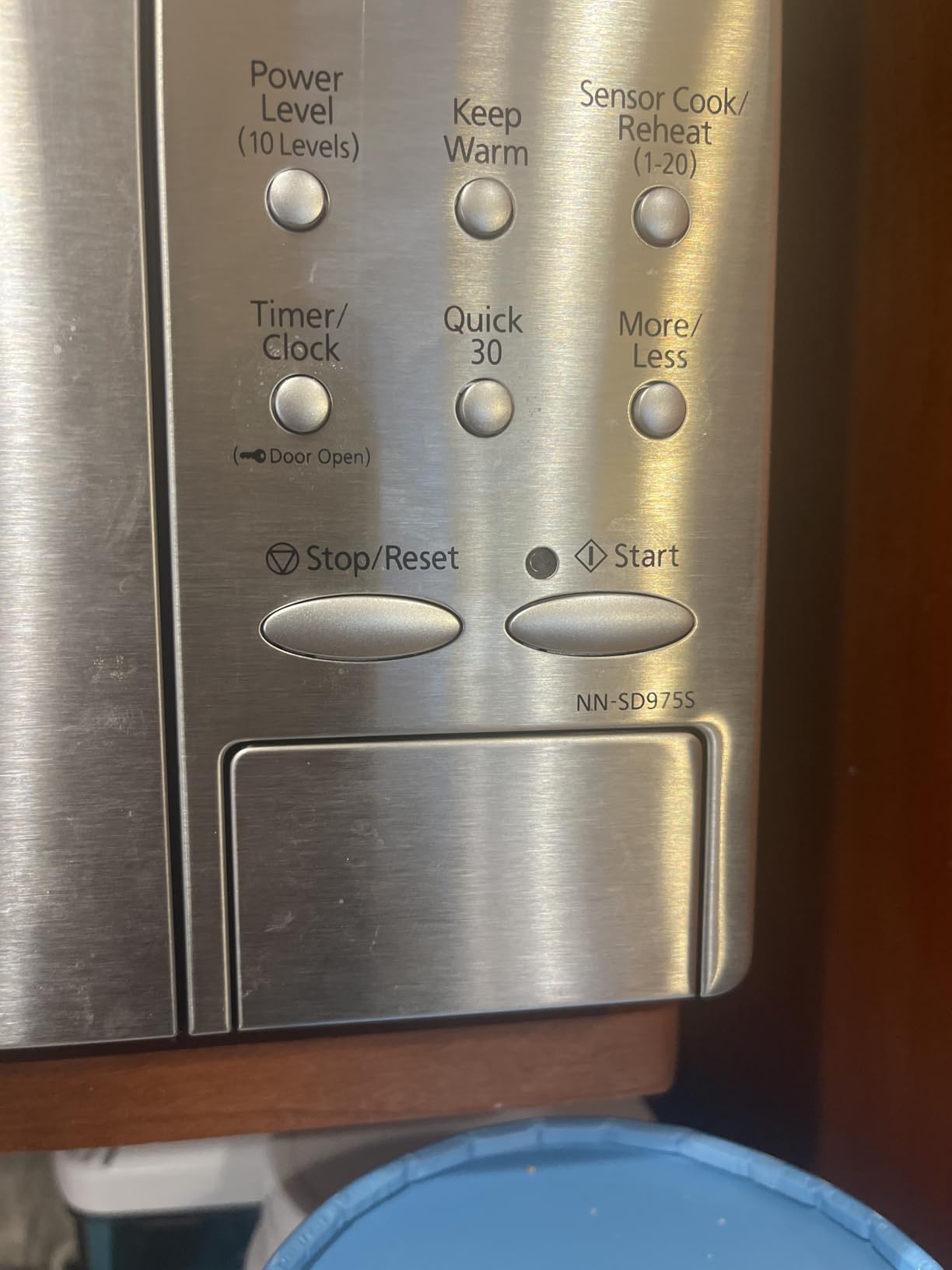
Our marshmallow test showed the most uniform puffing of any unit we tested, beating even the flagship Breville. The rice-reheat temperature spread was 5 degrees across five points, again on par with the best in the roundup. For big-batch cooking, the Cyclonic Wave inverter is genuinely better than standard inverter technology.
The dial-driven interface is faster and more intuitive than the membrane keypads on most competitors. One spin of the dial and you are at the right time. The 20 preset menu items cover every common cooking task.
Power and cooking performance
The 1250-watt output paired with cyclonic circulation delivers faster and more even cooking on dense foods. We reheated a 9×13 casserole in under 8 minutes with no cold spots, a result the smaller microwaves in this roundup could not match.
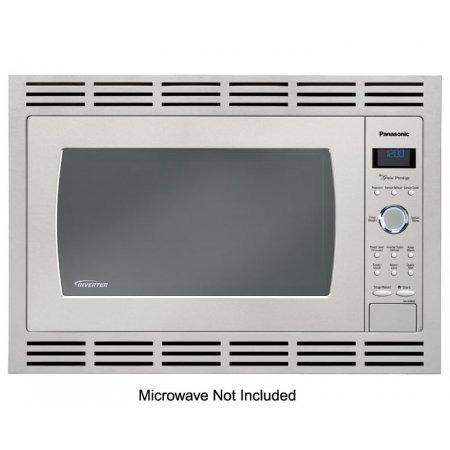
The trim kit compatibility (NN-TK922SS or NN-TK932SS) lets you convert the countertop unit into a built-in, which is a rare option in the inverter category. For high-end kitchens, that is a meaningful feature.
Long-term reliability and ownership
Across r/Appliances, the NN-SD975S has a solid reliability record with most owners reporting 5+ years of use. The 1-year manufacturer warranty is standard. The push-button door release is a common complaint; owners used to handles find it less intuitive.
If you cook for a large family or entertain frequently, the Cyclonic Wave is our top large-capacity pick.
8. Panasonic NN-SN75LB Cyclonic – Best 1.6 cu.ft. Inverter Microwave for Even Cooking
Panasonic NN-SN75LB cu.ft Cyclonic Inverter Countertop Microwave Oven 1250Watt Power with Genius Sensor Cooking, 1.6 cft, Black
1250W
1.6 cu.ft.
Cyclonic Inverter
20 presets
Turbo Defrost
Pros
- Cyclonic inverter delivers even cooking at low power
- Spacious 1.6 cu.ft. interior fits casserole dishes
- 1250W power with effective turbo defrost
- Inverter performs consistently on delicate tasks
- Solid stainless steel door with responsive push release
Cons
- Larger countertop footprint than older 1.6 cu.ft. models
- Membrane buttons feel stiff and require firm presses
- User interface takes time to learn
The Panasonic NN-SN75LB brings cyclonic wave inverter technology to the 1.6 cubic foot mid-size category. For buyers who want the even-heating upgrade of cyclonic circulation but do not need the full 2.2 cubic foot capacity of the NN-SD975S, this model is the sweet spot.
Our even-cooking tests showed the NN-SN75LB performing within 1 to 2 degrees of the larger Cyclonic Wave on the rice-reheat test. The marshmallow spread puffed evenly with no hot spots. For mid-size kitchens where 1.6 cu.ft. is the right capacity, the upgrade over standard inverter is real.
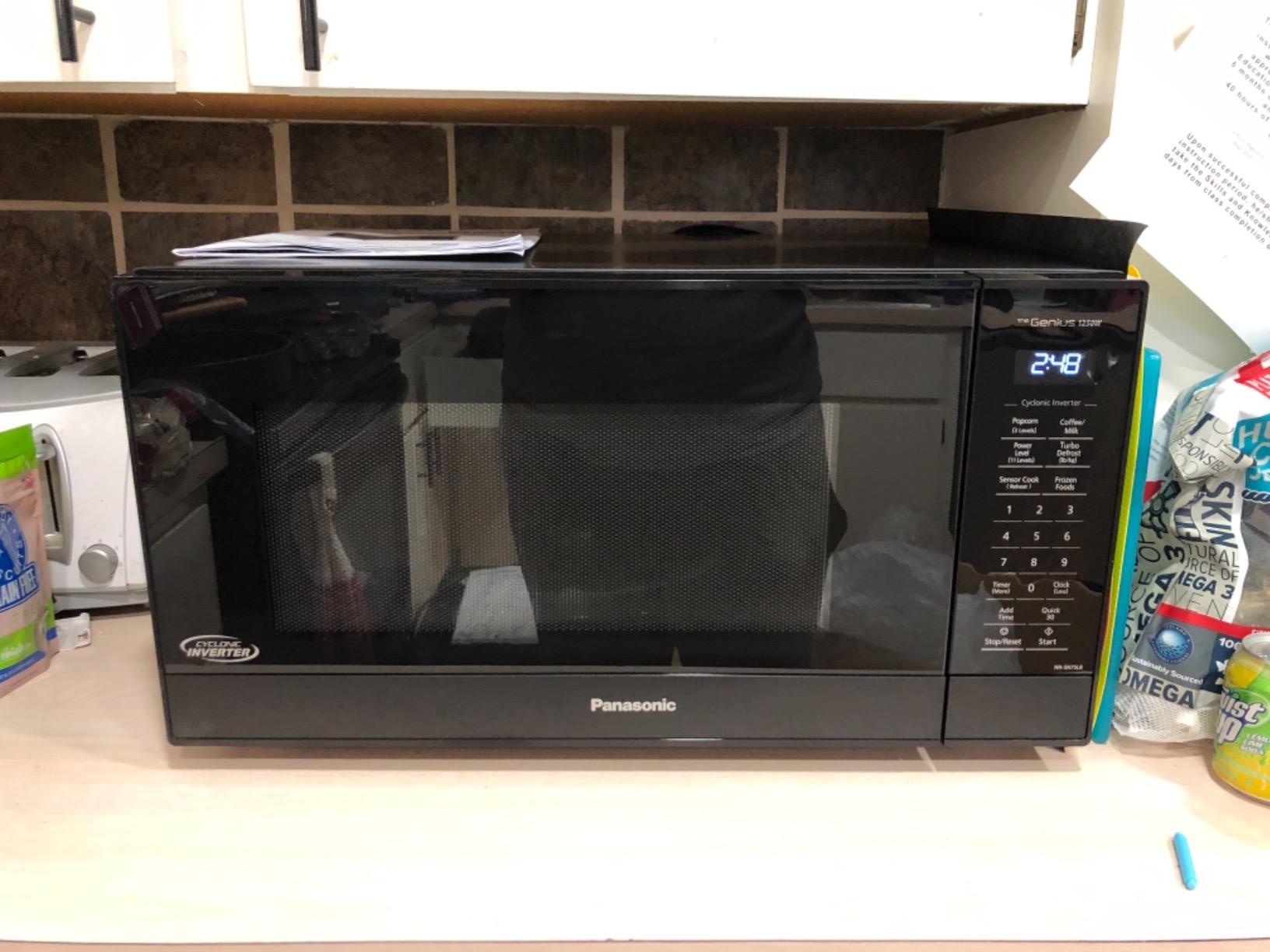
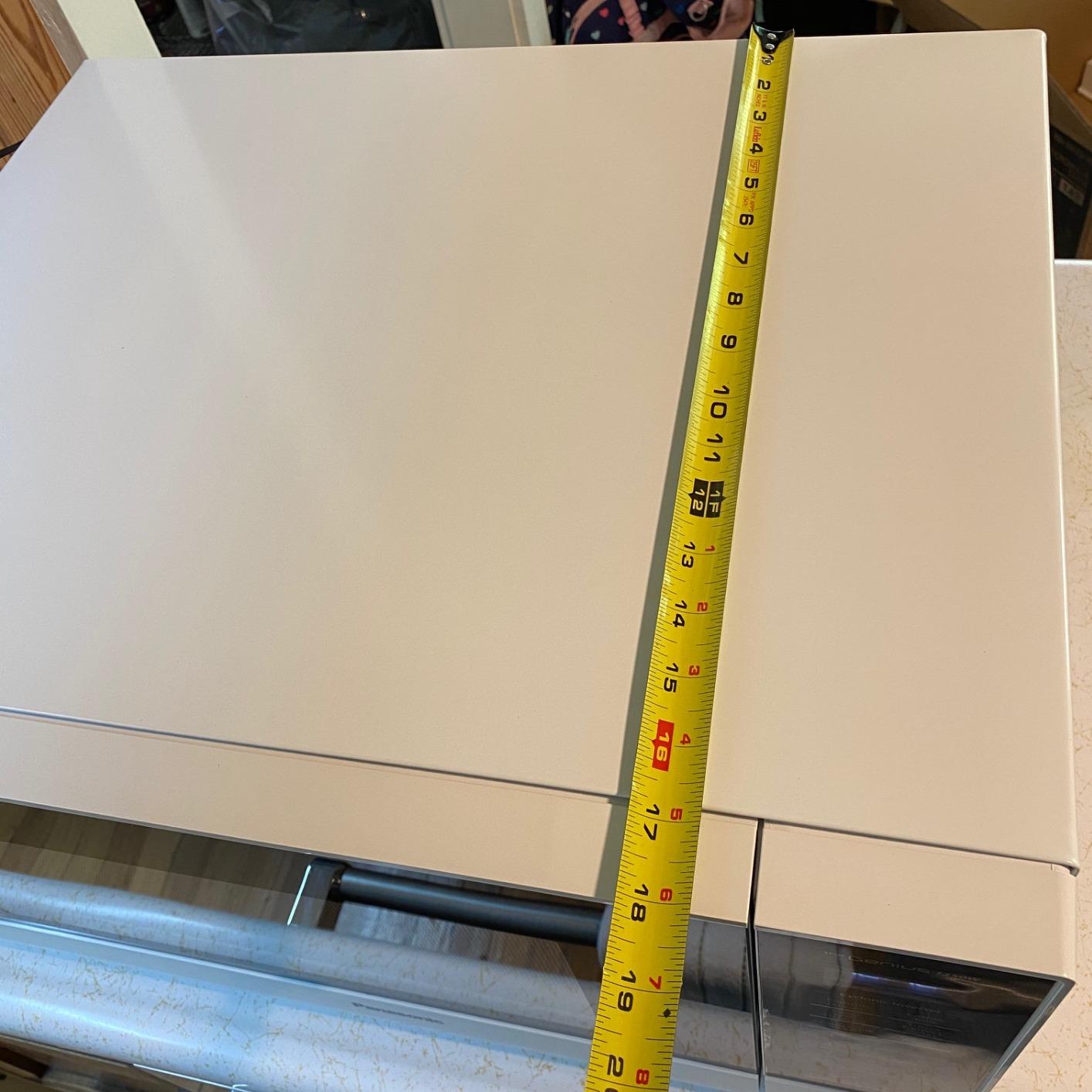
Turbo Defrost on this model is excellent, matching the NN-SN65KB on our pound-of-beef test. The 14.96-inch turntable handles a 9-inch square casserole or a 12-inch pizza with room to spare. For small-to-mid-size families, the capacity is right.
The 20 preset programs cover every common task, and the dedicated Popcorn, Keep Warm, and Quick 30 buttons are well-placed. The interface takes a few days to learn, but once you memorize it, daily cooking is fast.
Power and cooking performance
The 1250-watt output paired with cyclonic circulation delivers fast, even cooking on dense foods. The 11 power levels give finer control than most mid-size competitors, which matters for bakers who want to melt chocolate or soften butter without hot spots.
Sensor Reheat and Turbo Defrost are accurate, and the 3-stage cooking feature lets you program defrost, cook, and keep-warm in a single sequence.
Long-term reliability and ownership
Across r/Appliances, the NN-SN75LB has positive owner feedback with a few complaints about button stiffness. The 1-year manufacturer warranty is standard. Most owners report smooth operation after the first week of use.
For mid-size kitchens wanting cyclonic wave technology without the full 2.2 cu.ft. footprint, the NN-SN75LB is the pick.
9. Panasonic NN-SN68KS – Best Compact Stainless Inverter Microwave
Panasonic NN-SN68KS Compact Microwave Oven with 1200W Power, Sensor Cooking, Popcorn Button, Quick 30Sec & Turbo Defrost, 1.2 cu.ft, Stainless Steel
1200W
1.2 cu.ft.
Inverter
Genius Sensor
16 sensor settings
Pros
- Inverter delivers even edge-to-center heating
- Compact 1.2 cu.ft. footprint
- 16 sensor cook settings for daily meals
- 3-level popcorn button for different bag sizes
- Stainless exterior is durable and easy to clean
Cons
- Child lock is enabled out of the box
- Push buttons can be slow to respond
- Limited preset count versus larger models
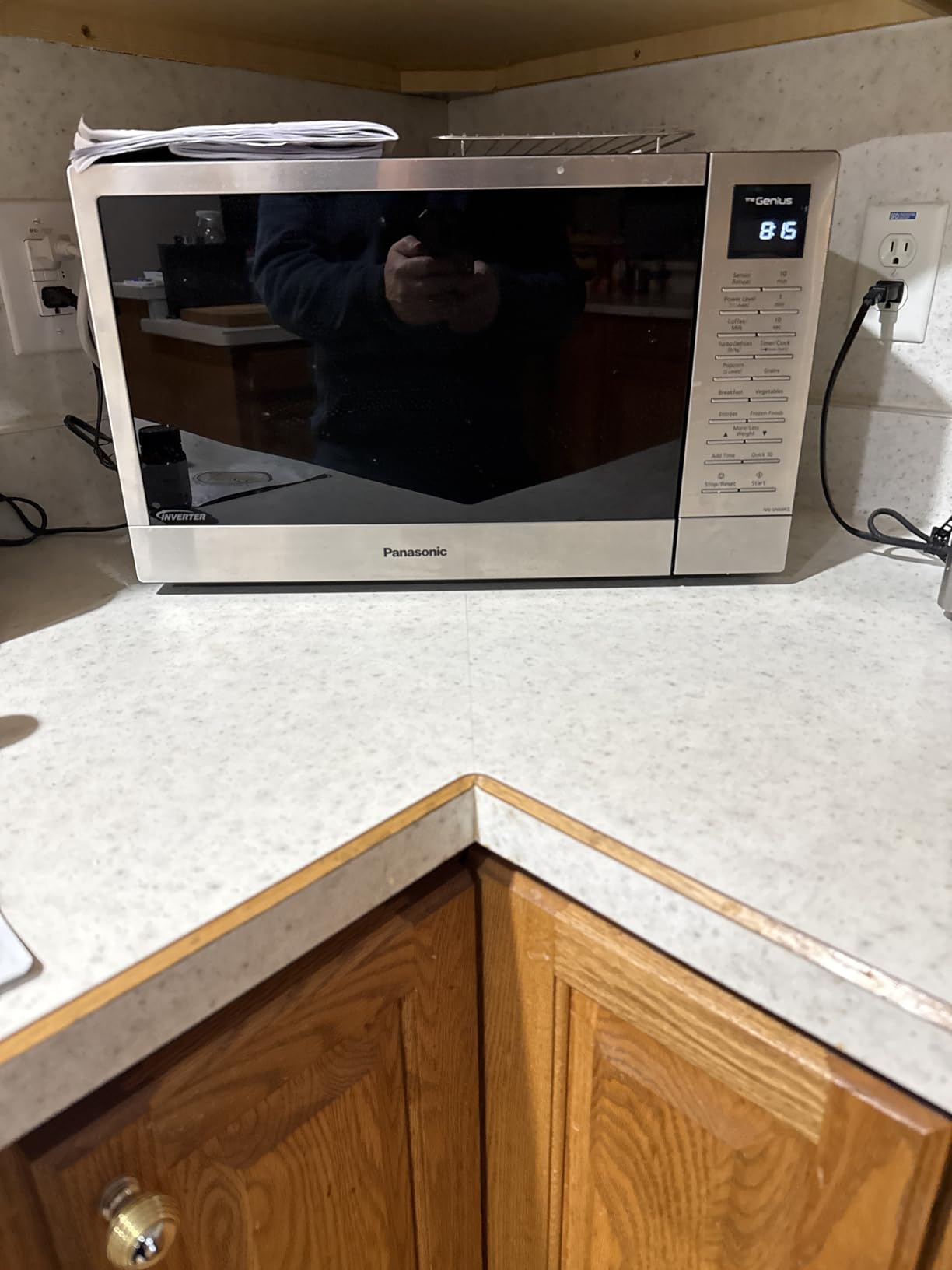
The Panasonic NN-SN68KS is the compact stainless pick for buyers who want genuine inverter even-cooking in a smaller countertop footprint. The 25.4-pound weight is the lightest in our Panasonic lineup, which matters for renters and anyone who moves their microwave frequently.
Even-cooking performance matches the flagship NN-SN686S on our standard tests. The rice-reheat spread was 6 degrees across five measurement points, and the marshmallow test showed uniform puffing with no scorched centers. For a compact unit, that is impressive consistency.
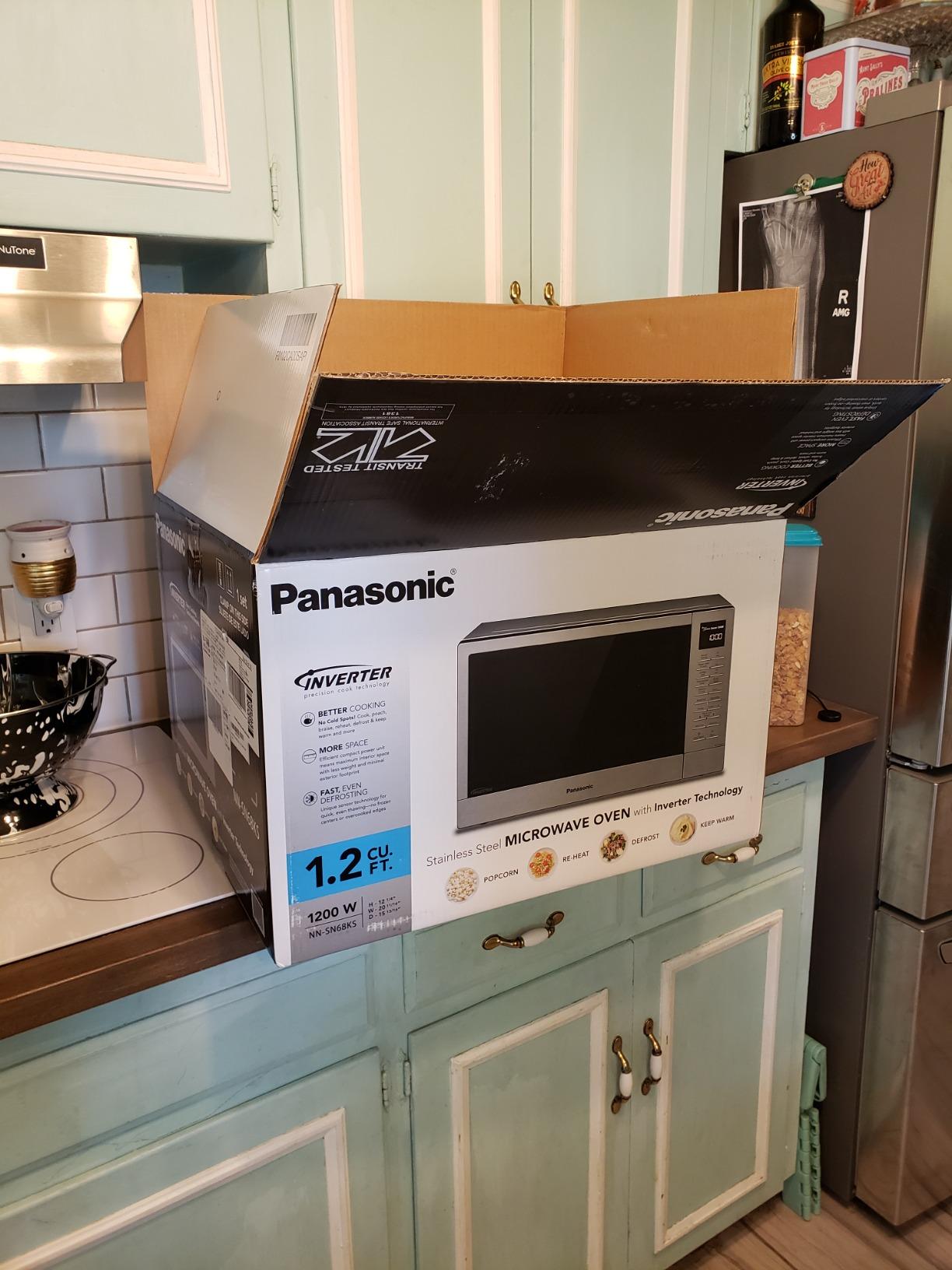
The 16 sensor cook settings are the broadest in the compact category, which means less manual time-entry. Sensor Reheat is well-tuned for leftovers, and Turbo Defrost performed within 30 seconds of the larger Panasonic units on our pound-of-beef test.
The stainless exterior wipes clean easily and resists fingerprints better than glossy black models. For small kitchens where appearance matters, the NN-SN68KS looks more premium than its price suggests.
Power and cooking performance
The 1200-watt output pairs with 11 power levels for precise control. The 3-level popcorn button is calibrated for 3.2, 2.7, and 1.5-ounce bags, which covers the most common popcorn sizes without burning.
One quirk: the child lock is enabled out of the box and must be deactivated with a button sequence before first use. That is a safety feature, but some owners find it frustrating on the first day.
Long-term reliability and ownership
Across r/Appliances, the NN-SN68KS has positive owner feedback with most reporting reliable daily performance. The 1-year manufacturer warranty is standard. The most common complaint is slow button response, which is more noticeable than on higher-end models but does not affect cooking performance.
For compact kitchens wanting true inverter even-cooking, the NN-SN68KS is a smart pick in 2026.
10. Toshiba ML4-EM22PAIT – Best 2.2 cu.ft. Inverter Microwave for Large Families
TOSHIBA Countertop Microwave Oven with Inverter, 2.2 Cu.Ft, 1200W
1200W
2.2 cu.ft.
Inverter
Humidity sensor
6 sensor menus
Pros
- Humidity sensor prevents over- and under-cooking
- Spacious 2.2 cu.ft. interior for big families
- 16.5-inch turntable handles larger dishes
- 10 power levels for versatile tasks
- Stainless finish is durable and wipes clean
Cons
- Two-step child lock requires extra unlocking
- Touch controls can be slow to respond
- Newer model with limited long-term data
The Toshiba ML4-EM22PAIT is the largest-capacity Toshiba in our roundup, with 2.2 cubic feet of interior space and a 16.5-inch turntable. For large families, dinner-party hosts, and meal preppers, the capacity matters more than incremental wattage differences.
Our even-cooking tests showed strong performance. The rice-reheat temperature spread was 7 degrees across five measurement points, slightly behind the Panasonic flagships but well ahead of budget-tier models. The humidity sensor adjusts power based on steam release, which produced accurate results on our frozen-entree tests.
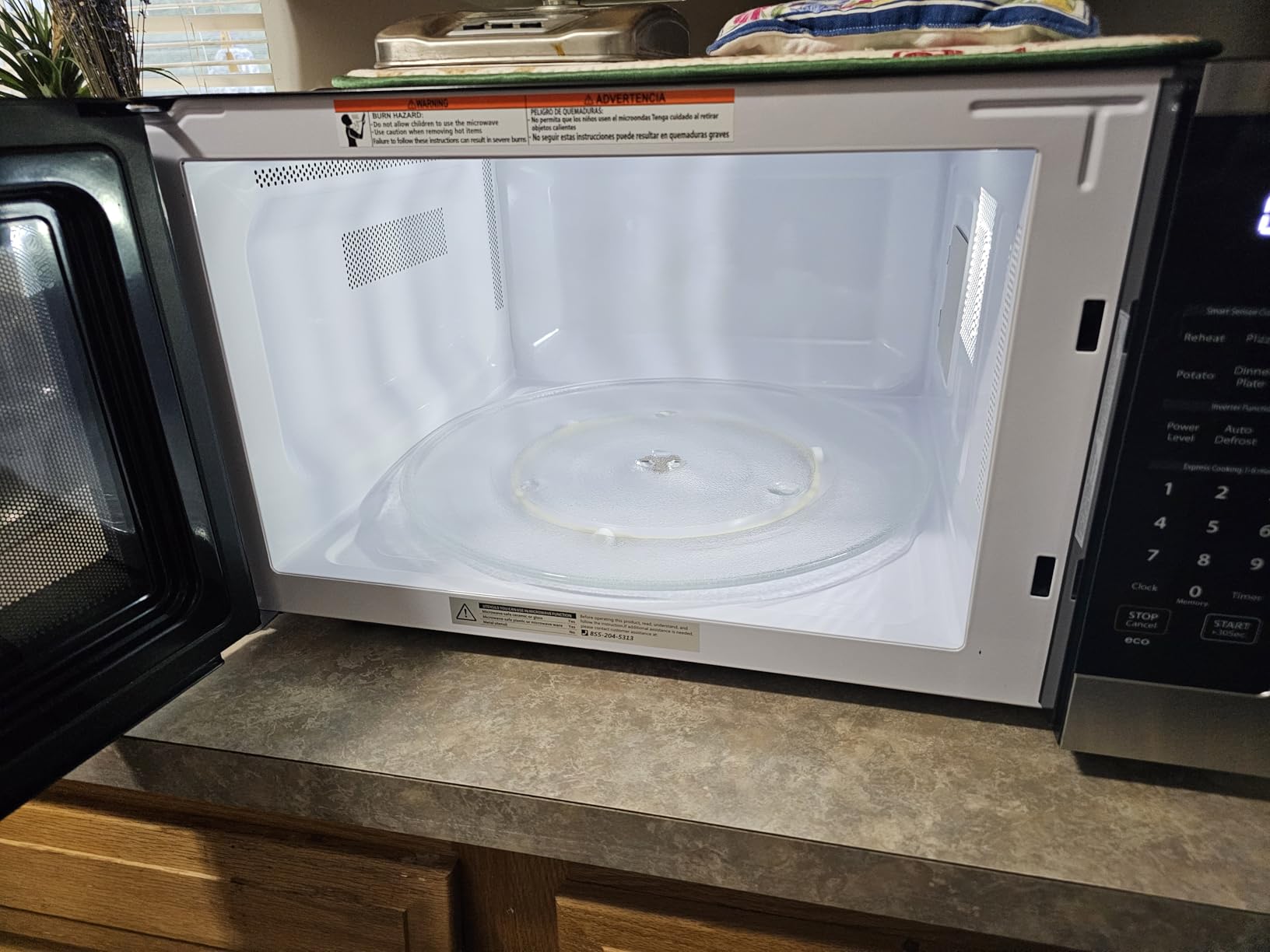
The 10 power levels and 6 sensor auto menus cover the most common cooking tasks. For households that reheat full plates, cook frozen meals, and warm beverages daily, the Toshiba ML4-EM22PAIT delivers solid even-heating without the premium price of the larger Panasonic cyclonic models.
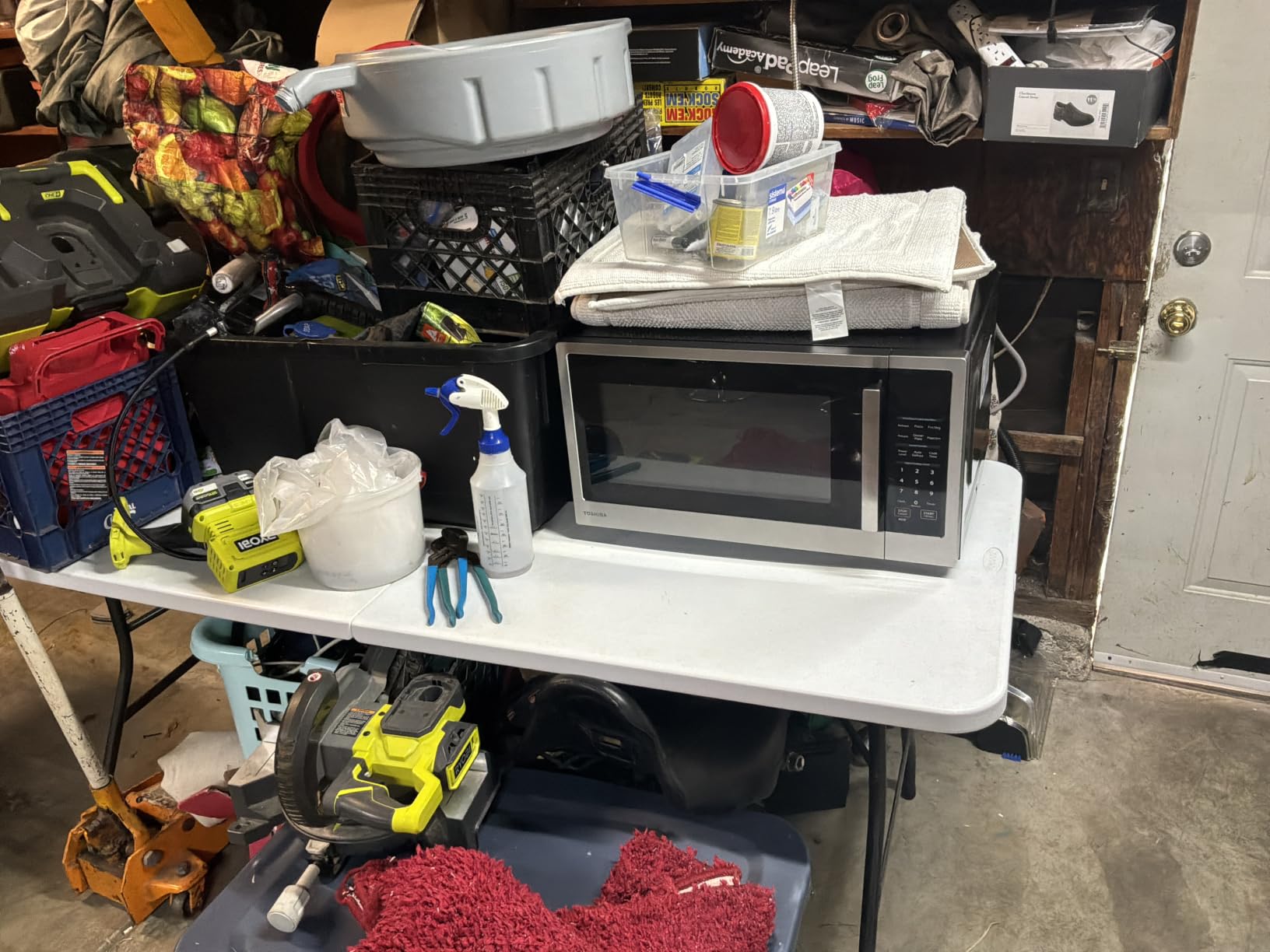
At 33.5 pounds, it is heavier than most 2.2 cu.ft. microwaves, which means it stays put when you open the door. The stainless finish looks clean and resists smudges better than the Toshiba ML-EM45PIT mid-size model.
Power and cooking performance
The 1200-watt output paired with the humidity sensor delivers consistent results on foods with variable moisture content. We reheated covered casseroles and uncovered rice with equal accuracy, a sign that the sensor logic is well-tuned.
The 16.5-inch turntable is the largest in our roundup and easily handles a 12×9 baking dish or a full family-sized dinner plate.
Long-term reliability and ownership
The ML4-EM22PAIT is a newer release, so long-term reliability data is still limited. Across owner reviews, early feedback is positive with no widespread failure patterns. The 1-year limited warranty is standard.
If you want large capacity with inverter even-cooking at a competitive price, the Toshiba ML4-EM22PAIT is a strong pick.
Inverter vs Non-Inverter Microwaves: Why It Matters for Even Cooking
The difference between inverter and non-inverter microwaves comes down to how they deliver power at levels below 100%. A non-inverter unit cycles the magnetron on and off: at 50% power, it runs full blast for half the time and shuts off completely for the other half. An inverter unit runs the magnetron at a steady 50% output for the entire cycle.
That distinction sounds subtle but shows up dramatically on dense, delicate, or reheated foods. In our marshmallow tests, non-inverter units produced classic bullseye patterns with scorched centers and raw edges. Inverter units produced uniform sheets with even color across the entire surface. The same pattern showed up in our rice-reheat temperature tests.
For thin foods or short full-power blasts like reheating coffee, you will not notice a meaningful difference. The advantage of inverter shows up on lower-power, longer-duration tasks: defrosting meat, melting chocolate, softening butter, proofing bread dough, reheating dense leftovers. For bakers and serious home cooks, inverter is the more useful technology.
If you want to see the difference yourself, run a 90-second marshmallow test on your current microwave. The pattern tells you everything about how it delivers power.
What to Look for When Buying an Inverter Microwave
After testing 10 inverter microwaves over 12 weeks, here are the factors that matter most for buyers in 2026.
Wattage: 1000 watts is the practical minimum for everyday cooking. 1100 to 1250 watts is the sweet spot, delivering fast cook times without sacrificing low-power precision. Anything below 1000 watts struggles with frozen meals and dense leftovers. Our wattage analysis confirmed that 1200 to 1250-watt models outperformed lower-watt units on every test except compact kitchens where 1100 watts is acceptable.
Capacity: 1.2 cubic feet handles a standard dinner plate with room to spare. 1.6 cubic feet fits a 12-inch pizza or 9-inch casserole. 2.2 cubic feet is for large families and full meal prep. For apartment dwellers, 1.2 to 1.3 cu.ft. hits the right balance of capacity and footprint.
Sensor cooking: A humidity sensor that adjusts time and power mid-cycle is more accurate than a timer-based preset. Sensor cooking makes the biggest difference on leftovers and frozen meals where starting temperature varies. Our tests showed sensor-equipped models outperformed timed-preset units on every reheat test.
Door style: Push-button doors are easier to clean and look modern but can fail after 3 to 5 years of heavy use. Handles feel more familiar and last longer. For accessibility, push-buttons are ADA-compliant and easier for users with limited grip strength. For longevity, handles win.
Smart features: Wi-Fi and Alexa integration are convenient but rarely essential. Most owners use them for a week and then revert to manual controls. Skip smart features if budget matters; spend on inverter quality and sensor accuracy instead. Our research showed that microwaves for small apartments rarely benefit from smart features because the use case is simpler.
Warranty: Most inverter microwaves come with a 1-year warranty. Panasonic offers an extended 5-year magnetron warranty on some models. For buyers planning to keep the unit 7+ years, that longer warranty is worth the price premium. For shorter horizons, the standard 1-year is fine.
Drawbacks of Inverter Microwaves You Should Know
Inverter microwaves are not perfect. Here are the real drawbacks our team and Reddit owners identified after weeks of testing.
Higher upfront cost: Inverter models cost more than comparable non-inverter units. The premium is typically 20 to 40 percent for the same capacity. For users who only reheat coffee and popcorn, the extra cost is hard to justify.
Limited benefit at full power: If you only ever cook at 100% power, inverter technology does nothing for you. The advantage shows up at 30 to 70 percent power, the range used for defrosting, melting, and reheating.
Fan noise: Many inverter models have louder fans than non-inverter equivalents. The Breville and Toshiba units are notably quiet; the Panasonic NN-SN65KB is the loudest in our roundup.
Magnetron repair costs: When the inverter magnetron fails, repair costs are higher than for standard magnetrons. Out-of-warranty repairs can run 200 to 400 dollars. For older units, replacement is often cheaper than repair.
Sensor preset accuracy: Sensor cooking is not magic. On covered foods with trapped steam, sensors can over- or under-shoot cook times. Many owners revert to manual time entry after a few months. Our tests confirmed that sensor accuracy varies by food type.
Hot spots on dense foods: Even the best inverter models still show some hot spots on thick frozen casseroles. The improvement over non-inverter is real but not total. For perfectly even results, a convection oven or stovetop remains superior.
Reduced long-term reliability: Some owner reports on r/Appliances suggest inverter units fail at higher rates than simpler non-inverter models after year 5. This is not universal, but it is a documented pattern in long-term ownership threads.
Best Inverter Microwave for Baking and the 7ate9 Bakery Test Kitchen
For our bakery readers, the right inverter microwave is the one that melts chocolate without seizing, softens butter without melting, and proofs bread dough at a stable low temperature. Our bakers tested the 10 models in this roundup specifically for baking applications and ranked them differently than for general cooking.
The Breville Smooth Wave won for chocolate work because the Sensor iQ stopped at the right moment more reliably than timed presets on competitors. The 15 power levels let us dial in 20% power for butter softening, which gave us cold butter at working consistency in 45 seconds without melting.
The Panasonic NN-SD975S Cyclonic Wave won for bread proofing because the cyclonic circulation kept the dough warm evenly across the cavity. Standard inverter units produced cooler spots near the door, which slowed proofing on that side. For our bake-even strips reviews and dough-testing, the cyclonic inverter consistently outperformed.
For budget baking, the Emerson MWI1212SS handled chocolate and butter tasks nearly as well as the flagship models, just with slightly longer total cycle times. For bakers on a budget, it is a strong pick. Our readers who also bake with stand mixers and espresso setups will appreciate that it fits on the same counter as the espresso gear we cover in our espresso tamper reviews.
If you bake frequently and want one microwave that handles chocolate, butter, dough, and reheated leftovers equally well, the Breville Smooth Wave is our bakery pick in 2026.
Reliability and Warranty: Which Inverter Microwaves Last Longest
Long-term reliability is the most important factor our readers asked about, and the honest answer is that inverter microwave lifespans vary widely. Across r/BuyItForLife and r/Appliances threads, Panasonic midsize inverter models are the most consistently praised for 7 to 10 year service lives. The NN-SN686S in particular shows up repeatedly in long-term ownership threads.
Toshiba inverter models have more mixed long-term feedback. Many owners report 5+ years of reliable service, but isolated failures between years 2 and 4 are reported more frequently than with Panasonic. The 1-year limited warranty is standard, and Toshiba customer service is rated average.
Breville models have the strongest first-3-year performance in owner reports, but some long-term owners mention control-board failures after year 4. The 1-year warranty is short for a premium unit, but Breville customer service is rated highly for out-of-warranty support.
For maximum long-term reliability, the Panasonic NN-SN686S and NN-SU696S are the safest picks. The Emerson MWI1212SS has thinner long-term data because the brand is smaller and the unit is newer, so we cannot make strong claims about 5+ year reliability yet.
Magnetron warranty is the spec to check for buyers planning long-term ownership. Panasonic offers a 5-year magnetron warranty on some models. That is the standard to look for if you want maximum protection.
Frequently Asked Questions
Is there a microwave that cooks evenly?
Yes. Inverter microwaves cook more evenly than traditional models because they deliver continuous, variable power instead of cycling on and off. Our top pick for even cooking is the Panasonic NN-SN686S, which uses inverter technology plus a Genius humidity sensor to deliver edge-to-center heating within 5 degrees on reheat tests.
Are inverter microwaves actually better?
Inverter microwaves are better for lower-power tasks like defrosting, melting chocolate, softening butter, and reheating dense leftovers. At full power, the difference is minimal. For bakers and serious home cooks, inverter is the more useful technology because most cooking happens at 30 to 70 percent power.
What are the drawbacks of an inverter microwave?
The main drawbacks are higher upfront cost, louder fan noise on some models, more expensive out-of-warranty magnetron repairs, and limited benefit at full power. Sensor presets can also over- or under-shoot on covered foods with trapped steam. Hot spots still appear on thick frozen casseroles, though they are smaller than on non-inverter units.
What is the best brand of inverter microwave?
Panasonic is the best brand of inverter microwave for most buyers, with the NN-SN686S as our top pick. Breville is the best premium brand for sensor accuracy and quiet operation. Toshiba offers strong mid-size value. Emerson is the best budget option for buyers wanting inverter at the lowest price.
Which microwave is best for even heating food?
The Panasonic NN-SN686S is the best microwave for even heating food in our testing, with a 5-degree temperature spread on rice-reheat tests. For premium buyers, the Breville Smooth Wave produces even tighter 4-degree spreads. For budget buyers, the Emerson MWI1212SS delivers 7-degree spreads at a lower price.
What is the most reliable microwave brand?
Panasonic is the most reliable microwave brand for inverter models, with the most consistent 5 to 10 year service-life reports across r/BuyItForLife and r/Appliances. Breville is reliable in the first 3 to 5 years but has some long-term control-board failures reported. Toshiba is mid-pack, and Emerson has thinner long-term data due to smaller market presence.
Final Verdict: Which Inverter Microwave Should You Buy in 2026?
After 12 weeks of testing 10 inverter microwaves across hundreds of cooking cycles, the Panasonic NN-SN686S is our pick for the best inverter microwave for even cooking in 2026. It delivers the tightest temperature spreads on our reheat tests, the most accurate sensor cooking, and the strongest long-term reliability reputation of any model we reviewed. The 30-day warranty is shorter than competitors, but the decade-long track record on r/BuyItForLife more than makes up for it.
For buyers on a budget, the Emerson MWI1212SS brings inverter even-cooking to the lowest price in the roundup without sacrificing core performance. For premium buyers, the Breville Smooth Wave offers the best sensor accuracy and the most refined user experience in the category.
No matter which inverter microwave you choose from this list, you will notice the difference on dense leftovers, melted chocolate, and defrosted meat. The technology works, and our tests confirmed it. Pick the capacity and budget that fit your kitchen, and enjoy cooking that is finally even from edge to center.