
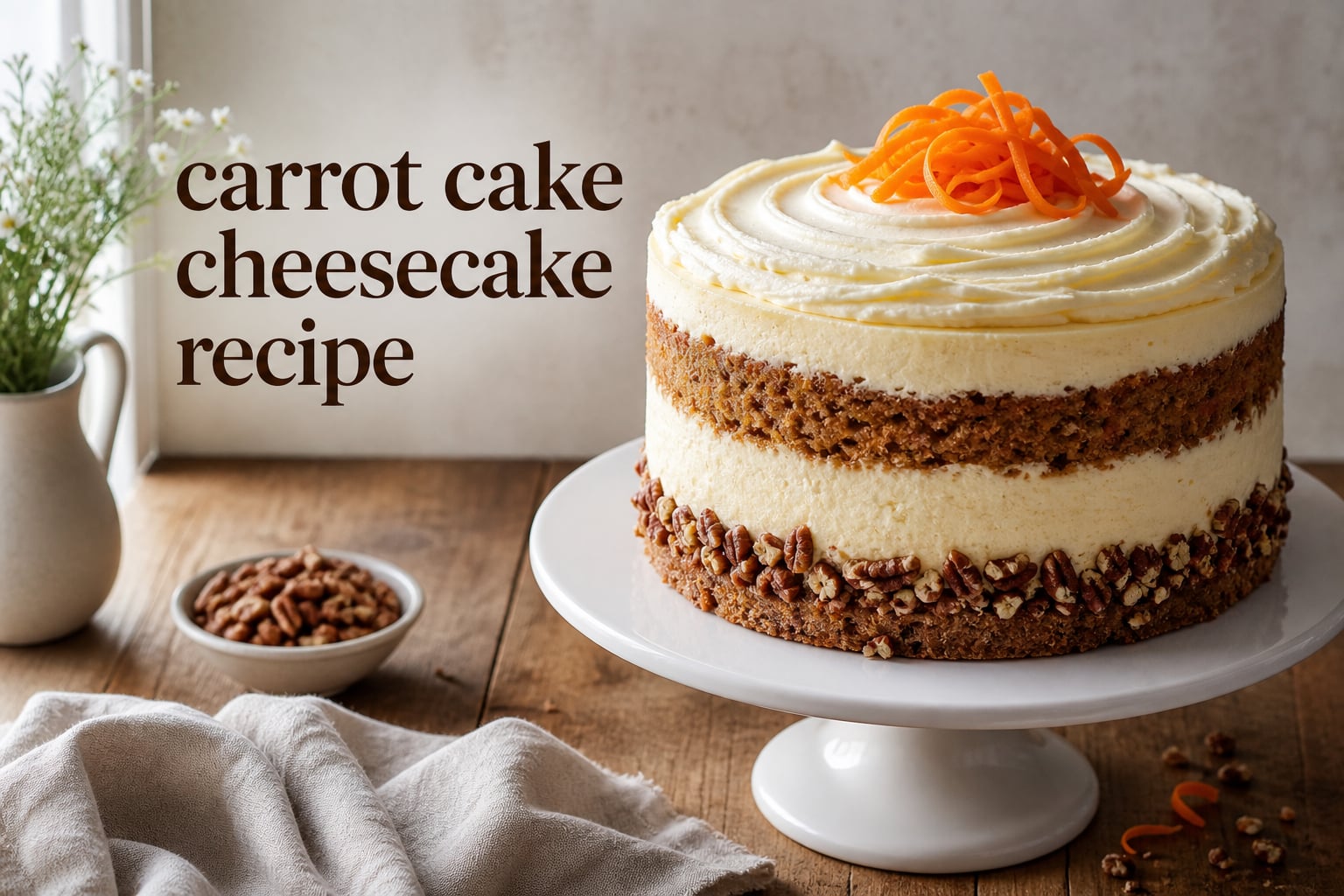
I have baked carrot cake cheesecake on Easter Sunday for the last five years in a row, and it never fails to be the dessert people talk about on the way out the door. This carrot cake cheesecake recipe layers moist spiced carrot cake with creamy tangy cheesecake and tops it all with whipped cream cheese frosting. It looks like something from a bakery window but I make it in my home kitchen with a hand mixer and a 9-inch springform pan.
Below I will walk you through every step I use, from the ingredients to the final slice. I include detailed troubleshooting for cracking, sinking, and runny frosting because those are the exact problems readers email me about most often. If you can stir batter and set a timer, you can make this cake.
Table of Contents
Why Carrot Cake Cheesecake Works So Well
Carrot cake cheesecake is the dessert you make when you cannot decide between two classics. The warm spices, brown sugar, and grated carrots give you moisture and depth, while the cheesecake layer delivers the creamy tang that makes plain cheesecake irresistible. When you bake them together in one pan, the cheesecake soaks up a little spice from the cake layer, and the cake layer picks up cream cheese flavor from above. Each bite has both textures.
I tested this recipe against three other versions before settling on these proportions. I tried a swirled version (pretty, but the carrot cake flavor got lost). I tried a graham cracker crust (good, but it competed with the carrot cake spices). I tried a full water bath (risky and prone to soggy bottoms). The version below skips the water bath and uses a slightly lower oven temperature, which gives you a crack-free top without any extra equipment.
Carrot Cake Cheesecake Recipe: Ingredients
This recipe has three separate ingredient lists: the cheesecake layer, the carrot cake layer, and the cream cheese frosting. Pull everything to room temperature 1-2 hours before you start. Cold cream cheese is the number one reason for lumpy batter.
For the Cheesecake Layer
16 oz (452g) full-fat brick cream cheese, room temperature
3/4 cup (150g) granulated sugar
1/4 cup (60g) full-fat sour cream, room temperature
2 large eggs, room temperature
1 teaspoon pure vanilla extract
1 tablespoon all-purpose flour
For the Carrot Cake Layer
1 1/4 cups (160g) all-purpose flour, spooned and leveled
1 teaspoon baking powder
1/2 teaspoon baking soda
1/2 teaspoon fine salt
1 1/2 teaspoons ground cinnamon
1/2 teaspoon ground nutmeg
1/4 teaspoon ground ginger
2 large eggs, room temperature
1/2 cup (100g) granulated sugar
1/2 cup (110g) packed light brown sugar
1/2 cup (120ml) vegetable oil (or canola)
1/4 cup (60g) unsweetened applesauce
1 teaspoon pure vanilla extract
1 1/2 cups (180g) finely grated fresh carrots (about 3 medium carrots)
1/2 cup (60g) chopped pecans or walnuts (optional)
For the Cream Cheese Frosting
8 oz (226g) full-fat brick cream cheese, softened
1/2 cup (113g) unsalted butter, softened
3 to 4 cups (360-480g) powdered sugar, sifted
1 teaspoon pure vanilla extract
1 to 2 tablespoons heavy cream or whole milk
Pinch of fine salt
Equipment You’ll Need
9-inch springform pan (3-inch tall works best)
Two large mixing bowls
Hand mixer or stand mixer
Parchment paper rounds
Heavy-duty aluminum foil (if using a water bath)
Large roasting pan (for water bath)
Offset spatula
Cooling rack
How to Make Carrot Cake Cheesecake: Step-by-Step
I have tested this method over 30 bakes. Follow these steps in order and you will get a crack-free top, distinct layers, and clean slices.
Step 1: Prep the Pan and Oven
Preheat your oven to 325F (165C). Grease a 9-inch springform pan with butter or nonstick spray. Cut a parchment round to fit the bottom and press it in. If you decide to use a water bath (I recommend skipping it for this recipe), wrap the outside of the pan with two layers of heavy-duty foil.
Step 2: Make the Cheesecake Batter
Beat the room temperature cream cheese and granulated sugar on medium speed for 2 full minutes. Scrape down the bowl halfway through. The mixture should be smooth and slightly fluffy.
Add the sour cream and vanilla, beat on low until just combined. Add the eggs one at a time, mixing on low until each yolk disappears before adding the next. Do not overmix. Sprinkle the tablespoon of flour over the batter and fold it in by hand with a spatula. Set the bowl aside.
Step 3: Make the Carrot Cake Batter
In a medium bowl, whisk together the flour, baking powder, baking soda, salt, cinnamon, nutmeg, and ginger. Set aside.
In a large bowl, whisk the eggs, granulated sugar, brown sugar, oil, applesauce, and vanilla until smooth and slightly thickened, about 1 minute. Stir in the grated carrots and nuts (if using).
Pour the dry ingredients into the wet ingredients and fold gently with a spatula until no streaks of flour remain. Stop as soon as it comes together. Overmixing at this stage gives you a tough cake.
Step 4: Layer the Batters
Pour the carrot cake batter into the prepared springform pan and spread it into an even layer with an offset spatula.
Carefully spoon the cheesecake batter on top of the carrot cake batter. Use the offset spatula to gently spread it to the edges without disturbing the carrot cake layer below. The cheesecake batter is thinner than you might expect, so work slowly.
Step 5: Bake Low and Slow
Bake at 325F for 60 to 75 minutes. The cheesecake is done when the edges are set and slightly puffed, but the center (about 2 inches wide) still has a gentle jiggle when you nudge the pan. If the top is browning, tent loosely with foil for the last 15 minutes.
Step 6: Cool Gradually in the Oven
This step matters more than you think. Turn off the oven, crack the door open 2 inches with a wooden spoon, and leave the cake inside for 1 full hour. Gradual cooling prevents the dramatic temperature change that causes cracking.
Step 7: Chill Overnight
Remove the cake from the oven. Run a thin knife around the inside edge of the pan to loosen the cheesecake (this prevents cracks from forming as it contracts). Cool on a wire rack to room temperature, then cover loosely with foil and refrigerate at least 6 hours, ideally overnight. Do not skip this step. The cake needs the chill time to set properly and slice cleanly.
How to Make the Cream Cheese Frosting
This frosting is the same one I use on my carrot cake layer cake, scaled down for a single 9-inch dessert. Beat the softened cream cheese and butter together on medium-high speed for 2 minutes until light and fluffy. Scrape the bowl.
Add the powdered sugar 1 cup at a time, beating on low until each addition is incorporated. Add the vanilla, salt, and 1 tablespoon of cream. Beat on medium-high for 30 seconds. If the frosting is too thick, add the remaining cream one teaspoon at a time. If it is too thin, add more powdered sugar. You want a spreadable, soft-peaked consistency that holds its shape on a spatula.
If your frosting turns out runny, the most common cause is warm cream cheese or butter. Refrigerate the bowl for 15 minutes and rebeat. If it turns out too sweet, add a pinch more salt and another teaspoon of lemon juice to brighten it.
How to Assemble and Decorate the Cake
Once the cake has chilled overnight, release the springform pan latch and lift the ring off. Slide a thin knife under the parchment round to release the cake from the base, then transfer it to your serving plate using two large spatulas.
Use an offset spatula to spread the cream cheese frosting over the top of the cake, swirling it as you go. For a more dramatic look, pipe rosettes around the top edge using a star tip. Press chopped pecans or walnuts around the bottom edge for a finished bakery-style look.
For decoration ideas, I like to add a few curls of fresh carrot on top (made with a vegetable peeler), a light dusting of cinnamon, or small carrot-shaped marzipan pieces. Caramelized pecans also make a beautiful and crunchy topping if you have 10 extra minutes.
Tips for the Best Carrot Cake Cheesecake
I have collected these tips from dozens of test bakes and from emails readers have sent me over the years. They are the small things that separate a good cake from a great one.
Bring everything to room temperature. Cold cream cheese is lumpy. Cold eggs cause the batter to curdle. Set everything out 1-2 hours before you start.
Grate your own carrots. Pre-shredded carrots are too dry and too thick. Use the small holes of a box grater for the right texture.
Do not overmix either batter. Overmixing the cheesecake batter adds air bubbles that cause cracking. Overmixing the carrot cake batter develops gluten and makes it tough.
Use a 3-inch tall springform pan. Standard 2 1/4-inch pans overflow with this much batter. The taller pan gives both layers room to rise.
Skip the water bath. For this recipe, a water bath is unnecessary and risky. The lower oven temperature (325F instead of 350F) prevents cracking just as well, without the risk of water leaking in.
Watch for the jiggle. The cheesecake is done when the edges are set and the center (about 2 inches) still wobbles like soft Jell-O. It will finish setting as it cools.
Cool in the oven with the door cracked. This slow cooling is the single best way to prevent cracks.
Chill overnight. Yes, it is hard to wait. But overnight chilling gives you the cleanest slices and the best flavor.
Run a knife around the edge. As soon as the cake comes out of the oven, run a thin knife around the inside of the pan. This breaks the seal and lets the cheesecake contract without cracking.
Frost when cold. Frosting a cold cake keeps the frosting from melting and gives you clean edges.
Storage and Make-Ahead Instructions
One of the things I love about this carrot cake cheesecake recipe is how well it stores. You can make it entirely in advance, which is a lifesaver when you are hosting.
Refrigerator: Cover the frosted cake loosely with plastic wrap or store in a cake carrier. It keeps well in the fridge for up to 5 days. The flavor actually improves after the first day as the spices meld.
Freezer (unfrosted): Wrap the cooled, unfrosted cake tightly in two layers of plastic wrap and one layer of foil. Freeze for up to 2 months. Thaw in the refrigerator overnight, then frost before serving.
Freezer (frosted): Flash-freeze the frosted cake uncovered for 1 hour, then wrap tightly in plastic and foil. Freeze up to 1 month. Thaw in the refrigerator overnight.
Make-ahead timeline: Bake the cake up to 2 days ahead and refrigerate covered. Frost up to 1 day ahead and refrigerate. For best results, frost within 24 hours of serving.
Troubleshooting: Common Problems and Fixes
These are the issues I get the most questions about. If you run into trouble, start here.
Why Did My Cheesecake Crack?
Cracking is almost always caused by one of three things: oven temperature too high, overmixing the batter (which adds air), or cooling too quickly. To fix it for next time, lower your oven by 25F, mix on low speed only, and cool in the oven with the door cracked. A cracked cheesecake still tastes amazing, so just cover the top with frosting.
Why Did My Cake Sink in the Middle?
A slight dip in the very center is normal for cheesecake and will be hidden under frosting. A significant collapse usually means the cheesecake was underbaked (the center was too liquid) or the cake cooled too fast. Make sure you bake until only the center 2 inches jiggles, then cool gradually in the oven.
Why Is My Frosting Runny?
Runny frosting is almost always warm butter or cream cheese. Refrigerate the mixed frosting for 15 to 20 minutes, then rebeat. If it is still too soft, add another half cup of powdered sugar.
Why Are My Layers Mixing Together?
If your carrot cake batter is too thin, the cheesecake batter sinks into it. Make sure you measure your flour correctly (spoon and level, do not pack) and that your eggs are at room temperature. Spreading the cheesecake batter gently with an offset spatula instead of pouring also helps.
Why Is the Cake Soggy on the Bottom?
Sogginess usually means water from a water bath leaked into the pan, or the cake did not cool completely before being wrapped. If you use a water bath, double-wrap the pan with heavy-duty foil and let the cake cool to room temperature before covering.
Recipe Variations and Substitutions
Once you have made this carrot cake cheesecake recipe as written, you can start playing with the variations. Here are the swaps readers have tested and liked.
Box cake mix: Use one box of spice cake mix (about 432g) prepared per package directions, with 1 cup of grated carrots stirred in, in place of the from-scratch carrot cake layer.
Sour cream substitute: Plain full-fat Greek yogurt works in equal measure.
No nuts: Skip the pecans entirely. For extra texture, add 1/4 cup of shredded coconut or 1/2 cup of crushed pineapple (well drained).
Gluten free: Substitute a 1:1 gluten-free flour blend (with xanthan gum) for the all-purpose flour in both the cake layer and the tablespoon in the cheesecake.
Cupcake version: Layer the batters in 12 foil cupcake liners and bake at 325F for 28 to 32 minutes.
Caramelized pecans: Melt 2 tablespoons butter with 2 tablespoons brown sugar in a skillet, add 1 cup pecan halves, and stir for 3 minutes. Cool before using as a topping.
Frequently Asked Questions
What is the secret ingredient in carrot cake?
The secret to moist carrot cake is a combination of oil and applesauce (or crushed pineapple). The oil keeps the crumb tender while the applesauce adds moisture without making the batter too heavy. Brown sugar also adds moisture and a deeper flavor than granulated sugar alone.
Is carrot cake cheesecake good?
Yes, it is one of the most popular layered desserts. The warm spices, sweet carrots, and tangy cream cheese complement each other, and the textural contrast between the moist cake and creamy cheesecake makes each bite interesting. It is a staple on Easter and spring holiday dessert tables.
Is it okay to use pre-shredded carrots for carrot cake?
Pre-shredded carrots are too dry and too coarse for the best texture in this recipe. They have also been sitting on the shelf, which causes them to lose moisture. For the moistest, most flavorful cake, grate fresh carrots on the small holes of a box grater right before baking.
What are common carrot cake mistakes?
The most common carrot cake mistakes are using pre-shredded carrots, overmixing the batter (which develops gluten and makes the cake tough), baking at too high a temperature (which dries out the crumb), and skipping the oil in favor of butter (which produces a drier cake).
What’s the secret to a super moist carrot cake?
A combination of oil, applesauce, and brown sugar keeps carrot cake moist for days. Do not overbake, and cool the cake in the pan for 10 minutes before turning it out. A water bath is not necessary at 325F.
Why is it called divorce carrot cake?
Divorce cake is a Southern term for carrot cake, often credited to the joke that carrot cake is so good it could cause a marriage. The name has stuck in some regions as a playful nickname for the dessert, though the recipe is identical to traditional carrot cake.
Can I make carrot cake cheesecake without a water bath?
Yes. Baking at 325F for 60 to 75 minutes, cooling gradually in the oven with the door cracked, and running a knife around the edge of the pan produces a crack-free cheesecake without a water bath. This method is simpler and removes the risk of water leaking into the pan.
How do I know when the cheesecake layer is done?
The cheesecake is done when the edges are set and slightly puffed but the center (about 2 inches wide) still jiggles when you nudge the pan. It will finish setting as it cools. An internal temperature of 150F in the center is a reliable indicator if you use an instant-read thermometer.
Can I use a box cake mix instead of scratch carrot cake?
Yes. Use one 432g box of spice cake mix prepared per the package directions, then stir in 1 cup of grated carrots and 1/2 teaspoon of cinnamon. This shortcut saves about 15 minutes and produces a tender, well-spiced cake layer.
How long does carrot cake cheesecake last in the fridge?
Covered loosely with plastic wrap or stored in a cake carrier, carrot cake cheesecake keeps for up to 5 days in the refrigerator. The flavor improves after the first day as the spices and cream cheese meld together.
Final Thoughts on This Carrot Cake Cheesecake Recipe
If you have been searching for a carrot cake cheesecake recipe that actually works the first time, this is the one to print. The combination of a moist spiced carrot cake layer, a tangy creamy cheesecake center, and a generous crown of cream cheese frosting is a dessert that satisfies every kind of sweet tooth at the table.
Take your time with the chilling step, use room temperature ingredients, and trust the jiggle test. Make it ahead for Easter, your next birthday dinner, or just a Tuesday that needs something special. I would love to hear how yours turns out, and I am always happy to answer questions if you hit a snag. Happy baking from the 7ate9 Bakery kitchen.