
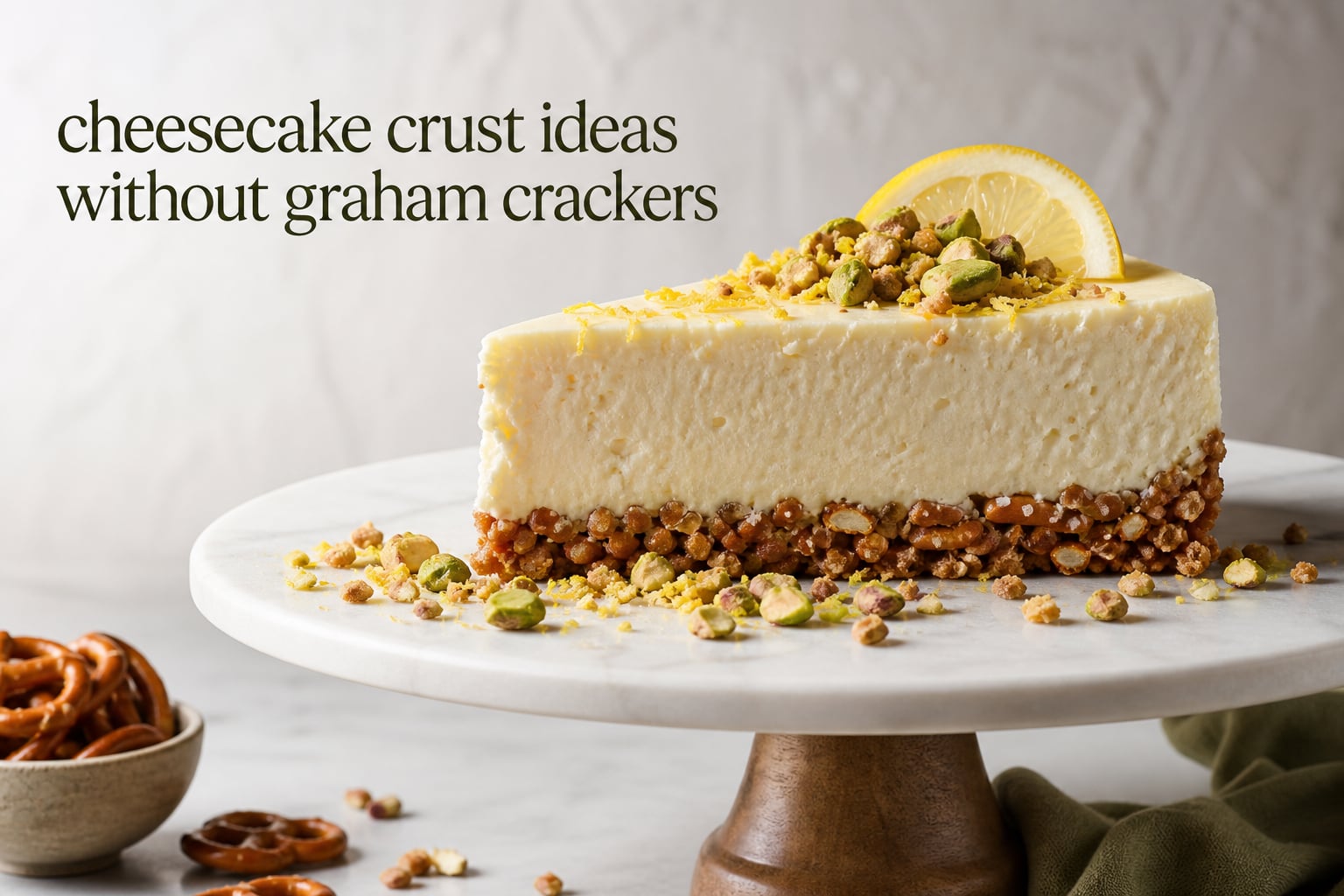
Cheesecake crust ideas without graham crackers are easier than they sound: crisp cookies, pretzels, nuts, cereal, coconut macaroons, brownies, and even phyllo can all make a satisfying base. The right pick depends less on tradition and more on the filling, the texture you want, and whether the cheesecake will bake or chill.
Graham crackers can be difficult to find outside the United States, and some bakers skip them because they contain honey or simply taste too sweet with a rich filling. A different crust is not a compromise; it is a chance to bring buttery, salty, chocolatey, spicy, or nutty character to the slice.
At 7ate9 Bakery, our starting point is simple: choose an ingredient you would happily eat with the filling, then turn it into a firm, even base. This guide explains which alternatives fit common cheesecakes, how a pressed crust holds together, and how to fix the problems that most often lead to a cracked or crumbly edge.
Table of Contents
Cheesecake crust ideas without graham crackers begin with cookies, nuts, cereal, or pastry
You can substitute cookies, pretzels, nuts, cereal, coconut macaroons, brownie, or phyllo for a graham cracker crust. Crush a crisp ingredient into fine crumbs when possible, combine it with melted butter for binding, press it evenly into a parchment-lined springform pan, then pre-bake or chill it according to the cheesecake method.
For the fastest choice, pick a crust by flavor rather than by what looks most familiar.
- Choose Oreo or another chocolate cookie for chocolate cheesecake, cookies-and-cream filling, or a plain cheesecake with berries.
- Choose Biscoff, shortbread, or vanilla wafers for lemon, vanilla, fruit-topped, or caramel-style cheesecake.
- Choose gingersnaps for pumpkin cheesecake and other holiday desserts.
- Choose pretzels or Ritz crackers when a sweet-and-salty finish will balance the filling.
- Choose almonds, pistachios, or almond flour for a naturally gluten-free direction and a nut-forward base.
- Choose coconut macaroons for tropical flavors, and choose phyllo when you want a flaky pastry contrast.
A dependable cheesecake crust starts with fine crumbs, melted butter, and even pressure
Most crumb crusts follow the same basic technique. Pulse the dry base in a food processor until it reaches fine, mostly even crumbs; large pieces can make the sides of the crust weak and hard to cut.
Stir the crumbs with melted butter until the mixture looks evenly moistened. Butter is the binding ingredient named most often for these alternatives because it helps the crumbs cling together as the crust bakes or chills.
Line the bottom of a springform pan with parchment paper before pressing in the mixture. The lining gives you a cleaner release and avoids losing the first slice to a stuck base.
Press the crumbs across the bottom first, then work them up the sides if your recipe calls for side walls. I use the flat bottom of a measuring cup or glass to compact the mixture; it is easier to spot thin patches before the filling goes in.
Use firm, even pressure instead of force in one small area. A base that is loose will crumble, while an overly compressed crust can turn hard and difficult to cut after it bakes.
Pre-baking gives baked cheesecake crusts a crisper finish
Pre-baking is the usual choice for a baked cheesecake because it sets the butter-bound crumb mixture before the filling is added. It also helps cookies, pretzels, cereal, and nuts keep their crunch beneath a moist filling.
Watch closely near the end of the bake because sweet cookies and coconut can darken faster than plain crumbs. Let the crust cool before adding filling unless the recipe specifically gives a different instruction.
Chilling gives no-bake cheesecake crusts time to set
A no-bake cheesecake crust does not need an oven if the chosen crumb mixture is compacted well and chilled until firm. The cold butter sets and gives the base enough structure for a soft, chilled filling.
Choose crisp cookies, pretzels, or cereal for a chill-set crust rather than ingredients that are already soft. A little patience matters here: cutting before the base is cold and firm is a common reason for broken slices.
Cookie crusts give cheesecake the widest range of familiar flavors
Cookies are the simplest graham cracker crust substitute because many are already crisp, sweet, and easy to crush. Forum discussions repeatedly point to Oreos and shortbread as dependable one-for-one directions when graham crackers are not available.
Check whether the cookie has a filling, a coating, or a strong spice profile before deciding. Those details affect both the sweetness and the amount of butter needed for a crumb mixture, so add melted butter gradually until the crumbs hold when pressed.
Oreos make a dark chocolate cookie crust for creamy or fruity fillings
An Oreo crust cheesecake has a dramatic chocolate base with a crisp texture. It suits chocolate cheesecake, cookies-and-cream fillings, and plain cheesecake finished with fruit toppings because the dark cookie gives the pale filling a clear contrast.
Crush the cookies to fine crumbs and press the mixture evenly rather than leaving large cookie chunks at the pan edge. If the flavor feels too rich for the filling, use it as a thin bottom crust rather than building tall sides.
Biscoff cookies make a caramelized crust for warmly spiced cheesecake
Biscoff cookies bring a caramelized flavor that works well when you want more warmth than a plain cookie crust. Their spiced character is a natural partner for caramel-style fillings, apple-inspired toppings, and other cozy desserts.
Let the filling lead the choice. A delicately flavored cheesecake can disappear behind a heavily spiced crust, while a richer filling benefits from Biscoff’s deeper flavor.
Shortbread makes a buttery crust for lemon, berry, and vanilla cheesecake
Shortbread crust cheesecake is a good answer for bakers who find graham crackers too sweet or too strongly flavored. Shortbread brings a buttery profile and a cleaner flavor, which lets lemon, vanilla, and fresh fruit toppings stay at the center of the slice.
Because shortbread is already rich, it rewards a light hand with added butter. Press it firmly, then pre-bake for a crisp base under a baked filling or chill it well for a no-bake version.
Vanilla wafers make a mild crust when the filling needs the spotlight
A vanilla wafer crust is mild, crisp, and easy to pair with many cheesecake flavors. It is a sensible choice for banana-style, vanilla, lemon, or fruit cheesecake because it does not compete with the topping.
This is also a useful option when serving guests with different tastes. The flavor reads as familiar without repeating the graham-cracker profile.
Gingersnaps make a spiced crust for pumpkin and holiday cheesecake
Gingersnap crust cheesecake brings spice and crunch to pumpkin cheesecake and holiday desserts. The cookie’s assertive flavor can stand beside a filling with warming spices rather than getting lost underneath it.
Use gingersnaps when you want the base to be part of the dessert’s personality. Skip them for a subtle lemon or plain vanilla filling unless a spicy contrast is the point.
Chocolate chip and peanut butter cookies make a playful cookie crust
Chocolate chip cookies and peanut butter cookies are two flexible choices when the pantry does not hold a classic crisp cookie. They work best when the cheesecake filling repeats or welcomes their flavor, such as chocolate, peanut butter, or a creamy vanilla center.
These cookies can be softer than wafers or sandwich cookies. Let texture guide you: crush what will break into crumbs, press it into a compact layer, and favor a baked application if the base seems tender.
Animal crackers make a gentle, lightly sweet crust for simple cheesecake
Animal crackers offer a light, uncomplicated cookie crust that is close in spirit to a traditional crumb base without relying on graham crackers. They are helpful when you want a small amount of sweetness and a neutral backdrop for fruit toppings.
Keep the crumbs fine so the tiny cookie shapes do not create uneven weak points. Their mild flavor makes them a practical choice for a first experiment with cheesecake crust alternatives.
Pretzels, crackers, cereal, and oats make crunchy sweet-and-salty bases
These cheesecake crust ideas without graham crackers are especially useful when a rich, sweet filling needs contrast. They turn a plain cheesecake into something more textural without asking you to make a separate pastry dough.
Pretzels make the clearest sweet-and-salty cheesecake crust
A pretzel crust cheesecake brings salt, crunch, and a toasted note to the plate. It pairs well with chocolate cheesecake, caramel-style toppings, fruit fillings, and any dessert that risks tasting one-note sweet.
Use pretzels that are crisp and dry, then crush them finely enough to pack tightly. Taste the crumb mixture before adding anything else because the salt level can vary from one pretzel to another.
Ritz crackers make a buttery, savory-leaning alternative
Ritz crackers can take the place of graham crackers when a buttery, lightly savory crust sounds better than another sweet cookie base. Their profile is especially helpful with chocolate, caramel, or fruit-topped cheesecake, where salt can sharpen the other flavors.
Because crackers are already buttery and salty, add binding butter carefully. The goal is a compact crust, not a greasy one.
Cornflakes and other crisp cereal make a light, crunchy crust
A cereal crust cheesecake is a useful answer when you want a lighter crunch. Cornflakes are one commonly mentioned choice, and other dry, crisp cereal can work when its flavor belongs with the filling.
Crush cereal just before mixing so it stays crisp. It can soften under a very wet topping, so a pre-baked base is a smart direction for cheesecake with juicy fruit or a long chill.
Rolled oats make a grain-based alternative with a less cookie-like flavor
Rolled oats offer a grain-based direction for bakers who do not want a cookie crust. The result is not a copy of graham crackers; it is a different base with an oatmeal-like character that can fit fruit, spice, and holiday desserts.
Oats need to be treated as their own crust rather than expected to behave exactly like fine cookie crumbs. Keep the layer even and choose a filling with enough flavor to make the combination feel intentional.
Ice cream cones make an unusual crunchy crust from a familiar sweet
Crushed ice cream cones are an offbeat but workable crust idea shared by home bakers. They fit best with playful flavors such as chocolate, vanilla, or fruit cheesecake where a cone-like crunch feels at home.
Use cones that are crisp and unfilled. Since they are usually sweet and light, make a thin, tightly pressed base and let the cheesecake filling provide most of the richness.
Nut, coconut, brownie, and phyllo bases add richer texture and stronger contrast
If a cookie crumb does not suit the dessert or the diet, these alternatives open up very different textures. Nuts create a dense, toasted base, coconut adds a tropical chew, brownies make the crust dessert-like, and phyllo gives a flaky pastry layer.
Almonds and almond flour make a nut crust for gluten-free cheesecake
An almond flour crust or finely ground almond crust is one of the most useful gluten-free cheesecake crust alternatives. It brings a nutty flavor and a denser texture that works with chocolate, lemon, and fruit toppings.
Choose this direction only when nuts are welcome at the table. A nut crust cheesecake is not appropriate for a nut-free need, even when every other cheesecake ingredient is safe.
Pistachios make a distinctive crust for fruit and tropical flavors
Pistachios make a more distinctive nut crust with a flavor that can stand beside fruit, citrus, and tropical cheesecake. Their character is more pronounced than a neutral cookie base, so pair them with a filling that can meet that intensity.
Pulse rather than continuously processing the nuts. You want a crumb mixture, not nut butter, because nut butter will not press and bake like a dry, crumbly base.
Coconut macaroons make a chewy tropical crust
A coconut macaroon crust is a direct choice for tropical flavors and coconut-forward cheesecake. It gives the base more chew than a dry cookie crumb and brings a sweet coconut note into every bite.
Pay attention while it bakes because coconut can brown quickly. A lighter-colored top is easier to work with than a deeply browned one that may taste bitter.
Brownies and blondies make a dessert-on-dessert cheesecake base
Brownie and blondie bases trade the usual crumb texture for a soft, dense layer. Brownie suits chocolate cheesecake especially well, while blondie can support vanilla, caramel-style, and fruit-topped fillings.
Think of this as a layered dessert rather than a pressed crust. The base should be stable before the cheesecake layer goes on, and the finished slice needs time to cool or chill before cutting.
Phyllo dough makes a flaky pastry crust for cheesecake
Phyllo dough cheesecake crust offers a flaky contrast to a creamy filling. It is a fitting choice when you want the dessert to lean toward pastry rather than cookie crumbs.
Phyllo is delicate, so work with it gently and keep the layers as the recipe directs. It is best for bakers who want crisp, visible pastry texture rather than a compact, uniform crumb base.
No-bake cheesecake crusts set in the refrigerator, while baked crusts hold up to oven fillings
A no-bake cheesecake crust should be made from an ingredient that stays crisp and can bind when cold. Cookies, shortbread, vanilla wafers, pretzels, and cereal are practical choices because they crush into small pieces and can form a chill-set base.
For a no-bake cheesecake, press the crust firmly and chill it before pouring in the filling. Keep the finished cheesecake cold until serving so both the filling and the butter-bound base stay firm.
Baked cheesecake gives you more freedom to use a pre-baked cookie, nut, oat, or pretzel crust. The brief oven step can dry and set the crumb layer before it meets the moisture of the filling.
Gluten-free choices work best when every ingredient is checked
Almond flour, almonds, pistachios, certified gluten-free cereal, and gluten-free cookies can all form gluten-free cheesecake crust alternatives. The key is to inspect each ingredient rather than assuming a naturally gluten-free base stays gluten-free after flavorings, mix-ins, or processing.
Some bakers report that gluten-free graham crackers carry a strong cinnamon taste. A neutral gluten-free cookie or a nut crust may be a better fit when you want lemon, vanilla, or delicate fruit flavors to come through clearly.
Nut-free and honey-free choices keep more guests in mind
For a nut-free cheesecake crust, choose pretzels, shortbread, vanilla wafers, sandwich cookies, cereal, animal crackers, or phyllo instead of almonds and pistachios. Read labels if allergies are involved, since a nut-free ingredient can still be made in a facility that handles nuts.
For a honey-free alternative, cookies, pretzels, crackers, cereal, oats, brownie, and phyllo can avoid the issue raised by bakers who cannot eat the honey commonly found in graham crackers. Ingredient lists matter more than the name of the crust style.
International bakers can start with the crisp foods their local shops already carry
If graham crackers are hard to find where you live, do not spend time trying to recreate an American pantry item unless you want to. A local plain tea biscuit, shortbread-style cookie, wafer, pretzel, or crisp cereal can provide the same structural role.
My practical rule is to avoid guessing by brand name. Taste the alternative first, ask whether its flavor belongs with the filling, and make a small, firmly pressed base from the texture you actually have.
Flavor pairing makes an alternative crust taste planned rather than improvised
A crust is part of the cheesecake’s flavor balance, not only its foundation. Match bold bases to bold fillings, and save mild bases for flavors that deserve room.
Chocolate cheesecake pairs well with Oreo, pretzel, brownie, or peanut butter cookie bases
Chocolate cheesecake can take a dark Oreo crust, a brownie base, or a peanut butter cookie direction because those flavors already belong near chocolate. Pretzels provide a different answer: salt breaks up the richness without adding another heavy sweet element.
Lemon cheesecake pairs well with shortbread, vanilla wafers, almonds, or pistachios
Lemon cheesecake benefits from a buttery or nutty crust that does not bury its citrus flavor. Shortbread and vanilla wafers keep the profile calm, while almonds and pistachios add a more grown-up nutty note.
Pumpkin cheesecake pairs well with gingersnaps, Biscoff, oats, or pecans only when nuts are welcome
Pumpkin cheesecake wants a base with spice or grain character. Gingersnaps and Biscoff provide warmth, while oats offer a less sweet choice for bakers who find a spiced filling and a sweet cookie crust too much together.
When nuts are part of the plan, a nut crust can also work with pumpkin flavors. Keep that option separate from a nut-free serving plan.
Fruit and tropical cheesecake pair well with vanilla wafers, shortbread, coconut, or pistachios
Fruit toppings tend to shine over a mild vanilla wafer or shortbread crust. Coconut macaroons and pistachios give tropical flavors more character, particularly when the filling itself has a coconut or fruit direction.
Holiday cheesecake pairs well with gingersnaps, Biscoff, shortbread, and pretzels
For holiday desserts, gingersnaps bring spice, Biscoff adds caramelized warmth, and shortbread brings butteriness. Pretzels are the surprise choice for a sweet-and-salty finish that keeps a rich seasonal dessert from tasting flat.
Crust problems usually come from crumb size, binding, moisture, or pan preparation
Home bakers most often ask why a cheesecake crust is crumbling or breaking. The answer is usually not one mysterious mistake; it is a small mismatch between the crumb texture, the butter binding, the pressure used to pack the base, and the way the cheesecake was chilled or baked.
A crumbly crust needs finer crumbs, more even binding, or more time to set
If the crust falls apart when sliced, start by looking at the crumb size. Large pieces leave gaps, while fine crumbs can press together into a more continuous layer.
Next, mix until the melted butter touches the crumb mixture evenly. A dry patch in one area and a greasy patch in another means the butter was not distributed well enough to bind the whole base.
Finally, compact the crust evenly and give it the required bake or chill time. Cutting a no-bake cheesecake too soon can break even a well-made base.
A greasy crust needs a lighter hand with butter
A greasy surface means the base has more butter than the crumbs can comfortably hold. Add melted butter gradually rather than pouring in a large amount at once, especially with rich shortbread, buttery crackers, or cookies with creamy filling.
The mixture should pack when squeezed, not look wet. If it is slick and shiny, add more crumbs from the same base ingredient until it returns to a pressable texture.
A stuck crust needs parchment paper and a cool, patient release
Parchment paper lining on the bottom of a springform pan is the simplest defense against a stuck base. Let a baked cheesecake cool as directed, and let a no-bake version chill fully before releasing the pan and moving slices.
Do not rush the first slice with a dull knife. Use a sharp knife and clean it between cuts for neater portions that do not pull the crust away from the filling.
A burned crust needs closer attention to sweet cookies and coconut
Cookies with sugar and coconut macaroon bases can brown sooner than plain crumbs. Pre-baking can still be useful, but watch for color change rather than treating every ingredient as if it bakes at the same rate.
If the flavor is already dark or strongly toasted, pick a less sweet, lighter base next time. Vanilla wafers, animal crackers, oats, or a simple nut crust may give you more control.
An overly sweet or bland crust needs a better flavor contrast
If the finished slice tastes too sweet, switch toward pretzels, Ritz crackers, oats, or a less sugary cookie the next time. A little salt or a more neutral base can make a creamy filling taste clearer.
If it tastes bland, do not reach automatically for more sugar. Try a crust with a defined identity, such as Biscoff for warmth, gingersnaps for spice, Oreo for chocolate, or pistachios for nuttiness.
Common cheesecake crust questions have direct answers
What to use for cheesecake crust instead of graham crackers?
Use crisp cookies, pretzels, nuts, cereal, coconut macaroons, brownies, or phyllo dough. For a crumb crust, crush the base ingredient, mix it with melted butter, press it into a parchment-lined springform pan, and then pre-bake or chill it based on the cheesecake recipe.
What can you substitute for a graham cracker crust?
Shortbread, Oreo cookies, vanilla wafers, Biscoff cookies, gingersnaps, pretzels, Ritz crackers, cornflakes, almonds, and pistachios are useful substitutes. Choose a mild base for lemon or fruit cheesecake and a bold or salty base for chocolate, pumpkin, or caramel-style fillings.
Can you make a cheesecake without a graham cracker crust?
Yes. A cheesecake can have a cookie, nut, cereal, pretzel, coconut, brownie, or phyllo crust, and some cheesecakes are served without a crust at all. The filling recipe and the desired texture should guide whether the alternative base is baked or chilled.
What can I use as crust for cheesecake?
Use a crisp cookie crumb, salty pretzels or crackers, cereal, oats, ground nuts, coconut macaroons, brownie or blondie, or phyllo pastry. The best choice is one whose flavor suits the filling and whose texture can be pressed or layered securely in the pan.
Cheesecake crust ideas without graham crackers make dessert more flexible and more personal
Start with the filling you want to serve, then choose a crust that adds contrast or gives that flavor room. Oreos, shortbread, pretzels, cereal, almonds, coconut, brownies, and phyllo all prove that a graham cracker base is only one option.
For a low-risk first try, make a thin shortbread, vanilla wafer, or pretzel crust and press it evenly into a parchment-lined pan. Once you are comfortable with the basic method, cheesecake crust ideas without graham crackers become a useful way to adapt for flavor, availability, and dietary needs in 2026.