
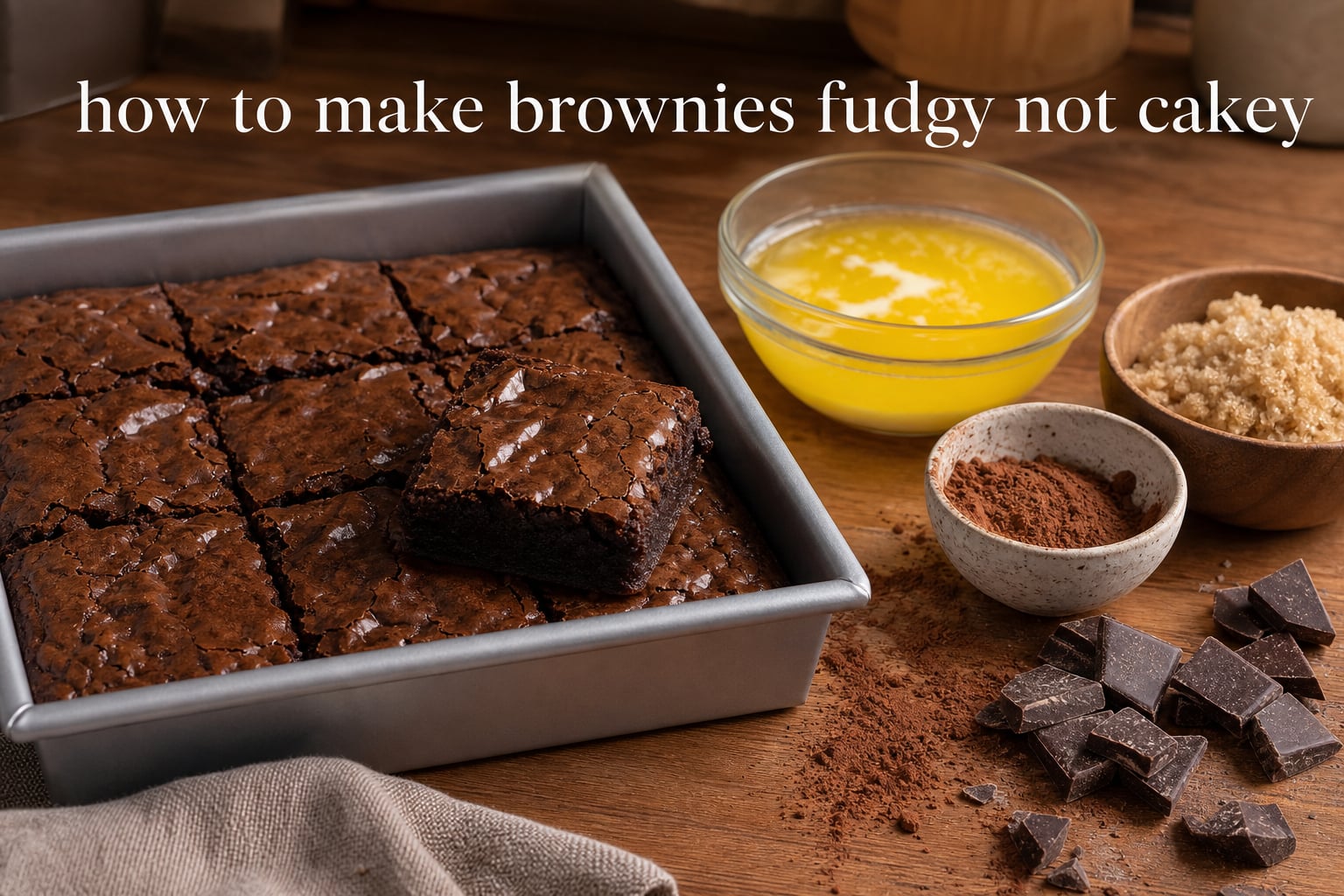
There is nothing more disappointing than pulling a pan of brownies out of the oven, expecting dense, rich, melt-in-your-mouth squares, only to cut into something that tastes like a thin piece of chocolate cake. If you have been wondering how to make brownies fudgy not cakey, you are in the right place. After testing dozens of batches in our kitchen (including some truly spectacular failures), we figured out exactly what separates a fudgy brownie from a cakey one.
The difference comes down to five things: your ratio of fat to flour, whether you use any leavening agents, how many eggs you add, how aggressively you mix the batter, and how long the brownies stay in the oven. None of these steps are complicated. But getting each one right is what turns a cakey disappointment into a dense, fudgy win.
I want to walk you through every factor so you never have to suffer through another dry, cakey brownie again. We will cover the science behind the texture, the exact ingredient ratios that matter, step-by-step techniques, how to get that coveted shiny crackly top, and even what to do if your brownies already came out cakey and need rescuing.
This guide is for home bakers who want bakery-quality fudgy brownies in 2026. Whether you are baking from scratch or trying to upgrade a boxed mix, the principles stay the same. Let us get into it.
Table of Contents
What Makes Brownies Fudgy vs Cakey: The Science Behind the Texture
Fudgy and cakey brownies are essentially two different baked goods that happen to share the same name. The texture difference comes down to how much structure versus how much fat and moisture you build into the batter. More structure means more cake. More fat and moisture means more fudge.
Flour is the main source of structure in any baked good because it forms gluten when mixed with liquid. The more flour you use, and the more you work the batter, the more gluten develops. Gluten creates a stretchy network that traps air bubbles and gives baked goods a light, cakey rise. That is great for actual cake. It is the enemy of fudgy brownies.
Fat, on the other hand, coats the flour proteins and shortens those gluten strands, which is why bakers call butter and oil “shortening.” The more fat you have relative to flour, the shorter and softer the texture becomes. Fat also keeps the crumb dense and moist because it interferes with starch gelation, the process where starches absorb water and set into a firm structure during baking.
Leavening agents like baking powder and baking soda release gas bubbles that inflate the batter. In a cake, that lift is exactly what you want. In a brownie, those bubbles create a light, airy crumb that feels cakey in the mouth. Skipping leaveners entirely is one of the fastest ways to guarantee a dense, fudgy result.
Sugar plays a double role. It sweetens, obviously, but it also acts as a tenderizer by competing with flour for available water. More sugar means less water available for gluten formation, which keeps the texture soft and slightly gooey. This is why fudgy brownie recipes call for what seems like an alarming amount of sugar. The sugar is doing structural work, not just sweetening.
Understanding this science matters because once you know why each ingredient behaves the way it does, you can troubleshoot any recipe. You stop following instructions blindly and start adjusting with confidence.
The 5 Key Factors for Fudgy Brownies
If you only remember five things from this entire guide, make it these. These are the five factors that determine whether your brownies turn out dense and fudgy or light and cakey. I have listed them in order of how much impact each one has on the final texture.
1. Use more fat than flour. Fudgy brownies rely on a high fat-to-flour ratio, meaning butter and melted chocolate should outweigh the flour by a wide margin. A good fudgy recipe uses roughly twice as much fat (by weight) as flour. This excess fat coats the flour proteins, limits gluten development, and keeps the crumb dense, rich, and soft. If your recipe has equal parts flour and fat, you are baking a cake, not a brownie.
2. Skip all leavening agents. Do not add baking powder, and do not add baking soda unless the recipe specifically calls for it to react with an acidic ingredient like natural cocoa powder. Leaveners create gas bubbles that puff the batter upward, giving you that light, airy, cakey crumb. Removing them entirely keeps the brownie dense and flat, which is exactly what you want.
3. Add an extra egg yolk. Egg yolks are about 30 percent fat, and that fat adds richness and tenderness to the crumb. Adding one extra yolk beyond what the recipe calls for boosts the fat content without adding much moisture or structure. The result is a denser, glossier, more decadent brownie. The whites, by contrast, contribute water and protein that can make the texture slightly more cake-like.
4. Underbake slightly. This is the single most important step and the one most home bakers get wrong. Fudgy brownies should come out of the oven when a toothpick inserted into the center comes out with moist crumbs clinging to it, not clean. If the toothpick comes out clean, you have overbaked them, and the residual heat will dry them out further as they cool. Pull them early and let carryover cooking finish the job.
5. Mix gently and minimally. Overmixing the batter once the flour is added develops gluten, and gluten means cakey texture. Stir just until the dry ingredients disappear into the wet ingredients. A few streaks of flour are fine. The less you work the batter, the more tender and fudgy the result.
Fudgy vs Cakey Brownies: Ingredient Comparison
Sometimes the easiest way to understand the difference is to see the ingredient ratios side by side. Below is a general comparison of what a typical fudgy brownie recipe looks like next to a cakey one, based on an 8×8 inch pan.
Fat: Fudgy brownies use 8 to 12 tablespoons of butter plus 4 to 6 ounces of melted chocolate. Cakey brownies use 4 to 6 tablespoons of butter and often skip melted chocolate entirely, relying on cocoa powder alone.
Flour: Fudgy brownies use 1/2 to 3/4 cup of flour. Cakey brownies use 1 to 1-1/4 cups. That difference of roughly half a cup of flour is enough to completely change the texture.
Sugar: Both styles use about 1 to 1-1/2 cups of sugar, but fudgy recipes lean toward the higher end because sugar tenderizes the crumb and keeps the texture soft.
Eggs: Fudgy brownies typically use 2 whole eggs plus 1 extra yolk. Cakey brownies use 2 to 3 whole eggs with no extra yolk. More whites means more protein and structure, which pushes the texture toward cake.
Leavening: Fudgy brownies use zero. Cakey brownies often include 1/4 to 1/2 teaspoon of baking powder to create lift.
Cocoa powder: Fudgy recipes often combine melted chocolate with Dutch-process cocoa for depth. Cakey recipes tend to use natural cocoa powder alone, which is lighter in flavor and more acidic.
The takeaway is simple. Fat goes up, flour goes down, leavening disappears, and you add a yolk. That formula works across almost any brownie recipe you want to convert.
How to Make Brownies Fudgy Not Cakey: Step-by-Step
Now that you understand the principles, here is the exact technique I use to get consistently fudgy brownies every single time. Follow these steps in order and your results will improve immediately.
Step 1: Melt the butter and chocolate together. Place butter and chopped chocolate in a heatproof bowl set over a saucepan of simmering water (a double boiler). Stir gently until smooth and fully combined. Let the mixture cool for about 10 minutes so it is warm but not hot when you add the eggs. This prevents the eggs from scrambling and gives the fat time to evenly distribute.
Step 2: Whisk in sugar thoroughly. Add the sugar to the warm butter-chocolate mixture and whisk vigorously until fully dissolved. This is where the shiny crackly top begins. Dissolving sugar in warm fat creates a glossy batter that bakes into that coveted crackly surface. Take your time here, a full minute of whisking makes a visible difference.
Step 3: Add eggs one at a time, plus an extra yolk. Crack each egg into the bowl separately and whisk until fully incorporated before adding the next. Then add your extra egg yolk and whisk until the batter is smooth and glossy. Adding eggs one at a time keeps the emulsion stable and prevents the batter from separating.
Step 4: Fold in the dry ingredients gently. Sift your flour and cocoa powder directly over the batter. Use a spatula to fold the dry ingredients in with slow, gentle motions. Stop the moment you no longer see streaks of dry flour. Overmixing at this stage is the number one cause of cakey brownies because it builds gluten.
Step 5: Use a metal pan and line it with parchment. Pour the batter into a metal baking pan lined with parchment paper. Metal conducts heat efficiently and evenly, which gives you more control over the bake. Glass and ceramic pans retain heat longer and can overbake the edges before the center sets.
Step 6: Bake at 350 degrees and check early. Bake at 350 degrees Fahrenheit and start checking 5 minutes before the recipe says to. Insert a toothpick into the center. If it comes out with moist crumbs attached, the brownies are done. If it comes out wet with raw batter, give them another 2 to 3 minutes and check again.
Step 7: Cool completely before cutting. Let the brownies cool in the pan on a wire rack for at least 2 hours. Fudgy brownies need this time to set because their structure comes from fat and chocolate firming up as they cool, not from flour and eggs drying out in the oven. Cutting too early gives you a gooey mess instead of clean, dense squares.
How to Get That Shiny Crackly Top
The shiny, crackly top is the hallmark of a great fudgy brownie. It is thin, delicate, and shatters slightly when you bite into it. Getting it right is not hard once you understand what creates it.
The crackly top comes from sugar dissolving in warm fat and then crystallizing on the surface during baking. This is why whisking the sugar into your warm butter and chocolate mixture matters so much. The more thoroughly the sugar dissolves before baking, the shinier and more crackled the top will be.
Whisking the eggs and sugar vigorously before combining with the fat is another technique bakers call the “ribbon stage.” When you whisk eggs and sugar together aggressively, the mixture becomes pale, thick, and forms ribbons when you lift the whisk. Folding this into your chocolate batter gives you a reliably crackly surface.
One common mistake is adding cold eggs to warm chocolate. The temperature shock can cause the butter to seize and the batter to split, which ruins the glossy top. Always use room-temperature eggs, or at least warm cold eggs in a bowl of hot water for 5 minutes before cracking them.
Finally, do not skimp on the sugar. Sugar is what crystallizes on top to create that glassy finish. If you reduce the sugar significantly, you will lose the crackly top along with the tender texture that keeps brownies fudgy.
How to Tell When Fudgy Brownies Are Done
Knowing when to pull fudgy brownies out of the oven is the hardest part for most home bakers, and it is also the most important. The goal is to catch them at the exact moment when the center is set but still moist.
The toothpick test is your best tool. Insert a toothpick into the center of the pan, about one inch deep. For fudgy brownies, you want it to come out with a few moist crumbs clinging to it. Not wet, raw batter. Not completely clean. Just a few soft, chocolatey crumbs.
If the toothpick comes out coated in wet batter, the brownies need more time. Give them 2 to 3 more minutes and test again from a slightly different spot. If it comes out completely clean, you have already overbaked them.
Visual cues help too. The edges should look set and slightly pulled away from the sides of the pan. The center should look glossy but not liquid. The surface should have a dry, crackled appearance. If the center still looks wet and jiggly when you gently shake the pan, they need more time.
Remember that brownies continue to cook from residual heat after you take them out of the oven. This is called carryover cooking, and it can firm up the center by several degrees. Pull them when they look slightly underdone and let the cooling process finish the job.
When in doubt, underbake. You can always put them back in for two minutes. You cannot undo a dried-out, overbaked brownie.
How to Fix Brownies That Are Already Cakey
Sometimes you follow a recipe, the brownies come out cakey, and you want to know if there is any way to save them. While you cannot reverse a cakey texture completely, there are a few things you can do to improve the result and avoid the same mistake next time.
1. Serve them with something rich. If your brownies came out cakey, serve them warm with a scoop of vanilla ice cream, a drizzle of hot fudge, or a dollop of whipped cream. The added richness and moisture compensate for the dry texture and make them feel indulgent again.
2. Turn them into a brownie sundae or trifle. Cut the cakey brownies into cubes and layer them in a glass with ice cream, chocolate sauce, and whipped cream. This presentation hides the texture problem entirely and turns a disappointment into a dessert people will love.
3. Use them as an ice cream mix-in. Crumble the cakey brownies and fold the pieces into softened vanilla or chocolate ice cream. The dry texture actually works well here because it absorbs moisture from the ice cream and creates a pleasant chew.
4. Adjust the recipe for next time. The real fix happens before the next batch. Reduce the flour by 2 to 3 tablespoons, add an extra egg yolk, drop any baking powder the recipe calls for, and check the oven 5 minutes earlier. These small adjustments are usually enough to shift a cakey recipe into fudgy territory.
5. Check your oven temperature. Many ovens run hot, and an oven that is 25 degrees too hot will overbake brownies before you realize it. Keep an oven thermometer inside and verify the actual temperature matches what the dial says.
Common Brownie Mistakes That Cause Cakey Texture
Most cakey brownies come from the same handful of mistakes. Here are the ones I see most often, drawn from our own testing and from home bakers in baking forums who share their frustrations.
Using too much flour. This is the most common culprit. People scoop flour directly from the bag with a measuring cup, which packs it down and adds 20 to 30 percent more flour than the recipe intends. Always spoon flour into your measuring cup and level it off with a knife, or better yet, use a kitchen scale.
Adding baking powder or baking soda. Some recipes and many box mixes include leavening agents. If you want fudgy brownies, leave them out. Even a quarter teaspoon of baking powder adds enough lift to turn a dense brownie into a cakey one.
Overmixing the batter. Once flour is in the bowl, every stroke develops gluten. Home bakers often mix until the batter is perfectly smooth, which overworks the gluten and creates a tough, cakey texture. Fold gently and stop as soon as the flour disappears.
Using too many eggs. Eggs add structure through their protein content, especially the whites. Adding extra whole eggs (rather than just an extra yolk) pushes the texture toward cake. Stick to 2 whole eggs plus 1 yolk for an 8×8 pan.
Baking too long. The instructions on many recipes and box mixes tell you to bake until a toothpick comes out clean. For fudgy brownies, that is wrong. You want moist crumbs on the toothpick, not a clean surface.
Using a glass or ceramic pan. These materials retain heat longer than metal, which means the brownies keep cooking after you take them out. This leads to overbaked, dry edges and a cakey center. Metal pans give you more control.
Not letting them cool fully. Fudgy brownies need time to set as they cool. Cutting them warm breaks the structure before it has firmed up, and the texture suffers. Wait at least 2 hours, or refrigerate them for cleaner cuts.
FAQs
What is the secret to fudgy brownies?
The secret to fudgy brownies is using more fat than flour, skipping all leavening agents like baking powder, adding an extra egg yolk for richness, and underbaking slightly so the center stays dense and moist. The fat from butter and melted chocolate keeps the crumb soft, while the minimal flour provides just enough structure without creating a cakey rise.
How to fix brownies that are too cakey?
To fix cakey brownies, serve them warm with ice cream, hot fudge, or whipped cream to add richness and moisture. You can also cube them for a brownie trifle or crumble them into ice cream. For the next batch, reduce the flour by 2 to 3 tablespoons, add an extra egg yolk, remove any baking powder, and pull them from the oven 5 minutes earlier.
How to avoid cakey brownies?
Avoid cakey brownies by using a high fat-to-flour ratio, never adding baking powder or baking soda, mixing the batter gently once flour is added, using only 2 eggs plus 1 extra yolk, baking in a metal pan, and pulling the brownies out when a toothpick comes out with moist crumbs instead of clean.
What makes fudge brownies fudgy?
Fudge brownies get their dense, fudgy texture from a combination of high fat content (butter and melted chocolate), low flour content, no leavening agents, an extra egg yolk, and slight underbaking. The fat coats flour proteins to limit gluten development, which keeps the texture dense and soft rather than light and cakey.
How do you know when fudgy brownies are done?
Fudgy brownies are done when a toothpick inserted into the center comes out with a few moist crumbs clinging to it, not clean and not wet with raw batter. The edges should look set and slightly pulled away from the pan, and the center should look glossy but not liquid. When in doubt, underbake them slightly because carryover heat will finish cooking the center as they cool.
Why do my brownies turn out cakey instead of fudgy?
Brownies turn out cakey when the batter has too much flour, too many eggs, leavening agents like baking powder, or is overbaked. Overmixing the batter also develops gluten, which creates a cake-like texture. Using a glass pan instead of metal can also cause overbaking because glass retains heat longer.
Final Thoughts on Making Fudgy Brownies
Making fudgy brownies instead of cakey ones is not about luck or a secret family recipe. It comes down to understanding how each ingredient affects texture and then applying that knowledge with a few simple technique changes. Once you internalize the five key factors, more fat than flour, no leavening agents, an extra egg yolk, gentle mixing, and slight underbaking, every batch improves.
If there is one thing I want you to take away from this guide, it is to trust the toothpick test and pull your brownies early. The single biggest difference between a fudgy brownie and a cakey one is often just two or three minutes in the oven. Residual heat finishes the job during cooling, so what looks slightly underdone at first turns into a perfect, dense square by the time you cut it.
I also want to encourage you to pay attention to your flour measurement. So many cakey brownie disasters come from packed measuring cups that add 25 percent more flour than the recipe intended. A kitchen scale costs very little and eliminates this problem entirely. If you do not have one, spoon and level your flour every time.
If your brownies came out cakey this time, do not throw them away. Cube them for a sundae, crumble them into ice cream, or layer them in a trifle. Then take the adjustments from this guide and try again. Learning how to make brownies fudgy not cakey is a skill that gets better with each batch, and your next pan will be closer to that dense, rich, melt-in-your-mouth texture you are after.
Happy baking, and here is to your best fudgy brownies yet.