
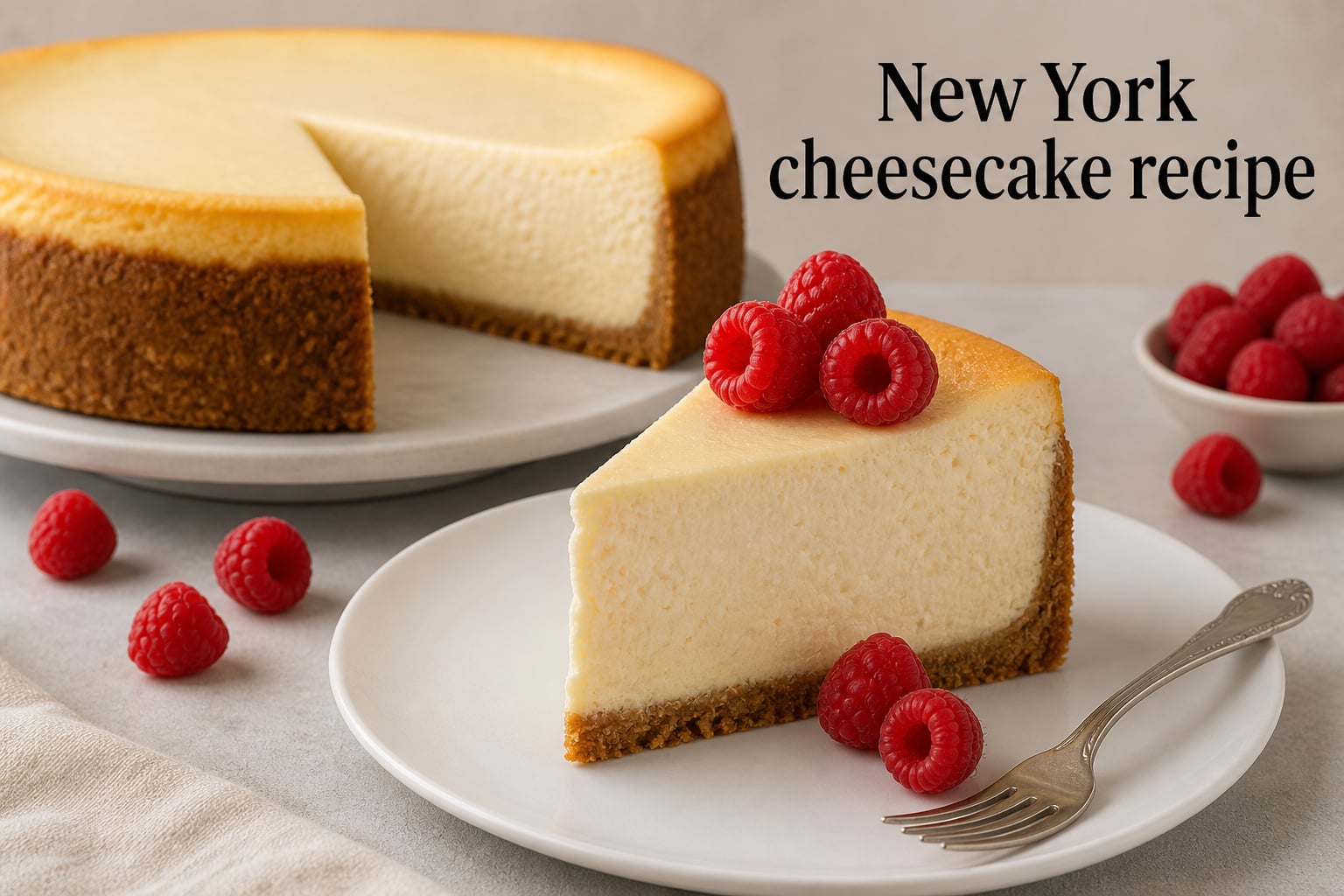
A great New York cheesecake recipe should give you a tall slice with a buttery graham cracker crust, a lightly tangy flavor, and a dense creamy center that holds its shape. This version gets there with full-fat cream cheese, sour cream, a little heavy cream, gentle mixing, and a slow cool-down.
The secret to New York cheesecake is not one fancy trick. It is using room-temperature dairy, keeping air out of the filling, baking with gentle moisture, and giving the cheesecake time to chill completely before you cut it.
Plan ahead for this dessert: the hands-on work is simple, but the cheesecake needs a long refrigerator rest. That patience gives a homemade New York cheesecake its clean slices and settled, rich texture, making it especially useful as a birthday dessert, holiday cheesecake, or dinner-party finish.
Table of Contents
Make this New York cheesecake recipe for a dense, creamy classic
This recipe makes one 9-inch springform pan cheesecake, enough for 12 modest slices or 10 generous ones. The filling is rich but not heavy in a dull way; sour cream adds tang while heavy cream softens the set just enough.
Use a conventional oven setting rather than convection if you can. Fan-forced heat can set the outside too quickly, so reduce the oven temperature slightly and begin checking early if convection is your only option.
New York cheesecake is denser and tangier than regular cheesecake
New York style cheesecake is a baked cream cheese cheesecake known for its substantial, close texture. It usually has more cream cheese and commonly includes sour cream, heavy cream, or both, so each bite tastes rich, mildly tangy, and smooth.
Regular cheesecake is a broad category rather than one fixed formula. It may be lighter, more mousse-like, flavored with ricotta or mascarpone, made without a crust, or even set without baking.
The difference shows up most clearly on the fork. A classic New York cheesecake cuts into a firm, tall wedge, while a lighter cheesecake may feel softer and more airy.
- New York style: dense, creamy, tangy, cream-cheese-forward, and baked.
- Regular cheesecake: can be baked or no-bake, light or rich, and made with several types of cheese.
- This recipe: uses sour cream and heavy cream for a balanced NY style cheesecake rather than a dry or overly stiff one.
Use these ingredients for the crust and creamy filling
Choose full-fat brick-style cream cheese, not whipped tub cream cheese. Brick cream cheese has the body that a dense creamy cheesecake needs, while cold or lower-fat substitutes can leave the batter lumpy or the finished cake less stable.
Use these ingredients for the graham cracker crust
- 2 cups graham cracker crumbs, from about 16 full sheets
- 2 tablespoons granulated sugar
- 6 tablespoons unsalted butter, melted
- Pinch of fine salt
Graham crackers give the familiar, lightly honeyed crust expected from a classic New York cheesecake. The small amount of sugar helps it toast and hold together, while melted butter carries the crumbs into a compact layer.
Use these ingredients for the New York cheesecake filling
- 32 ounces full-fat brick cream cheese, room temperature
- 1 1/4 cups granulated sugar
- 1 tablespoon all-purpose flour
- 1 cup full-fat sour cream, room temperature
- 1/3 cup heavy cream, room temperature
- 1 tablespoon vanilla extract
- 1 tablespoon fresh lemon juice
- 4 large eggs, room temperature
- 1 large egg yolk, room temperature
- Pinch of fine salt
The flour is a modest insurance policy: it helps the filling set neatly without turning it cakey. Sour cream supplies the signature tang and a tender richness, while the heavy cream keeps the final texture silky instead of rubbery.
Set the cream cheese, sour cream, heavy cream, eggs, and yolk on the counter until no longer chilled in the center. Depending on your kitchen, that can take one to two hours; do not rush this step with a microwave because partially melted cream cheese is harder to mix evenly.
Prepare the springform pan before you begin mixing
Use a 9-inch springform pan with sides at least 2 1/2 inches high. Lock the base in with the raised rim facing upward, then line the base with a round of parchment paper for easy transfer.
Wrap the outside of the pan in two broad layers of heavy-duty aluminum foil, bringing the foil well above the rim. This is useful protection against water-bath leaks, although the more reliable safeguard is the pan-in-pan method described below.
Make this New York cheesecake recipe in eight steady steps
Step 1: Bake the graham cracker crust until it smells toasted
Position an oven rack in the center and heat the oven to 350 degrees F. Stir the graham cracker crumbs, sugar, salt, and melted butter until every crumb looks moistened.
Press the mixture firmly across the bottom of the prepared springform pan and about 1 inch up the sides. A flat-bottomed measuring cup makes the base even without crushing the crumbs too hard.
Bake for 10 minutes, then move the pan to a rack. Let the crust cool while you make the filling, and lower the oven temperature to 325 degrees F.
Step 2: Beat the cream cheese smooth before adding anything else
Place the room-temperature cream cheese in a large bowl and beat on low to medium-low speed until smooth, stopping twice to scrape the bowl and beater. This first smoothing step is where you prevent the tiny white lumps that are difficult to remove later.
Add the sugar, flour, and salt, then mix only until blended. Scrape the bowl again, especially the bottom and the seam where the bowl meets the sides.
Step 3: Add the cultured dairy and flavorings on low speed
Mix in the sour cream, heavy cream, vanilla, and lemon juice on low speed. The batter should look glossy and uniform, not fluffy.
Keep the mixer low from this point forward. High speed puts excess air into the filling, and those air bubbles expand in the oven before collapsing into cracks or a puffy, uneven top.
Step 4: Add eggs gently for a smooth filling
Add the eggs one at a time, mixing on low just until each disappears into the batter. Add the yolk last and scrape the bowl after the final egg.
Do not continue beating to make the batter lighter. New York cheesecake gets its creamy density from a smooth, minimally aerated batter, not from volume.
Step 5: Set up the water bath without risking a soggy crust
For the safest water bath cheesecake, set the foil-wrapped springform pan inside a slightly larger cake pan or oven-safe skillet. Put that inner pan in a large roasting pan, then pour the filling into the springform pan.
Bring a kettle of water to a simmer. Once the roasting pan is on the oven rack, pour hot water into the roasting pan until it reaches about halfway up the sides of the outer pan, never into the inner pan.
This pan-in-pan arrangement keeps water away from the springform seam while still surrounding the cheesecake with gentle, humid heat. If you do not have a second pan that fits, use the foil-wrapped springform directly in the roasting pan and inspect the foil carefully for tears.
Step 6: Bake until the edge is set and the center still wobbles
Bake at 325 degrees F for 65 to 80 minutes. The outer 2 to 3 inches should look set, while a 2-inch circle in the center should wobble like soft gelatin when you nudge the pan.
An instant-read thermometer inserted into the center should register about 150 degrees F. If you prefer not to pierce the cake, rely on the wobble test and the matte, set edge rather than waiting for the entire surface to look firm.
Ovens differ. Forum bakers frequently report longer timing in gas ovens, so start checking at 65 minutes but give your cake the visual cues it needs instead of following the clock blindly.
Step 7: Cool slowly so the top does not split
Turn off the oven, crack the door open a few inches, and let the cheesecake sit in the water bath for 60 minutes. A slow temperature change lets the filling finish setting without pulling hard against the edges.
Lift the springform pan from the water bath, discard the foil, and place it on a wire rack. Run a thin knife around the inside edge once the pan is warm rather than hot, which helps the cake release as it contracts.
Step 8: Chill overnight for clean slices and full flavor
Cool the cheesecake to room temperature, about one to two hours, then cover it and refrigerate for at least 8 hours. Overnight is better: the crumb crust firms, the flavor becomes more rounded, and the creamy filling settles into the texture you want.
Release the springform ring only after chilling. For tidy slices, dip a long thin knife in hot water, dry it, cut once, and wipe the blade clean between every slice.
Prevent cheesecake cracks by limiting air, heat shocks, and overbaking
Cracks are cosmetic, not a sign that a cheesecake is unsafe to eat. They happen when the filling expands too much or cools too quickly, then pulls apart as it settles.
- Bring all filling ingredients to room temperature so the batter becomes smooth without extended mixing.
- Mix on low speed after the cream cheese is smooth; avoid whipping air into the eggs.
- Use a water bath to moderate the oven heat and keep the surface from drying fast.
- Stop baking while the center still has a small wobble; a fully firm center is usually overbaked.
- Cool in the switched-off oven for one hour before taking the cake out.
- Run a knife around the warm cake edge so it can shrink away from the pan rather than tearing in the middle.
A water bath is helpful, but it is not magic. The low-speed mixing and gradual cooling matter just as much, which explains why a no-water-bath method can work but has less margin for error.
Fix a cracked cheesecake by covering it rather than overworking it
Do not try to press a crack closed while the cake is hot. Chill the cheesecake fully, then cover the top with lightly sweetened sour cream, fruit compote, lemon curd, chocolate ganache, or a simple berry topping.
A shallow split will not change the flavor. A deeply sunken center, however, points to overmixing, an oven that runs hot, or a cake that was baked until fully firm.
Fix common New York cheesecake problems with these checks
Prevent a lumpy filling by warming the dairy first
Cold cream cheese is the usual cause of lumps. Stop mixing, let the bowl sit at room temperature until the batter softens, then mix slowly and scrape thoroughly rather than turning the mixer to high.
Prevent a soggy crust by separating the springform pan from the water
Foil can leak through a tiny seam, especially when it is narrow or torn. Put the springform pan inside a larger dry pan before it goes into the roasting pan, and the water cannot reach the crust even if foil fails.
Prevent a dry cheesecake by trusting the wobble
A dry, grainy texture comes from overbaking. Remove the cheesecake when its center wobbles in a small area, then let residual heat finish the job during the slow oven cool-down.
Adjust for an unreliable oven by checking the actual temperature
If your cheesecakes brown fast or always need extra time, check the oven with a standalone oven thermometer. Gas ovens may lose heat quickly after adjustments, while any oven that runs hot can turn a correct recipe time into an overbaked cheesecake.
Serve the cheesecake plain or with a bright topping
New York cheesecake is good without anything on it, especially when you want the tangy cream cheese flavor to lead. Serve chilled but let each slice stand for 10 to 15 minutes before eating so the filling softens slightly.
For a simple finish, choose one topping rather than piling on several rich elements. Fresh berries, warm berry sauce, sour cherries, lemon curd, salted caramel, chocolate ganache, or lightly sweetened whipped cream all work with the buttery graham crust.
Cut 10 large slices for a celebration cake or 12 slimmer slices after a big meal. A plate with a small spoonful of sauce beside the slice looks neat and keeps the crust crisp longer than sauce poured over the top.
Store New York cheesecake in the refrigerator or freezer
Keep the cheesecake covered in the refrigerator for up to 5 days. For the best crust texture, store toppings separately and add fruit or sauce just before serving.
To freeze, chill the cheesecake fully first, then freeze it uncovered until firm. Wrap the whole cake or individual slices tightly in plastic wrap followed by foil, label it, and freeze for up to 2 months.
Thaw wrapped cheesecake overnight in the refrigerator. Do not thaw it on the counter, since condensation can make the surface wet and the crust soft.
Use this printable recipe card for the full method
Classic New York Cheesecake
Yield: 10 to 12 servings | Prep: 35 minutes | Bake: 65 to 80 minutes | Chill: at least 8 hours
Crust: Combine 2 cups graham cracker crumbs, 2 tablespoons sugar, a pinch of salt, and 6 tablespoons melted butter. Press into a lined 9-inch springform pan and bake at 350 degrees F for 10 minutes.
Filling: On low speed, mix 32 ounces room-temperature full-fat cream cheese with 1 1/4 cups sugar, 1 tablespoon flour, and a pinch of salt. Blend in 1 cup sour cream, 1/3 cup heavy cream, 1 tablespoon vanilla, and 1 tablespoon lemon juice. Add 4 eggs and 1 yolk one at a time.
Bake: Pour into the cooled crust. Bake in a protected water bath at 325 degrees F until the edge is set and the center reaches about 150 degrees F or has a small wobble. Cool in the turned-off oven for 1 hour, cool to room temperature, then chill overnight.
Get clear answers to New York cheesecake questions
What is the secret to New York cheesecake?
The secret is full-fat room-temperature cream cheese, cultured dairy for tang, low-speed mixing, gentle water-bath heat, and a long chill. Those steps create a dense, smooth filling without excess air or a dry texture.
Do you need a water bath for New York cheesecake?
A water bath is not strictly required, but it is the most dependable way to bake a creamy cheesecake with a level surface and fewer cracks. Put the springform pan inside a larger dry pan before setting it in the water bath to protect the crust from leaks.
Why does my New York cheesecake crack?
Cheesecake usually cracks because the batter was overmixed, the cake was overbaked, or it cooled too quickly. Use room-temperature ingredients, mix eggs on low, remove the cake while the center still wobbles, and cool it gradually in the turned-off oven.
Can you freeze New York cheesecake?
Yes. Freeze fully chilled cheesecake whole or in slices, tightly wrapped in plastic wrap and foil, for up to 2 months. Thaw it overnight in the refrigerator while still wrapped.
Make this New York cheesecake recipe slowly and let the chill do its work
This New York cheesecake recipe succeeds because each stage has one job: a toasted graham crust supports the filling, gentle mixing keeps it smooth, the water bath softens the bake, and the overnight chill makes it sliceable. Give the cake time at each stage and you will have a reliable, creamy centerpiece that needs little more than a sharp knife and a plate.