
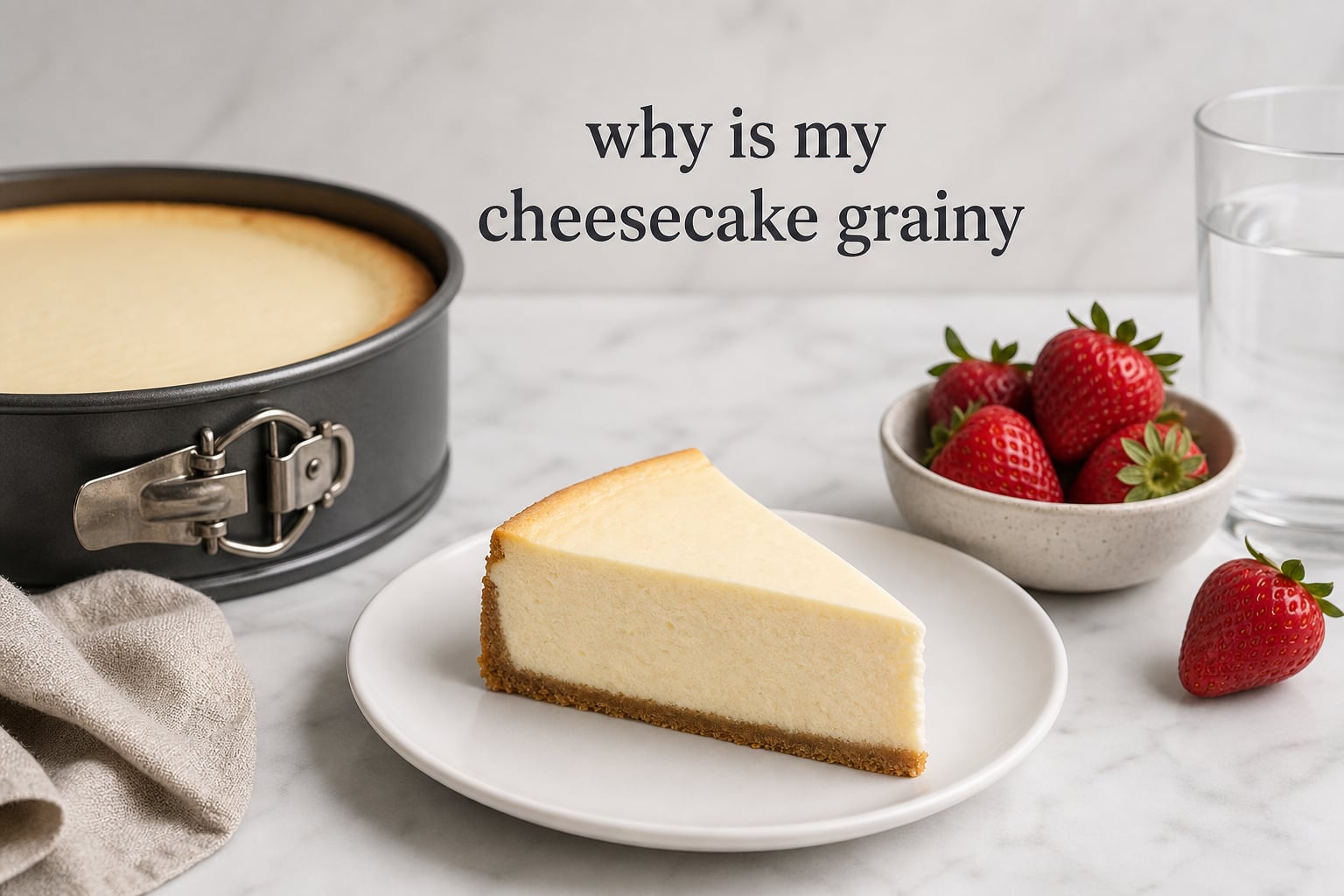
If you have ever pulled a cheesecake out of the oven, taken that first bite, and wondered why is my cheesecake grainy, you are not alone. Our team has tested dozens of recipes over the years, and that gritty, sandy mouthfeel is the number one complaint we hear from home bakers. The short answer is almost always the same: your eggs overcooked.
A cheesecake is essentially a baked custard. It relies on egg proteins to set gently into a creamy, velvety texture. When those proteins heat too quickly or too much, they contract, tangle together, and squeeze out moisture. That moisture loss is exactly what creates the grainy, curdled texture that ruins your dessert.
The good news is that grainy cheesecake is completely preventable once you understand the science and adjust your technique. Let’s walk through what goes wrong and how to fix it for good.
Table of Contents
Why Is My Cheesecake Grainy: The Science Behind the Texture
When bakers ask us why is my cheesecake grainy, we start by explaining the science. Understanding the protein coagulation process is the single most helpful thing you can do to improve your results.
Egg proteins are long, coiled molecules that unwind and link together when heated. This process, called coagulation, is what sets your cheesecake from liquid to sliceable. At around 185°F (85°C), those proteins begin to bond. But if the temperature climbs too high or rises too fast, the proteins over-tighten. They squeeze out the water and fat they were holding, leaving behind dry, rubbery clumps.
That expelled moisture separates from the protein network, and the texture turns from smooth custard into something that feels sandy or gritty on your tongue. This is the same process that turns scrambled eggs rubbery when you cook them too hard. Your cheesecake is having the exact same problem, just in a larger, slower-baking format.
The fix comes down to controlling heat. Gentle, even, low-temperature cooking gives those egg proteins time to set properly without overcooking.
The 5 Main Causes of Grainy Cheesecake
After testing recipe after recipe in our kitchen, we narrowed down the culprits to five root causes. Most grainy cheesecakes come down to one or more of these mistakes.
1. Overcooked Eggs and Protein Coagulation
This is the leading cause. Eggs are sensitive to heat, and cheesecake batter is mostly eggs and cream cheese. If your oven runs hot, if you bake too long, or if you skip the water bath, the eggs cook past their ideal temperature range. The proteins over-coagulate, expel moisture, and leave you with a grainy texture throughout the cake.
2. Cold Cream Cheese Creating Lumps
Cold cream cheese does not blend smoothly into batter. It leaves small lumps that never fully dissolve, creating a speckled, uneven texture. We have seen bakers blame their recipe when the real problem was cream cheese straight from the fridge. Room temperature cream cheese is non-negotiable for a smooth result.
3. Over-Mixing Introducing Too Much Air
It feels natural to beat the batter until perfectly smooth, but over-mixing whips air into the eggs. That air expands in the oven, puffs the cake up, and then collapses as it cools. The result is a dense, sometimes grainy texture with surface cracks. Mix only until ingredients are combined.
4. High Oven Temperature Cooking Too Fast
Baking at 350°F or higher forces the eggs to coagulate too quickly. The outside of the cheesecake sets and overcooks before the center is even warm. We recommend baking at 325°F or lower for most recipes. Low and slow is the cheesecake baker’s mantra.
5. Skipping the Water Bath for Even Heating
The water bath, also called a bain-marie, is the single most effective tool for preventing grainy texture. It surrounds the cheesecake with gentle, steamy, even heat that never exceeds the boiling point of water. Without it, the dry oven heat cooks the edges too fast while the center lags behind.
How to Prevent Grainy Cheesecake: 6 Essential Tips
Now that you know what causes the problem, here is our proven six-step system for achieving that velvety-smooth texture every time. These tips come from years of testing and troubleshooting in our own kitchen.
1. Use Room Temperature Ingredients
Take your cream cheese, eggs, sour cream, and any dairy out of the fridge at least 2 hours before baking. Room temperature cream cheese blends smoothly without lumps, and room temperature eggs incorporate evenly. Cold ingredients mixed together create exactly the kind of texture problems that lead to a grainy result.
You can speed this up by cutting cream cheese into cubes and letting them sit for an hour, or placing sealed ingredients in a bowl of lukewarm water for 15 minutes. Never microwave cream cheese to soften it, as the edges overheat and separate before the center softens.
2. Master the Water Bath Technique
Wrap your springform pan tightly in heavy-duty foil to prevent leaks. Place the pan inside a larger roasting pan, then pour hot water into the outer pan until it reaches about halfway up the sides of the springform. The water should be hot, not boiling.
The steam from the water bath keeps the oven environment moist and regulates the temperature around the cheesecake. This gentle, humid heat is what professional bakeries use to achieve that signature creamy texture. Never skip this step for a baked cheesecake.
3. Keep Oven Temperature Low
Bake your cheesecake at 325°F or lower. Some recipes even call for 300°F for a slower, gentler bake. The lower temperature gives the egg proteins time to coagulate gradually, which is exactly what produces a smooth, creamy set rather than a grainy one.
Every oven is different, so use an oven thermometer to verify accuracy. Many ovens run 25 degrees hotter than the dial indicates, which is more than enough to overcook your eggs and create that grainy texture.
4. Don’t Over-Mix the Batter
Beat the cream cheese first until smooth, then add sugar and mix until combined. Add eggs one at a time, mixing on low speed just until each one disappears. Stop mixing the moment the batter looks smooth and uniform.
If you use a stand mixer, keep it on the lowest speed for egg incorporation. We prefer mixing eggs by hand with a whisk for the final additions. This prevents excess air from creating the puff-and-collapse cycle that ruins texture.
5. Know When It’s Done: The Wobble Test
The most common mistake we see is overbaking. A cheesecake is done when the edges are set but the center still wobbles slightly when you gently shake the pan. That 2 to 3 inch circle in the middle should jiggle like gelatin, not slosh like liquid.
It will continue to cook from residual heat as it cools. If you wait until the center is fully set in the oven, you have already overbaked it. The wobble test takes practice, but it is the single most reliable doneness indicator we use.
6. Cool Slowly to Prevent Texture Issues
Turn the oven off, crack the door open, and let the cheesecake sit inside for one hour. This gradual cooling prevents thermal shock, which causes both cracking and texture changes. Then move it to the counter until fully cool, and refrigerate for at least 6 hours or overnight before slicing.
Patience here makes a noticeable difference. A cheesecake sliced too early will be soft and may seem grainy because it has not fully set. The overnight chill is what gives you that clean, creamy slice.
Can You Fix a Grainy Cheesecake?
This is the question we get most often after someone has already baked the cake. The honest answer is that prevention is far more effective than any fix. Once egg proteins have overcoagulated, that grainy texture is baked in permanently.
However, if your cheesecake is only slightly grainy, you can mask it. Top slices with a fruit compote, chocolate ganache, or a dollop of whipped cream. The added moisture and flavor help distract from the texture. For a cheesecake that is borderline, a blended topping can even out the experience enough to serve guests without disappointment.
If your batter is grainy before baking, you may still be able to save it. An immersion blender on low speed can smooth out lumps from cold cream cheese. Strain the batter through a fine mesh sieve to remove any stubborn bits. These steps only work before baking, not after.
No-Bake vs Baked Cheesecake: Grainy Texture Differences
Most articles only address baked cheesecakes, but no-bake cheesecakes can also turn out grainy. The causes and fixes are completely different, so it helps to know which type you are making.
No-bake cheesecakes rely on gelatin or whipped cream for structure rather than eggs. Graininess here usually comes from undissolved gelatin, sugar that did not fully dissolve, or cream cheese that was too cold during mixing. The fix is to bloom gelatin properly, sift your sugar, and always start with room temperature cream cheese.
For baked cheesecakes, the protein coagulation issue we discussed earlier is the primary concern. Basque cheesecakes, which intentionally bake at very high temperatures, will always have a slightly different texture. But if your Basque cheesecake is grainy rather than creamy under the caramelized top, the same low-and-slow principles apply to the interior set.
Frequently Asked Questions
What happens if you overmix your cheesecake?
Over-mixing incorporates too much air into the batter, which causes the cheesecake to puff up during baking and then collapse as it cools. This creates a dense, sometimes grainy texture with cracks on the surface. Mix on low speed and stop as soon as ingredients are combined.
Can you fix grainy cream cheese?
Grainy cream cheese batter can sometimes be rescued before baking by blending briefly with an immersion blender on low speed or straining through a fine mesh sieve. However, once baked and grainy, the texture cannot be fully reversed. Prevention through room temperature ingredients and proper technique is the best solution.
Is it better to overbake or underbake cheesecake?
Underbaking is always better than overbaking for cheesecake. An underbaked cheesecake will continue to set as it cools and chills, while an overbaked one becomes grainy, dry, and crumbly. The center should still wobble slightly when you remove it from the oven.
What makes a cheesecake light and fluffy?
Light and fluffy cheesecake comes from properly softened room temperature ingredients, gentle low-speed mixing, a water bath for even heat, and a low oven temperature. Beating the cream cheese smooth before adding eggs and avoiding over-mixing are the two most important steps.
Why does my cheesecake have a grainy texture?
Grainy texture in cheesecake is most often caused by egg proteins cooking too quickly and overcoagulating. When this happens, the proteins contract and squeeze out moisture, creating a sand-like texture. Using a water bath, low oven temperature, and room temperature ingredients prevents this.
What does an overdone cheesecake look like?
An overdone cheesecake will have a grainy or curdled texture throughout, often with deep cracks across the top surface. The center may appear dry and puffy rather than creamy, and the edges will be firm, possibly browned, and slightly sunken after cooling.
Is it okay if cream cheese is grainy?
Grainy cream cheese before mixing usually means it was too cold. Let it sit at room temperature for 2 to 3 hours before using. If the baked cheesecake turns out grainy, it is still safe to eat, but the texture will not be as smooth and creamy as intended.
So the next time you catch yourself wondering why is my cheesecake grainy, remember the core principle: control the heat. Eggs are the foundation of your cheesecake’s texture, and gentle cooking is what keeps them smooth and creamy instead of dry and gritty.
Start every recipe with room temperature ingredients. Always use a water bath. Bake low and slow. Master the wobble test. Cool gradually. Follow these five habits, and that grainy texture will become a thing of the past. Your next cheesecake can be the velvety, restaurant-quality dessert you have been aiming for.