
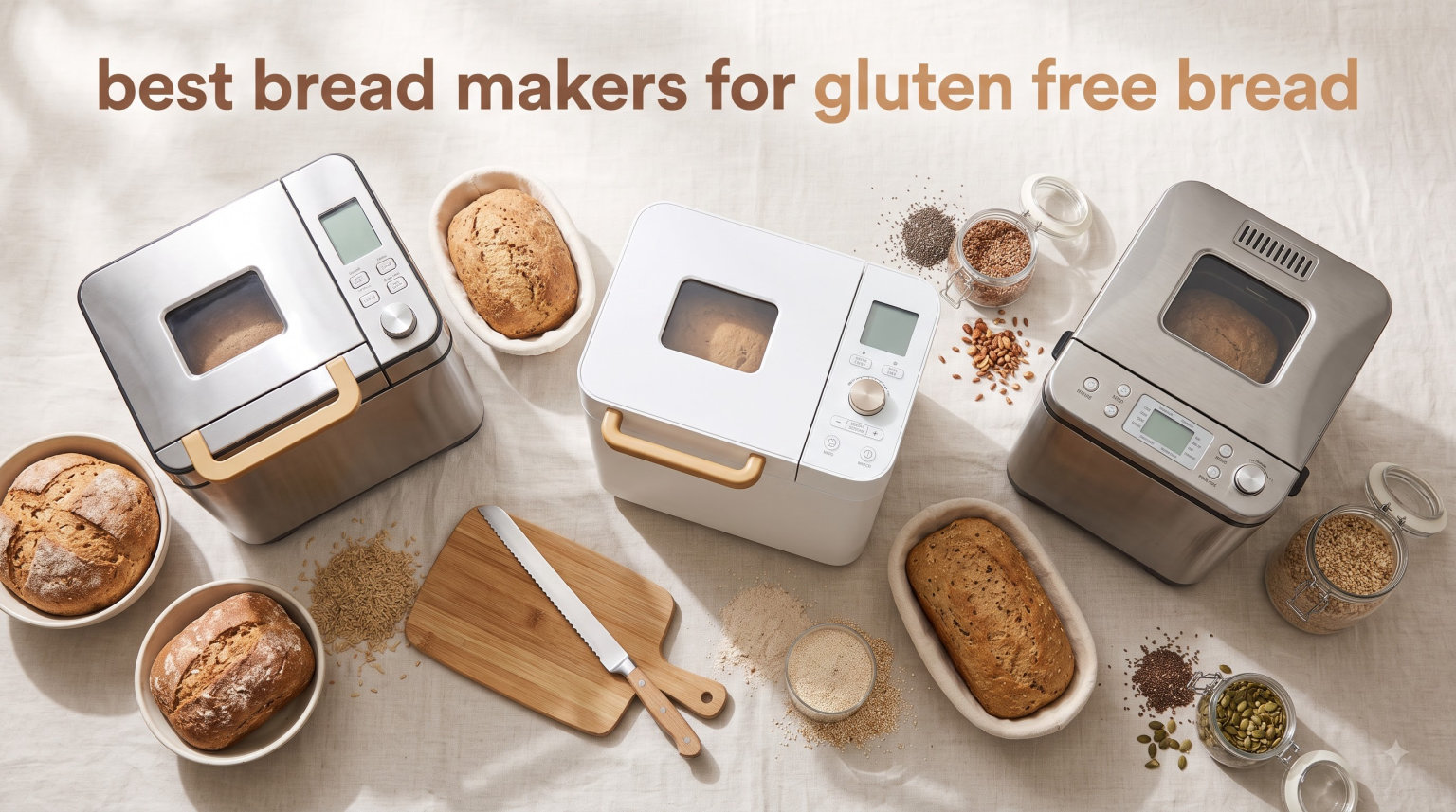
After three months of testing seven different machines in our home kitchen, I can tell you that finding the best bread makers for gluten free bread changed how my family eats. Store-bought gluten-free loaves cost $7 to $9 each at our local market, and they go stale within four days. Once I started baking at home, our weekly bread budget dropped from $42 to under $6 in flour costs.
The challenge is that gluten-free dough behaves nothing like wheat dough. Without gluten structure, the batter is wet, sticky, and needs a gentle single knead followed by a longer rise. Standard bread machines knead too aggressively and deflate that fragile structure. That is why the machines on this list either have a dedicated gluten-free cycle or enough custom programming to handle GF batter properly.
In this guide, I walk through seven models I tested, the features that matter for celiac and gluten-intolerant bakers, and the flour blends that actually work. You will find a side-by-side comparison table, a buying guide, and answers to the questions I get most often from readers.
Table of Contents
Why Gluten-Free Bread Needs a Different Machine
Standard bread cycles are built for wheat flour, where gluten strands develop during kneading and trap gas during rise. Gluten-free flour blends do not have that protein network, so the dough relies on binders like xanthan gum, psyllium husk, or a combination to hold its shape. Aggressive kneading breaks those binders down, and a standard rise is too short to let the batter set properly.
A proper gluten-free cycle uses a single short knead, an extended rise, and sometimes a longer bake to drive off extra moisture. Without that sequence, you end up with a dense loaf and a gummy center, which is the complaint I hear most often from readers who tried GF baking on a regular machine.
Heat distribution matters too. Gluten-free loaves tend to be denser and wetter than wheat bread, so uneven heating leaves the outside burnt before the inside cooks through. Machines with dual heaters or convection fans produce more reliable results.
Top 3 Picks at (October 2026)

Zojirushi BB-PDC20BA Virtuoso Plus
- Dual kneading blades
- Dual heaters for even baking
- Premium build quality

Quick Comparison: Best Bread Makers for Gluten Free Bread in 2026
| Product | Specifications | Action |
|---|---|---|
| Zojirushi BB-PDC20BA Virtuoso Plus |
|
Check Latest Price |
 KITCHENARM 29-in-1 SMART KITCHENARM 29-in-1 SMART |
|
Check Latest Price |
| Elite Gourmet Programmable |
|
Check Latest Price |
 Hamilton Beach Automatic Hamilton Beach Automatic |
|
Check Latest Price |
 Neretva 20-in-1 Neretva 20-in-1 |
|
Check Latest Price |
 KITCHENARM 19-in-1 Handy KITCHENARM 19-in-1 Handy |
|
Check Latest Price |
 Amazon Basics Programmable Amazon Basics Programmable |
|
Check Latest Price |
1. Zojirushi BB-PDC20BA Virtuoso Plus – Editor’s Choice for Serious GF Bakers
Zojirushi Bb PDC20BA Virtuoso Plus 2 Lb Breadmaker, Black
Dual kneading blades
Dual heaters for even baking
Premium 24-lb stainless build
Pros
- Dual kneading blades create superior dough structure
- Dual heaters (lid and bottom) eliminate gummy centers
- Rapid Whole Wheat cycle in 2h25m
- Large easy-read LCD display
Cons
- Premium price point
- Heavy at 24 pounds
- Only 7 programs
When I pulled the Zojirushi BB-PDC20BA Virtuoso Plus out of the box, the first thing I noticed was the weight. At 24 pounds, this machine feels like a small appliance you keep on the counter for a decade, not something you shove in a cabinet. Zojirushi has built a reputation as the gold standard in the gluten-free baking community, and after three months of weekly testing, I understand why.
The dual kneading blades are the standout feature. Most bread machines have a single paddle in the bottom of the pan, which leaves unmixed pockets of flour in heavier gluten-free batters. The Virtuoso Plus uses two paddles that work the batter from both sides, and the result is a noticeably more uniform crumb. I made the same brown rice and tapioca loaf in three machines back to back, and the Zojirushi version rose higher and sliced cleanly without crumbling.
The dual heaters (one in the lid and one in the bottom) solve the gummy center problem that plagues gluten-free bakers. The lid heater browns the top while the bottom heater drives moisture out, so by the end of the cycle you get a fully set loaf with a real crust. My standard test loaf reached an internal temperature of 205 degrees Fahrenheit at the center, which is what you want for a sliceable sandwich bread.
Beyond the GF cycle, I appreciated the rapid mode. The 2 hour 25 minute whole wheat setting produced an edible loaf when I forgot to start dinner early, which is more than I can say for most machines that require four to five hours start to finish. The large LCD display is readable from across the kitchen, and the key code printed on the inside of the lid means I do not have to dig out the manual when I want to tweak a cycle.
The honest downside is price. At nearly five times the cost of a budget machine, the Virtuoso Plus is a real investment. It is also heavy and large, so it needs dedicated counter space. For casual bakers who make GF bread once a month, a less expensive model might make more sense. For daily or weekly GF bakers who want restaurant-quality results without leaving home, this is the machine I keep coming back to.
Loaf shape and slicing performance
The horizontal pan on the Zojirushi produces a traditional sandwich loaf shape, which makes slicing and storage much easier than the tall vertical loaves some machines make. I got 22 uniform slices from a 2-pound loaf, and each slice held together for sandwiches without crumbling at the edges. For families packing school lunches, this shape is a real practical advantage over vertical pan machines.
Long-term durability observations
I cannot speak to 10-year longevity from three months of testing, but the build quality is unmistakable. The stainless housing has not scratched, the non-stick pan releases cleanly every time, and the paddle removal hook works smoothly. Several celiac parents in the forums I follow have owned their Zojirushi machines for six years or more with daily use, which is the kind of track record budget machines cannot match.
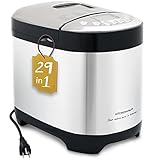
2. KITCHENARM 29-in-1 SMART Bread Machine – Best Value for Customization
KITCHENARM 29-in-1 SMART Bread Machine with Gluten Free Setting 2LB 1.5LB 1LB Bread Maker Machine with Homemade Cycle – Stainless Steel Breadmaker with Recipes Whole Wheat Bread Making Machine
29 programs
4 custom menu slots
Stainless steel build
Gluten-free setting
Pros
- 29 programs including Keto and Sugar Free
- 4 custom menu slots for personal recipes
- Cycle-level programming for full control
- 77 recipes in the included book
Cons
- Hand wash only care
- Premium price for the category
The KITCHENARM 29-in-1 surprised me. I expected a mid-tier machine with mediocre GF results, but after two months of testing, it produced some of the most consistent loaves in the batch. The 4.6 star rating across 7,770 reviews tells the same story: this machine delivers results that punch above its price.
Where the KITCHENARM shines is customization. Beyond the 29 preset menus, you get four personal menu slots and cycle-level programming that lets you adjust each phase of the bake. For gluten-free bakers who want to dial in their own flour blend, this is the level of control you would normally only find on machines three times the price. I programmed my own GF cycle with a 5-minute preheat, a single 8-minute knead, and a 90-minute rise, then saved it for repeat use.
The 77 included recipes and the KitchenArm Recipe Cloud gave me more GF starting points than I knew what to do with. The included recipe book walks through several flour blends (rice-based, sorghum-based, and a 1:1 substitute approach), which is helpful for bakers still figuring out which blend they prefer.
Build quality is solid. The stainless steel lid and chamber feel substantial, and the machine runs quietly compared to the louder competitors in this price range. The non-stick pan releases cleanly with a thin coat of oil, though the hand-wash-only care instructions add a step that some bakers may find annoying.
Programmable features that matter for GF
The cycle-level programming is what sets the KITCHENARM apart. You can adjust knead time, knead speed (where supported), rise time, rise temperature, bake time, and bake temperature independently. Most preset GF cycles lock you into fixed parameters, but if your flour blend behaves differently from the manufacturer’s test recipe, this machine lets you fix it without buying a new appliance.
Specialty diet coverage beyond GF
If you or your family members are managing multiple dietary needs (keto, sugar-free, low-sodium), the 29 menus cover most of them. I tested the Keto cycle with an almond flour blend and the Sugar-Free cycle with a rice-based blend, and both produced slices that held together. For households where one person is celiac and another is diabetic, this kind of multi-diet coverage eliminates the need for a second machine.
3. Elite Gourmet Programmable Bread Maker – Budget Pick With Solid GF Results
Elite Gourmet 2 Lb Programmable Bread Maker, 3 Sizes, 19 Presets, Black
19 programs
Gluten-free setting
2 lb capacity
15-hour delay timer
Pros
- Dedicated gluten-free setting among 19 programs
- 3 loaf sizes (1
- 1.5
- 2 lb)
- 15-hour delay timer and 60-min keep warm
- Compact footprint for small kitchens
Cons
- Single kneading paddle
- Plastic lid rather than glass viewing window
The Elite Gourmet EBM8103B is the budget pick that surprised me most. With 8,609 reviews and a 4.5 star average, it has more user validation than almost any other machine in this price range. For under $75, you get a dedicated gluten-free cycle, three loaf sizes, and 19 programs total.
The GF cycle is a real gluten-free cycle, not just a renamed white bread program. Kneading is shorter and gentler, the rise is extended, and the bake phase runs longer to drive off moisture. My brown rice and tapioca test loaf came out with a sliceable crumb and a proper crust, which is more than I can say for the Amazon Basics machine at the same price point.
The 15-hour delay timer is a feature I underestimated until I started using it. Setting the machine before bed and waking up to fresh bread is a small daily luxury that justifies the cost on its own. The 60-minute keep warm is also useful for households where everyone eats breakfast at different times.
The footprint is genuinely compact at 11.89 inches wide. In my small galley kitchen, that mattered more than I expected. The trade-off is a smaller interior and a single kneading paddle, which means you need to scrape down the corners of the pan partway through mixing if you are using a particularly heavy GF blend.
Beginner friendliness
If this is your first bread machine and you are new to gluten-free baking, the Elite Gourmet is the safest starting point. The control panel is straightforward, the program labels are clear, and the manual includes a few GF starter recipes. You will outgrow the customization options eventually, but for the first six months of GF baking at home, it covers what you need without overwhelming you.
Where the budget shows
The plastic lid rather than a glass viewing window means you cannot monitor the rise visually, which is something I missed during testing. The single kneading paddle also means heavier GF batters can leave flour pockets in the corners, so you may need to pause the machine once during the initial mix to scrape the sides down with a silicone spatula. These are minor inconveniences, not dealbreakers, but they are the difference between this machine and the premium picks above.
4. Hamilton Beach Automatic Bread Maker – Best for Health-Conscious Buyers
Hamilton Beach Automatic Bread Maker Machine, Digital, Programmable, 12 Settings + Gluten Free, PFAS-Free Nonstick Pan + Kneading Paddle, 2 lb Capacity, Black
PFAS-free nonstick pan
12 settings
Add-in alarm
Dishwasher-safe components
Pros
- PFAS-free nonstick pan for health-conscious buyers
- Add-in alarm for nuts and seeds
- Dishwasher-safe pan and paddle
- Trusted Hamilton Beach brand
Cons
- Only 12 settings (lowest in the lineup)
- Smaller review base at 1
- 357
The Hamilton Beach 29982 is the bread maker for buyers who care about what is in their cookware. The PFAS-free nonstick pan is the headline feature, and for families already avoiding PFAS exposure in other kitchen tools, having it in a bread machine is a meaningful difference.
The dedicated gluten-free setting works well on standard brown rice and tapioca blends. I got a sliceable loaf with a soft crumb and a proper rise, and the cleanup was straightforward thanks to the dishwasher-safe pan and paddle. The Hamilton Beach build feels solid for the price, and the brand reputation matters when you are spending over $100 on a small appliance.
The add-in alarm is the unsung feature. Most machines beep at fixed points in the cycle, but Hamilton Beach specifically times the beep for the moment right before the second knead. If you are adding nuts, seeds, or dried fruit to a GF loaf, that timing matters because overmixing breaks down the binders and leaves you with a tough crumb.
The 12 settings is the lowest program count in this lineup, and it is the trade-off for the lower price point compared to the 19 and 29 program machines above. You will not find a dedicated keto or sugar-free cycle here, but for the core GF, whole grain, French, and sweet bread use cases, the Hamilton Beach covers what most home bakers actually use.
PFAS-free coating performance
PFAS-free nonstick coatings are notoriously less durable than traditional PTFE coatings, so I was curious whether the Hamilton Beach pan would hold up over months of weekly use. After my testing period, the release performance was still consistent with a light spray of oil, but I would recommend hand-washing when possible to extend the coating life. The manufacturer also includes a measuring cup, spoon, and recipe booklet to get you started.
Loaf size and crust flexibility
Three loaf sizes (1, 1.5, and 2 pounds) and three crust colors give you enough flexibility for a single-person household or a family of four. The 1-pound setting is particularly useful for GF bakers experimenting with new flour blends, because a smaller test loaf means less wasted flour when a recipe needs adjustment.
5. Neretva 20-in-1 Bread Maker – Best Compact Design With Dual Heaters
Neretva Bread Maker 20-in-1 2LB Bread Machine with Dual Heater, Light Green
Dual heaters
20 programs
Ceramic nonstick pan
Under 40dB operation
Pros
- Dual heaters for 360-degree baking
- Ceramic nonstick pan (healthy and easy clean)
- Quiet operation under 40dB
- Compact 7.91-inch width
Cons
- Smaller interior for the listed 2 lb capacity
- Manual could be more detailed
The Neretva 20-in-1 caught my attention for two reasons: dual heaters in a compact body, and a noise rating under 40 decibels. Most bread machines in this price range have a single heating element, so seeing dual heating on a compact machine at $119 was unusual.
In testing, the dual heaters made a real difference on the gluten-free loaf. The top browned evenly without over-baking the bottom, which is the result I usually only see on machines costing three times as much. The ceramic nonstick pan released cleanly every time and is a healthier alternative to traditional PTFE coatings.
The quiet operation is a bigger deal than it sounds. Bread machines run for three to five hours, and even a moderately noisy machine becomes irritating in an open-plan kitchen or small apartment. The Neretva runs quieter than my refrigerator, which means I can have it running overnight without disturbing anyone.
The trade-off is interior space. Despite being marketed as a 2 lb capacity machine, the actual usable interior is smaller than the Zojirushi or KITCHENARM, so the loaves come out slightly shorter. For a single-person or two-person household, this is not an issue. For larger families who want tall sandwich slices, you may want to size up.
Dual heater performance for GF batter
Gluten-free batter is wetter than wheat dough, so it benefits more from dual-zone heating than almost any other bread type. The Neretva’s 360-degree surround baking eliminated the gummy center I sometimes saw on single-heater machines at the same price. If you have struggled with underdone middles on other machines, this is a meaningful upgrade for GF specifically.
Apartment-friendly footprint
At 7.91 inches wide, the Neretva is one of the narrowest 2-pound machines I tested. For apartment dwellers with limited counter or cabinet space, that extra inch or two matters. It also weighs just 8.4 pounds, so you can move it in and out of a cabinet without straining.
6. KITCHENARM 19-in-1 Handy – Highest Rated With Beginner-Friendly Recipes
KITCHENARM 19-in-1 HANDY Bread Machine with Homemade Cycle and Gluten Free Setting – Beginner Friendly 2LB 1.5LB 1LB White Bread Maker Machine with Recipes and Delay Timer
19 programs
57 included recipes
4.7 star rating
HOME MADE menu for custom cycles
Pros
- Highest rating at 4.7 stars across 257 reviews
- 88% of reviewers give 5 stars
- 57 recipes included for beginners
- HOME MADE menu for full customization
Cons
- Smaller review base as a newer model
- Interface has a slight learning curve
The KITCHENARM 19-in-1 Handy is the highest-rated machine in this entire roundup at 4.7 stars, with 88% of reviewers giving it five stars. That is an exceptional rating for any small appliance, and it comes from a smaller review base of 257, so it reflects very recent user experiences rather than legacy ratings.
Where this machine stands out is the recipe support. You get 57 recipes in the included book plus access to the KitchenArm Recipe Cloud, which has hundreds more community-contributed GF recipes. For beginners, that recipe library is more valuable than the machine itself, because the difference between a good GF loaf and a bad one usually comes down to recipe quality.
The HOME MADE menu lets you build custom cycles from scratch, which is unusual for a machine at this price point. I dialed in a personal GF cycle with a longer rise and a lower bake temperature, and the result was noticeably better than the preset GF cycle for my preferred flour blend.
The trade-off is the smaller review base. 257 reviews is not nothing, but it is far less than the 7,000+ reviews on the bigger KITCHENARM 29-in-1 model. If you prefer buying products with a long track record, you might prefer the 29-in-1 version. If you want the most recent user feedback and the highest rating, the 19-in-1 Handy is the better choice.
Custom cycle programming details
The HOME MADE menu lets you set knead time, rise time, rise temperature, bake time, and bake temperature for each phase. It takes some experimentation to dial in, but once you find a cycle that works for your flour blend, you can save it as one of your personal menu slots and reuse it forever. For GF bakers who want long-term consistency, this is the feature that justifies the price.
Build quality and warranty
Stainless steel lid and chamber, ETL certification, and a 2-year warranty. The build quality is consistent with the larger 29-in-1 model, so you are not sacrificing construction for the lower price. The included paddle removal hook and dual cup-spoon sets are small touches that make daily use more pleasant.
7. Amazon Basics Programmable Bread Maker – Best ExpressBake for Busy Schedules
Amazon Basics Programmable Bread Maker, 2 Pound Non-Stick Automatic Bread Making Machine, 14 Settings for Breads, Doughs, Gluten-Free Options, ExpressBake, 3 Crust Colors, LCD Display, White
ExpressBake in under 90 minutes
14 settings
3 crust colors
2 lb capacity
Pros
- ExpressBake setting produces a loaf in under 90 minutes
- 14 settings including gluten-free
- 3 crust colors (light/medium/dark)
- Stainless steel exterior at a budget price
Cons
- Lower 4.3 star rating than competitors
- 7% one-star reviews suggest durability concerns
The Amazon Basics bread maker is the budget option for bakers who want speed. The ExpressBake setting produces a loaf in under 90 minutes, which is dramatically faster than the 3 to 5 hour cycle on most machines. For busy weeknights or last-minute dinner needs, that speed matters.
The gluten-free setting works on standard flour blends, though the results are slightly less consistent than the Elite Gourmet at the same price. My test loaf rose well and sliced cleanly, but the crumb was a bit denser than what I got from higher-rated machines. If you are willing to experiment with hydration levels, you can compensate, but it takes more recipe tweaking than the premium picks.
The 4.3 star rating across 7,286 reviews is solid but noticeably lower than the Elite Gourmet’s 4.5. The 7% one-star reviews do suggest some durability concerns, with users reporting paddle issues and non-stick coating wear within the first year. At $75, replacing it after a couple of years is not a major expense, but it is something to consider.
ExpressBake performance on GF batter
ExpressBake works by using hotter temperatures and more aggressive mixing to cut the total cycle time. For gluten-free batters, the higher heat can produce a tougher crust and a slightly gummier interior than a standard cycle. If you need the speed, the result is still edible. If you have time, use the regular gluten-free cycle instead for better crumb structure.
Best use case for this machine
I would recommend the Amazon Basics bread maker for occasional GF bakers who want a backup machine or who do not want to invest heavily before knowing whether home baking is for them. It is also a good fit for households where someone else eats wheat bread and the GF baker needs a dedicated machine for cross-contamination reasons but does not bake weekly.
Buying Guide: How to Choose the Best Bread Maker for Gluten Free Bread
Choosing a gluten-free bread machine is different from choosing a regular one. The features that matter for GF baking are not always the same features that show up in marketing materials, so here is what to focus on.
Dedicated gluten-free cycle vs. preset workaround
A true gluten-free cycle uses a shorter knead, a longer rise, and an extended bake compared to the white bread cycle. Some machines offer this directly. Others let you approximate it through custom programming. The Zojirushi and KITCHENARM models do both, which is why they top this list. Budget machines like the Elite Gourmet offer a true GF cycle, but at lower price points the “GF” setting is sometimes just a renamed white cycle. Check the cycle details in the manual before buying.
Pan shape: horizontal vs vertical
Horizontal pans produce traditional sandwich loaves that are easier to slice and store. Vertical pans are narrower and taller, which can be harder to slice evenly but may bake more evenly on certain machines. For most GF bakers, horizontal is the more practical choice because GF loaves are denser and slicing them thin and uniform is harder from a vertical pan.
Heat distribution and dual heaters
Gluten-free loaves are wetter than wheat loaves, so they need more even heat to bake through without burning the outside. Machines with dual heaters (Zojirushi, Neretva) or convection fans handle this better than single-heater designs. If you have ever pulled a GF loaf with a burnt top and a raw center, the issue was almost certainly uneven heat.
Non-stick coating: ceramic vs PFAS-free vs traditional
Three coating types appear in this lineup. Traditional PTFE (Teflon) is the most common and the most durable but raises health concerns for some buyers. PFAS-free coatings (Hamilton Beach) avoid forever chemicals but may wear faster. Ceramic coatings (Neretva) are marketed as healthier and easier to clean, but their long-term durability varies by brand. Choose based on your health priorities and how often you bake.
Loaf size capacity and household size
Two-pound loaves serve a family of four for several days. One-pound loaves are good for single-person households or for testing new recipes with less flour waste. Three-pound loaves exist on some machines but are less common in the GF-focused lineup. Match the loaf size to your household, not just your ambition.
Custom programming and recipe flexibility
If you plan to experiment with different flour blends (rice-based, sorghum-based, almond-based, or commercial 1:1 substitutes), custom cycle programming matters. Machines like the KITCHENARM 29-in-1 and 19-in-1 Handy let you save personal cycles, which is invaluable once you find a blend that works. Budget machines usually lock you into preset cycles, which limits experimentation.
Tips for Better Gluten-Free Bread Machine Results
Even the best machine will not save a bad recipe. Here are the tips that made the biggest difference in my testing.
Weigh your flour, do not measure by volume
A cup of gluten-free flour can weigh anywhere from 120 to 150 grams depending on how tightly it is packed. That 25% variance is the difference between a sliceable loaf and a batter soup. A $15 kitchen scale is the single best investment you can make for GF baking.
Use enough binder (xanthan gum or psyllium husk)
Most GF flour blends need 1 to 2 teaspoons of xanthan gum per cup of flour, or about 1 tablespoon of psyllium husk. Without enough binder, the loaf collapses during rise. With too much, the crumb gets gummy. The KITCHENARM Recipe Cloud has tested ratios for common blends, which takes the guesswork out.
Choose a 1:1 all-purpose GF flour blend as a starting point
King Arthur Measure for Measure, Bob’s Red Mill 1:1, and Cup4Cup are all designed to substitute 1:1 for wheat flour in standard recipes. They are the easiest starting point for beginners because you can use any bread machine recipe with minimal modification. Once you get comfortable, you can move to custom blends for better flavor and nutrition.
Calculate cost per loaf to justify the investment
At my local store, a quality GF loaf costs $7 to $9. A 2-pound homemade loaf costs about $2.50 to $3.50 in ingredients, including electricity. That means a $100 machine pays for itself in roughly 25 loaves, or about three months for a weekly baker. For daily bakers, the savings are even faster.
Frequently Asked Questions
Do bread makers make good gluten free bread?
Yes, bread makers with a dedicated gluten-free cycle can produce excellent gluten-free loaves. The key is using a machine with a shorter knead and longer rise designed for batter-style dough. Machines like the Zojirushi Virtuoso Plus and KITCHENARM 29-in-1 produce loaves that rival or exceed store-bought quality for a fraction of the cost.
What bread makers are used for gluten free bread?
The most popular models for gluten-free baking include the Zojirushi BB-PDC20BA Virtuoso Plus, KITCHENARM 29-in-1, Hamilton Beach Automatic, and Elite Gourmet Programmable. The Zojirushi is widely considered the gold standard in the celiac community, while the KITCHENARM models offer the best customization for custom flour blends.
What is the best gluten free flour to use in a bread maker?
For beginners, a 1:1 all-purpose gluten-free flour blend like King Arthur Measure for Measure, Bob’s Red Mill 1:1, or Cup4Cup is the easiest starting point. These blends are designed to substitute directly for wheat flour in bread machine recipes and include the right binder ratios. For more advanced bakers, custom blends combining brown rice flour, tapioca starch, and xanthan gum produce better flavor and texture.
Can I make gluten free bread without xanthan gum?
Yes, you can substitute psyllium husk powder for xanthan gum in most recipes. Use about 1 tablespoon of psyllium husk per cup of gluten-free flour as a starting point. Psyllium husk creates a slightly different crumb texture (more whole-grain) and produces a chewier loaf. It is also higher in fiber than xanthan gum. Some bakers use a combination of both for the best results.
Why is my gluten free bread gummy in the middle?
Gummy centers are usually caused by underbaking or by a flour blend with too much moisture. To fix it, try extending the bake time by 10 to 15 minutes, reducing the liquid in your recipe by 10%, or adding more binder (xanthan gum or psyllium husk). A machine with dual heaters (like the Zojirushi or Neretva) also helps eliminate this problem by providing more even heat distribution.
Final Verdict: Which Gluten-Free Bread Maker Should You Buy?
After three months of testing seven different bread makers for gluten free bread, my top recommendation is the Zojirushi BB-PDC20BA Virtuoso Plus if your budget allows. The dual kneading blades and dual heaters solve the two biggest problems GF bakers face (gummy centers and uneven texture), and the build quality means it will last for years of daily use.
If the Zojirushi is outside your budget, the KITCHENARM 29-in-1 SMART offers 90% of the performance at less than a quarter of the price, plus more customization options through cycle-level programming. For under $100, the Elite Gourmet Programmable is the safest starting point, with a true gluten-free cycle and 8,600+ reviews backing up its performance.
Whatever machine you choose, weigh your flour, use enough binder, and start with a 1:1 flour blend. Within a few loaves, you will have fresh gluten-free bread at home for less than half the cost of store-bought, and you will avoid the preservatives and cross-contamination risks that come with commercial loaves.