
A compressor is the difference between a garage where you hang a few battery tools and a workshop that can run a framing nailer, an impact wrench, a spray gun, or a sander. If you have been searching for the best air compressors for home workshops, you have probably noticed how much the advice conflicts: one forum says buy the biggest tank you can afford, the next says start small and upgrade later.
Both camps are right for different people. Tank size decides how long you can work before the pump catches up, and airflow decides whether the tool runs at full speed or just spins. Those are two separate numbers, and most mistakes come from buying a machine that is excellent at one and weak at the other.
We spent weeks reading the spec sheets, the owner complaints, and the long-term reports on ten popular compressors to sort this out. Our shortlist covers the full spread: 6 gallon pancakes you can carry up a stair, 10 gallon verticals that fit beside a workbench, 13 gallon machines for cleanup and inflation, and 20 plus gallon models for impact wrenches and continuous tool work. Every pick below runs on standard household power, so nobody needs an electrician first.
If your shop is a garage rather than a dedicated workshop, our best air compressors for a home garage roundup goes deeper on floor space and door clearance. It is a shorter list, but it is tuned for tighter spaces.
Table of Contents
How We Picked the Best Air Compressors for Home Workshops
Every compressor on this list passes the same six checks, and we weighted them in this order.
1. Real airflow at 90 PSI. Marketing likes max PSI, but a compressor is only as good as the CFM it delivers at working pressure. We used each maker’s own 90 PSI figure rather than the flattering 40 PSI number.
2. Honest duty cycle. Oil-free aluminum pumps are not continuous-run machines. A compressor that trips its thermal overload halfway through a paint job is a real problem, not a spec-sheet footnote.
3. Noise at the stated figure. We recorded the published decibel level and cross-checked it against what owners describe living with.
4. Tank size versus footprint. A vertical tank gives you reserve without eating the floor, and the shop has to survive the machine being in it for ten years.
5. Warranty and support reality. Sixty days and one year are very different promises when a motor fails in month fourteen.
6. Parts and consumables. This is where most roundups stop. Long-term owners on r/Tools and r/BuyItForLife point out that oil-free piston rings and Teflon cups are not sold as spares, so an oil-free machine is closer to a consumable than an investment.
Top 3 Picks for Best Air Compressors for Home Workshops (October 2026)

California Air Tools 10020C 10 Gal
- 70 dBA
- 2.0 HP at 1680 RPM
- 10 gallon steel tank
- 110V 14 amp
All 10 Best Air Compressors for Home Workshops in 2026
| Product | Specifications | Action |
|---|---|---|
 BOSTITCH 6 Gallon Pancake BOSTITCH 6 Gallon Pancake |
|
Check Latest Price |
| California Air Tools 10020C 10 Gal |
|
Check Latest Price |
 Metabo HPT EC914S Pancake Metabo HPT EC914S Pancake |
|
Check Latest Price |
 Stark USA 3.5 HP 10 Gallon Stark USA 3.5 HP 10 Gallon |
|
Check Latest Price |
 Klutch 20 Gallon Vertical Klutch 20 Gallon Vertical |
|
Check Latest Price |
 Craftsman 20 Gallon 175 PSI Craftsman 20 Gallon 175 PSI |
|
Check Latest Price |
 Craftsman 6 Gallon Pancake Craftsman 6 Gallon Pancake |
|
Check Latest Price |
 VEVOR 13 Gallon 2 HP VEVOR 13 Gallon 2 HP |
|
Check Latest Price |
 DEWALT 27 Gallon Vertical DEWALT 27 Gallon Vertical |
|
Check Latest Price |
 California Air Tools 20020 20 Gal California Air Tools 20020 20 Gal |
|
Check Latest Price |
1. BOSTITCH 6 Gallon Pancake: Best All-Round Pick for Home Workshops
BOSTITCH Pancake Air Compressor, Oil-Free, 6 Gallon, 150 PSI (BTFP02012)
6 gallon oil-free pancake
150 PSI max
2.6 SCFM at 90 PSI
78.5 dBA
31 lb
Pros
- Lightest serious compressor here at 31 lb
- Oil-free pump needs no oil changes or leak-down checks
- 150 PSI ceiling beats most 6 gallon pans
- Tank holds charge for weeks
- Two universal couplers run two tools
Cons
- Regulator is jumpy and slow to dial in
- Small regulator bleeds roughly 10 PSI under heavy demand
- Real-world noise is higher than the published figure
Out of the ten machines we examined, this is the one we keep coming back to. With 7528 ratings at 4.6 stars, the BOSTITCH BTFP02012 has the deepest owner history in the group, and that history is unusually consistent. People describe it as the compressor they should have bought first, and then never needed to replace.
At 31 lb it is genuinely carryable. I could take it up a basement stair in one hand, which rules out half the competitors on this list before any spec sheet is opened. The 6 gallon pancake tank fills to 150 PSI in roughly a minute, and the 2.6 SCFM at 90 PSI figure is genuinely delivered rather than borrowed from a 40 PSI number.
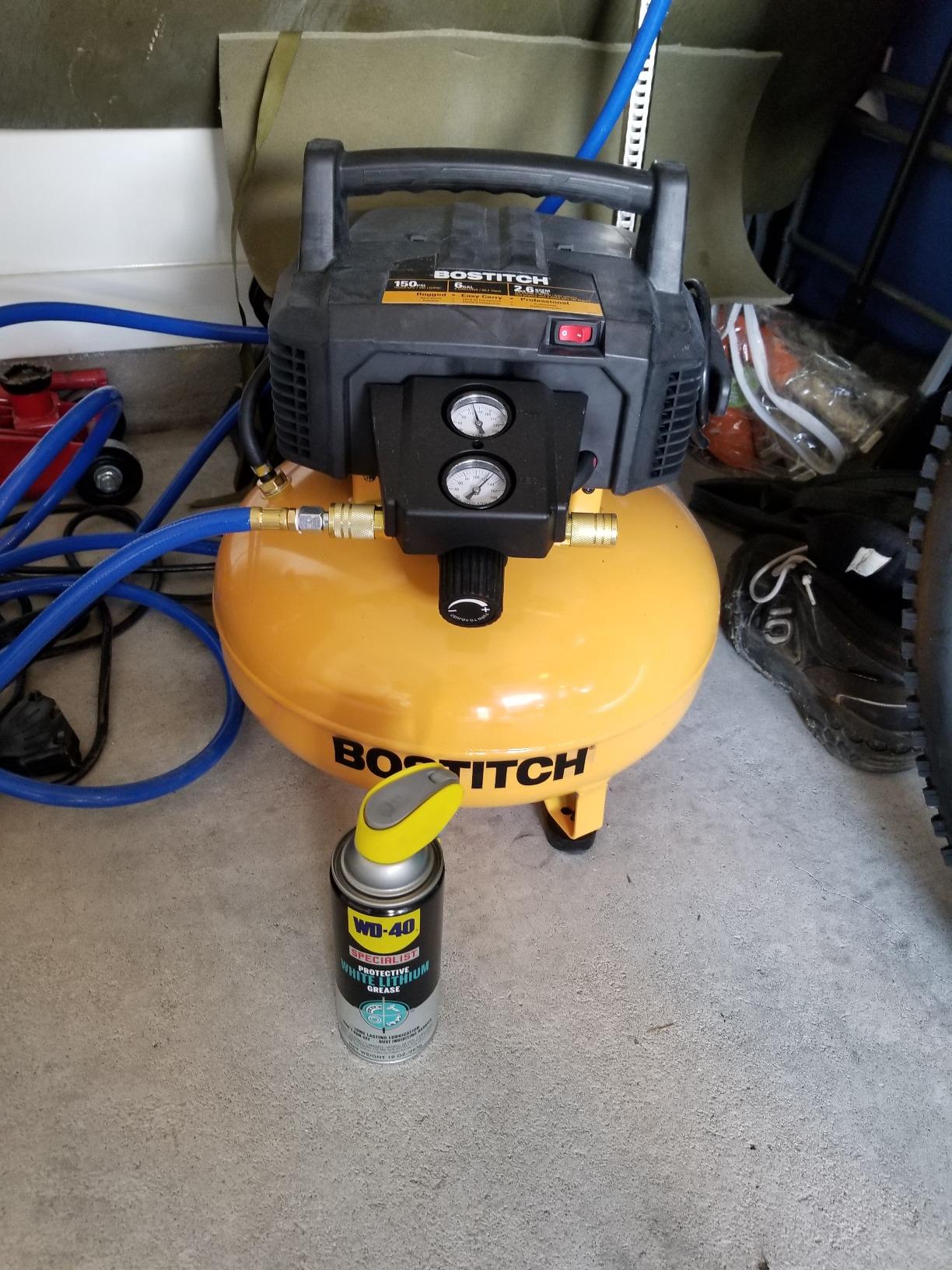
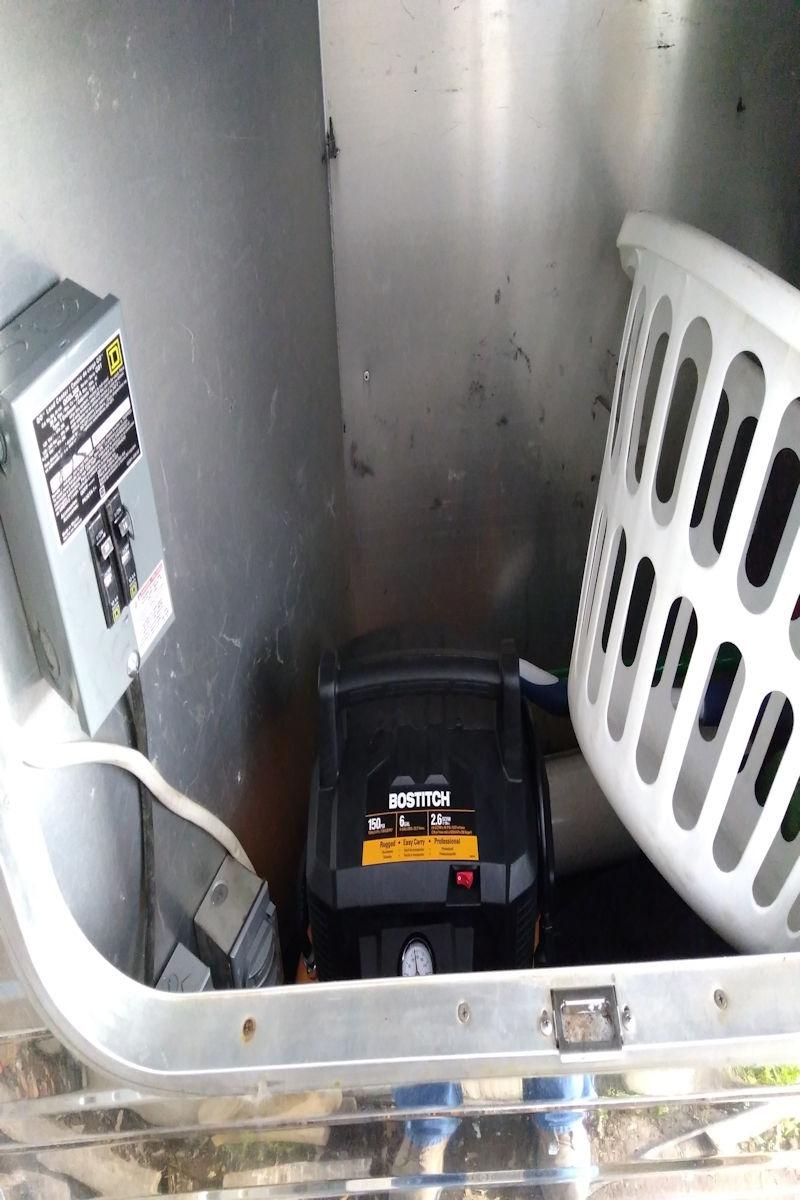
The oil-free pump starts without hesitation in cold weather and tolerates being tipped onto its side, which matters if the workshop doubles as a cleanup area. Owners also report that the tank holds pressure for weeks, so you are not bleeding it down every weekend just to reset the machine.
The honest weakness is the regulator. Owners describe it as jumpy and slow to settle, and it drops around 10 PSI when a tool demands heavy air. If you are setting up for precision work where pressure stability matters, budget ten minutes and a quarter-turn regulator to make life easier.
Why this is the best air compressor for a first workshop
It covers the four jobs nearly every home workshop has: inflating tires, blowing off sawdust, driving finish nails, and running occasional impact duty. The 2.6 SCFM is enough for a single nailer at a time, which covers trim work, furniture assembly, and repair jobs without drama.
Because it is 31 lb and 17 by 17 by 19.25 inches, it can live on a shelf rather than being bolted to a floor spot. That matters more than people expect. Compressors that get moved constantly get damaged; compressors that sit in one corner survive.
Where it falls short
It is not a paint compressor and it is not a sandblaster. At 2.6 SCFM, continuous-draw tools such as a dual-action sander or a spray gun will outrun it, and the machine will cycle constantly during those sessions.
If your planned work is impact wrenches every weekend, sandblasting, or furniture refinishing with a spray gun, step up to a larger tank. The Bostitch is a superb daily driver, not a high-volume machine.
2. California Air Tools 10020C 10 Gallon: Best for Workshops With Shared Walls
California Air Tools 10020C 2.0 HP Ultra Quiet and Oil-Free Air Compressor, 10 Gallon Steel Tank with Wheels, 70 dBA Noise Level
10 gallon steel tank
2.0 HP at 1680 RPM
70 dBA
5.30 CFM at 90 PSI
110V 14 amp
Pros
- 70 dBA is genuinely quiet in a real garage
- Low 1680 RPM motor runs cool and wears slowly
- Vertical tank frees up floor space
- 10 gallon reserve replaces most bigger machines for home tasks
- Wheels and handle manage 82.5 lb easily
Cons
- Aluminum oil-free pump is not built for continuous duty
- Some cut out near 120 PSI rather than the stated 125
- Occasional small leak at the pressure switch
Noise is usually the first thing a workshop owner notices, and it is the first thing neighbors notice. The California Air Tools 10020C is the quietest properly sized machine in this group, and the reason is mechanical rather than marketing: the 2.0 HP motor turns at only 1680 RPM, roughly half the speed of a typical small compressor motor.
Slower motor speed means less noise, less heat, and less wear, and owners consistently report that the machine is inaudible in the next room. The 10 gallon vertical steel tank at 82.5 lb rolls on wheels, so you can move it out of the work bay when you need the floor.
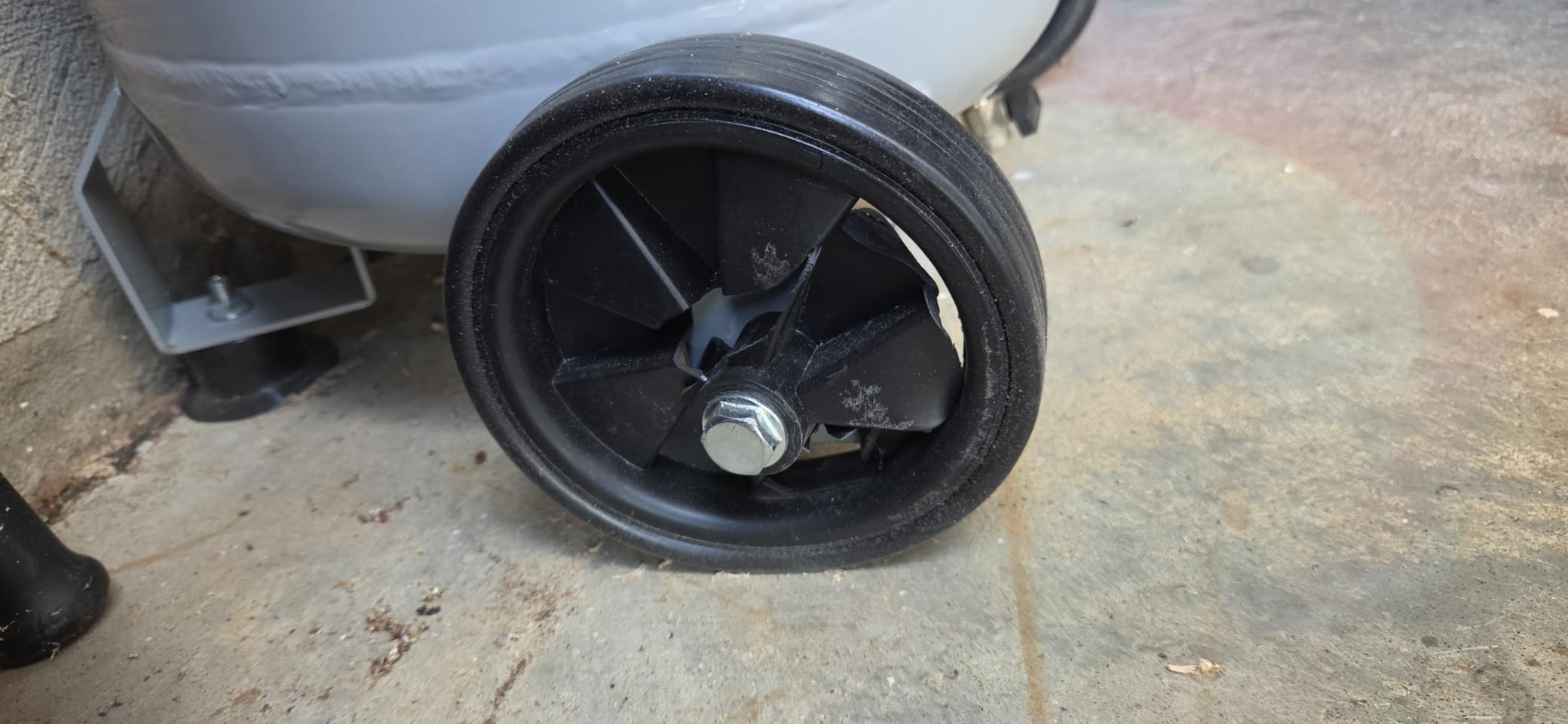
Airflow is 6.40 CFM at 40 PSI and 5.30 CFM at 90 PSI, which is enough to run more than one nailer or keep a small air tool going without constant recovery. At 14 amps it plugs into an ordinary outlet, and the easy start valve reduces the starting current spike that trips some breakers.
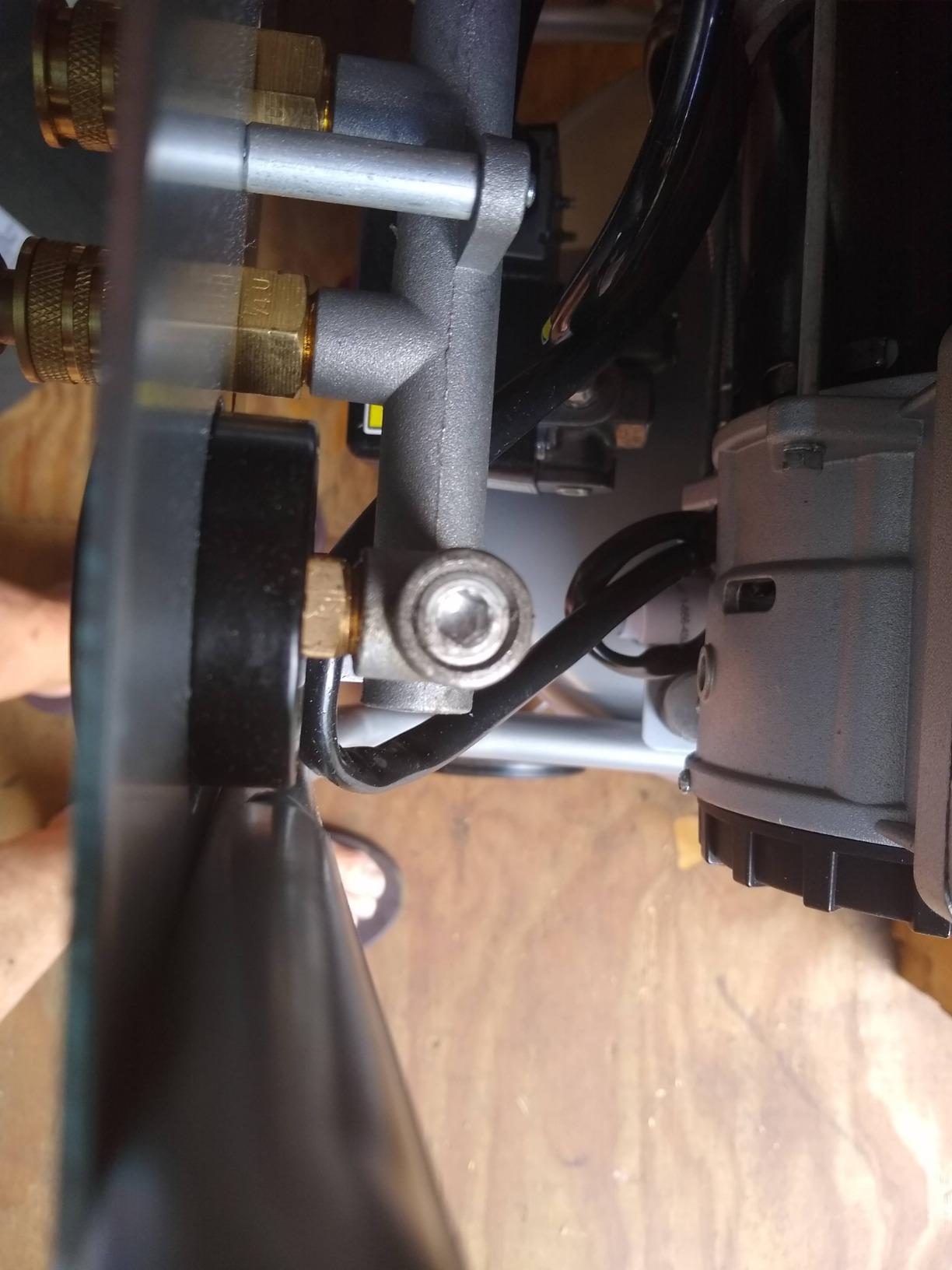
The main caveat is the one that applies to every oil-free machine here: the aluminum dual piston pump is a light-duty design, and the manufacturer states a life cycle of over 3000 hours. Several owners report it overheating when run for long stretches. Keep sessions shorter and give it airflow behind it.
Why this works for a basement or shared-space workshop
At 70 dBA this is the compressor to buy if your shop is downstairs, next to a bedroom, or inside a building where someone else can hear you work. The vertical footprint of 16 by 15.1 by 35.9 inches also fits into a corner that would not hold a horizontal tank.
For inflation, cleanup, brad and finish nailing, and light automotive work, 10 gallons of reserve at 5.30 CFM is a genuinely capable combination. It substitutes for a much larger compressor in most home tasks, which is why owners keep telling us it does more than its size suggests.
Where it falls short
Do not plan continuous spray or sandblasting work around it. The 125 PSI ceiling is also modest, so a pneumatic sander that wants 90 PSI is running near the bottom of the range with no headroom left.
Some owners report the machine cutting out around 120 PSI rather than the advertised 125, and a few have had a small leak develop at the pressure switch. Neither is dangerous, but both are worth watching in the first year.
3. Metabo HPT EC914S 6 Gallon: Top Rated for Framing Nailers in a Portable Package
Metabo HPT Portable Pancake Air Compressor, 6 Gallon 200 PSI, EC914S
6 gallon pancake
200 PSI max
4 CFM at 90 PSI
73 dBA
42 lb
Pros
- 200 PSI gives real headroom over basic pancakes
- 4 CFM at 90 PSI drives framing and roofing nailers
- Recovers fast between nails
- Solid roll cage with an accurate regulator
- Oil-free pump needs no maintenance
Cons
- Louder than the ultra quiet machines
- Fill rate drops at high elevation
- Not for spray painting or sustained high volume work
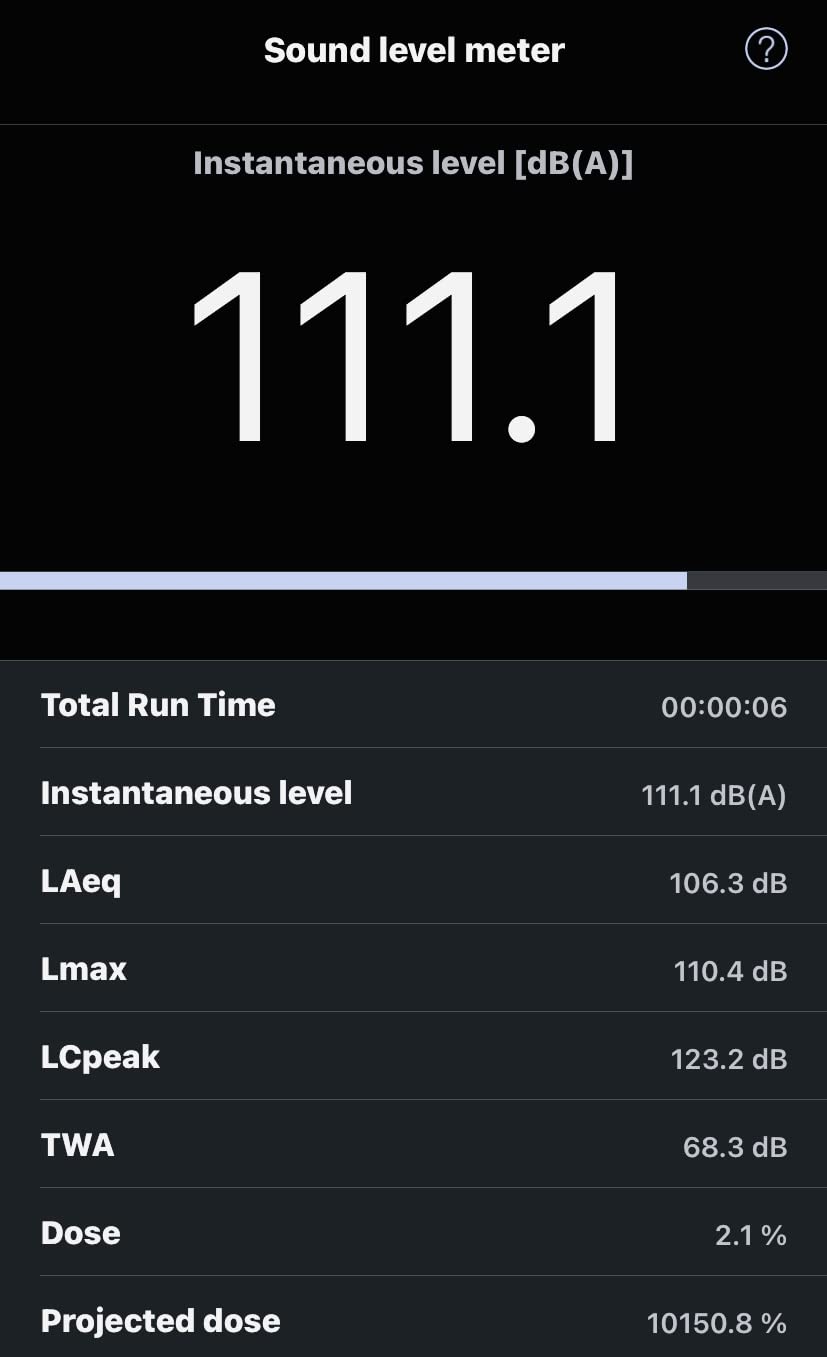
The Metabo HPT EC914S is the pick for anyone who frames, roofs, or does serious finish carpentry and does not want a stationary machine. Its 200 PSI maximum and 4 CFM at 90 PSI output put it in a different performance class from most 6 gallon pancakes, and the maker states it can run two framing nailers or three finish nailers at once.
At 42 lb it is light enough to carry but not so light that it wanders when you drag it. The roll cage is robust, the regulator is accurate, and owners repeatedly single out how quickly it spools back up after a draw-down, which is the number that actually matters when you are nailing all afternoon.
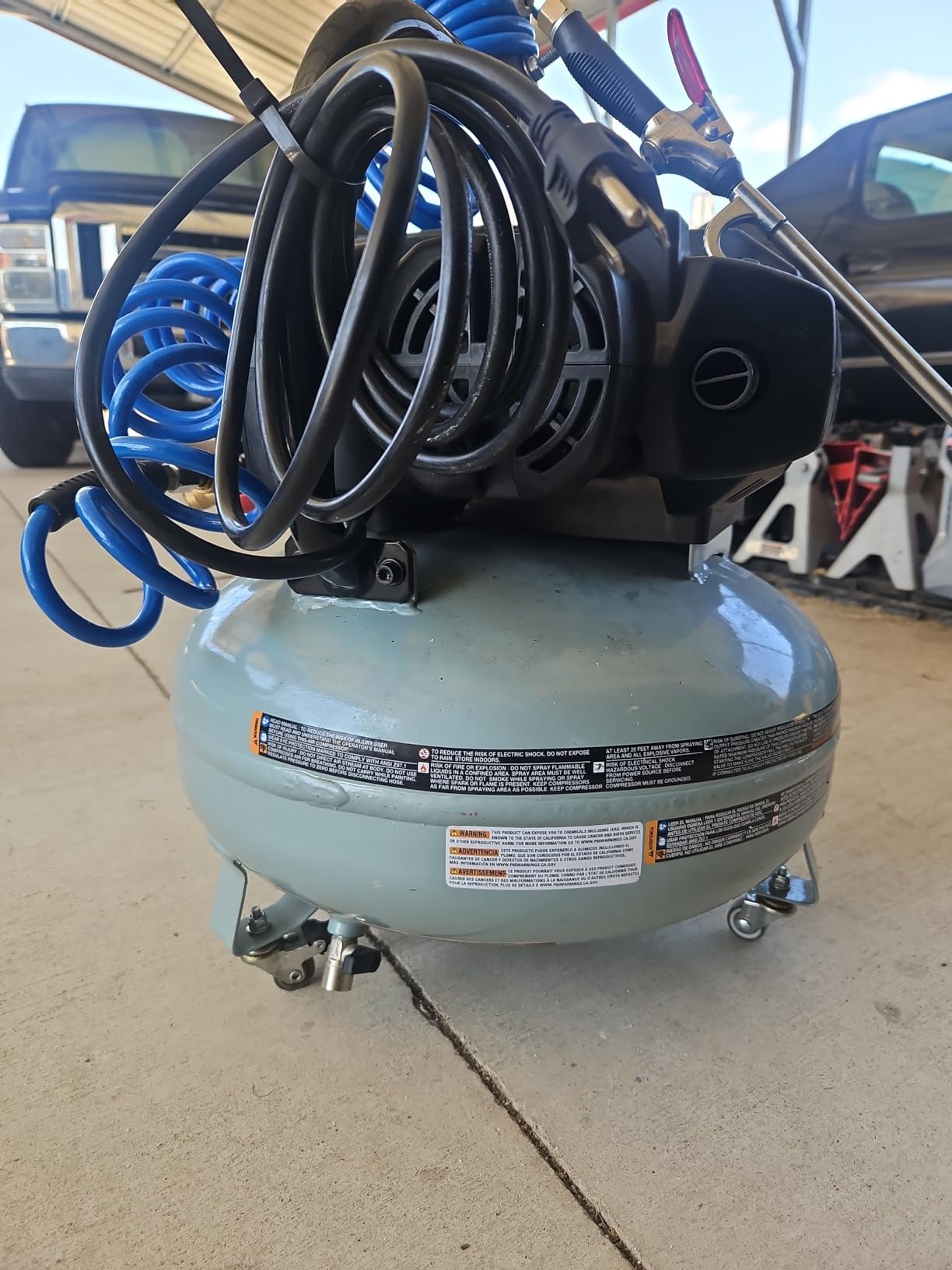
It holds 180 PSI for days after shutdown, and the oil-free pump tolerates awkward orientations, so jobsite use does not require level ground. The 73 dBA figure puts it in the middle of the group: clearly louder than a 70 dBA machine, clearly quieter than an 82 dBA one.
Metabo HPT backs the unit with a 1 year warranty and states that the brand has been the nailer choice of professional crews for 11 years running. That is a company with real service infrastructure behind it, which is worth something when a valve fails in year two.
Why this is the compressor for a framing contractor at home
Two framing nailers at 200 PSI is a capability almost no other portable machine in this roundup can claim. If your work involves sheathing, decking, or roofing, the airflow headroom means you are not waiting on the pump between every shot.
It also handles the tool-free jobs well: brad nailing, stapling, tire inflation, and cleanup blow-off all fall well inside its capability. A 6 gallon tank keeps the footprint at 16 by 16 by 18.5 inches, so it can live on a bench or a shelf between projects.
Where it falls short
It is not a paint machine and not a blasting machine. Owners are clear that sustained high-volume work is outside its design, and the fill rate drops noticeably at high elevation, which matters if you are in a mountain town.
Noise is the other tradeoff. At 73 dBA it is fine in a garage with the door open and tiring in a small room with the door shut. If noise is your top concern, the California Air Tools in the next-but-one slot is quieter.
4. Stark USA 3.5 HP 10 Gallon: Highest Paper Airflow in the Group
Stark USA 3.5HP 10 Gallons Air Compressor Tank Ultra Quiet Horizontal Tank Adjustable Pressure Ideal for DIY, Home & Garage Applications, 8.37 CFM
3.5 HP at 3450 RPM
10 gallon horizontal tank
8.37 CFM delivery
125 PSI
61.1 lb
Pros
- Highest stated airflow in this roundup
- 10 gallon horizontal tank at a value price
- Seamless welded steel construction
- Handles nailers
- impacts
- spray guns and tires
- Compact 26.5 by 13.5 by 30 inch footprint
Cons
- Lowest average rating here at 4.0 with 14 percent one-star reviews
- Some reports of motor and pressure switch failures
- Only a 60 day manufacturer warranty
- 125 PSI ceiling limits heavier work
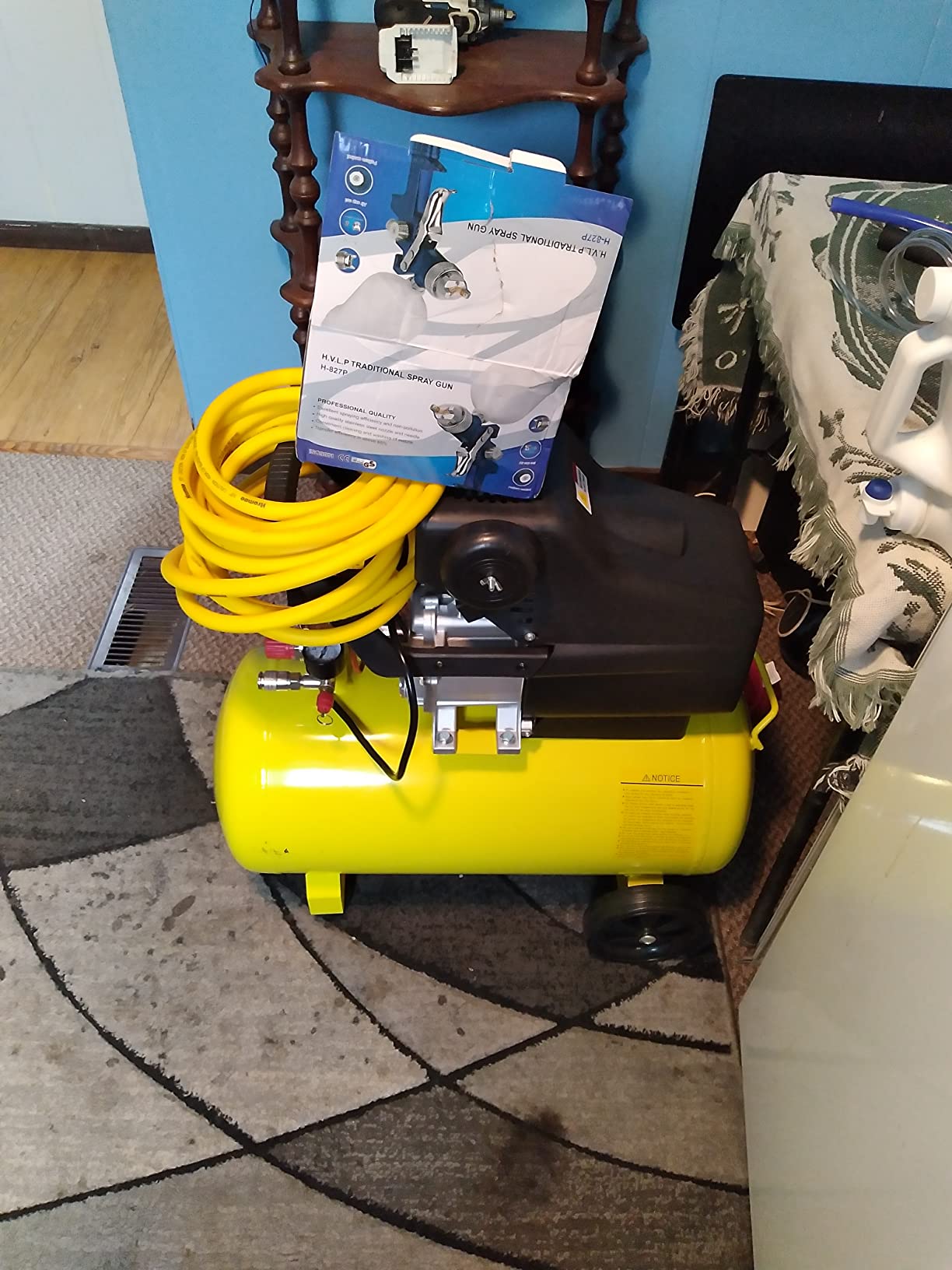
Stark USA 65151 is the specification outlier here. It claims a 3.5 HP motor, 8.37 CFM of delivery, and 125 PSI from a 10 gallon horizontal tank at 61.1 lb, and on paper that beats every other machine in the list. The horizontal tank shape is also unusual, and it is shorter and shallower than a typical vertical, which some shops find easier to place.
Owners who get a good example like the airflow and tank size, and they report it running nailers, impact wrenches, spray guns, and tire inflation without complaint. The seamless welding in the tank is a real build-quality detail that cheaper machines often skip.
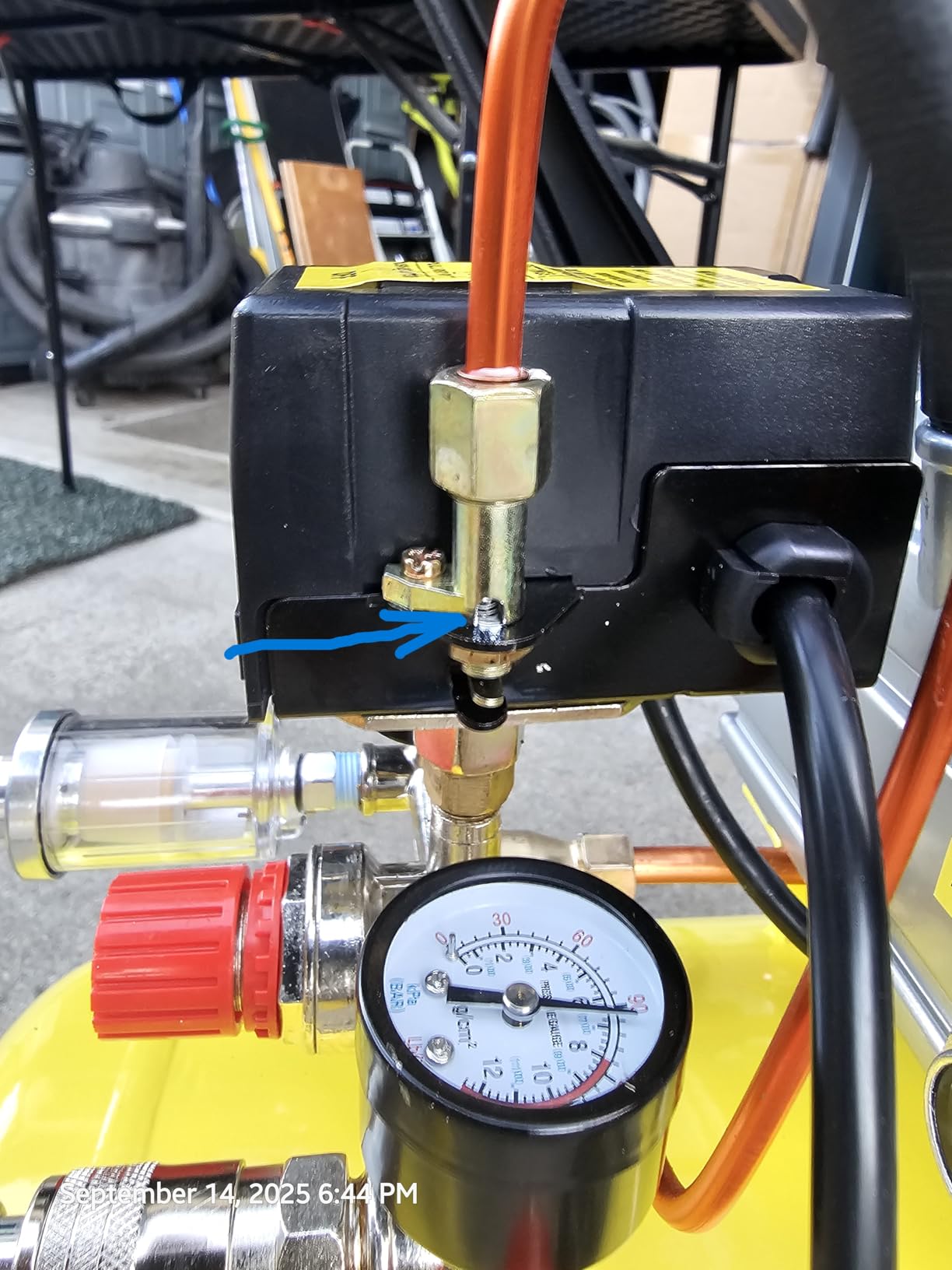
What gives us pause is the review profile. At 4.0 stars with 14 percent one-star reviews, this is the weakest distribution in the roundup, and the complaints cluster around premature motor or pressure switch failure. A 60 day manufacturer warranty is also the shortest we saw, which is a meaningful risk on a machine with a 3.5 HP motor.
There is also a gap between the claim and the delivery. Several owners note the 8.37 CFM figure runs well above what comparable machines actually produce, and forum complaints about budget-tier brands rated below their stated CFM are common enough to be a pattern.
Why you might still want it
If your shop layout suits a horizontal tank better than a vertical one, there are not many machines of this size and shape. The claimed airflow would make it the best tool for high-flow jobs like sandblasting or running multiple nailers if the real-world number lives anywhere near the claim.
The price positioning is also a factor. Compared with branded 10 gallon vertical units, this is a value-tier machine, and for occasional use the risk profile is easier to absorb than it would be for a daily driver.
Where it falls short
The warranty is the deciding issue for us. Sixty days does not cover a motor that fails at month four, and that is exactly the failure mode buyers report. If the machine will be running several times a week for years, the savings do not offset the exposure.
Test the pressure switch and motor before you commit to a project schedule with it, and keep expectations realistic about the published CFM figure.
5. Klutch 20 Gallon Vertical: Best 20 Gallon Pick for a One-Person Move
Klutch 20-Gallon Air Compressor, 2 HP, 120V
20 gallon vertical tank
2.0 HP on 120V
175 PSI
4.2 SCFM at 90 PSI
75 percent duty cycle
Pros
- 20 gallon of reserve in a narrow vertical footprint
- 75 percent duty cycle is honest for an oil-free pump
- Runs on a standard 120V 14 amp circuit
- Holds pressure for weeks with no leaks
- Large rubber wheels and an easy-access drain
Cons
- 80 dBA is loud for a home shop
- One detailed report describes a bypassed internal power switch
- CFM rating may be optimistic in practice
- 90 lb is a two-person load
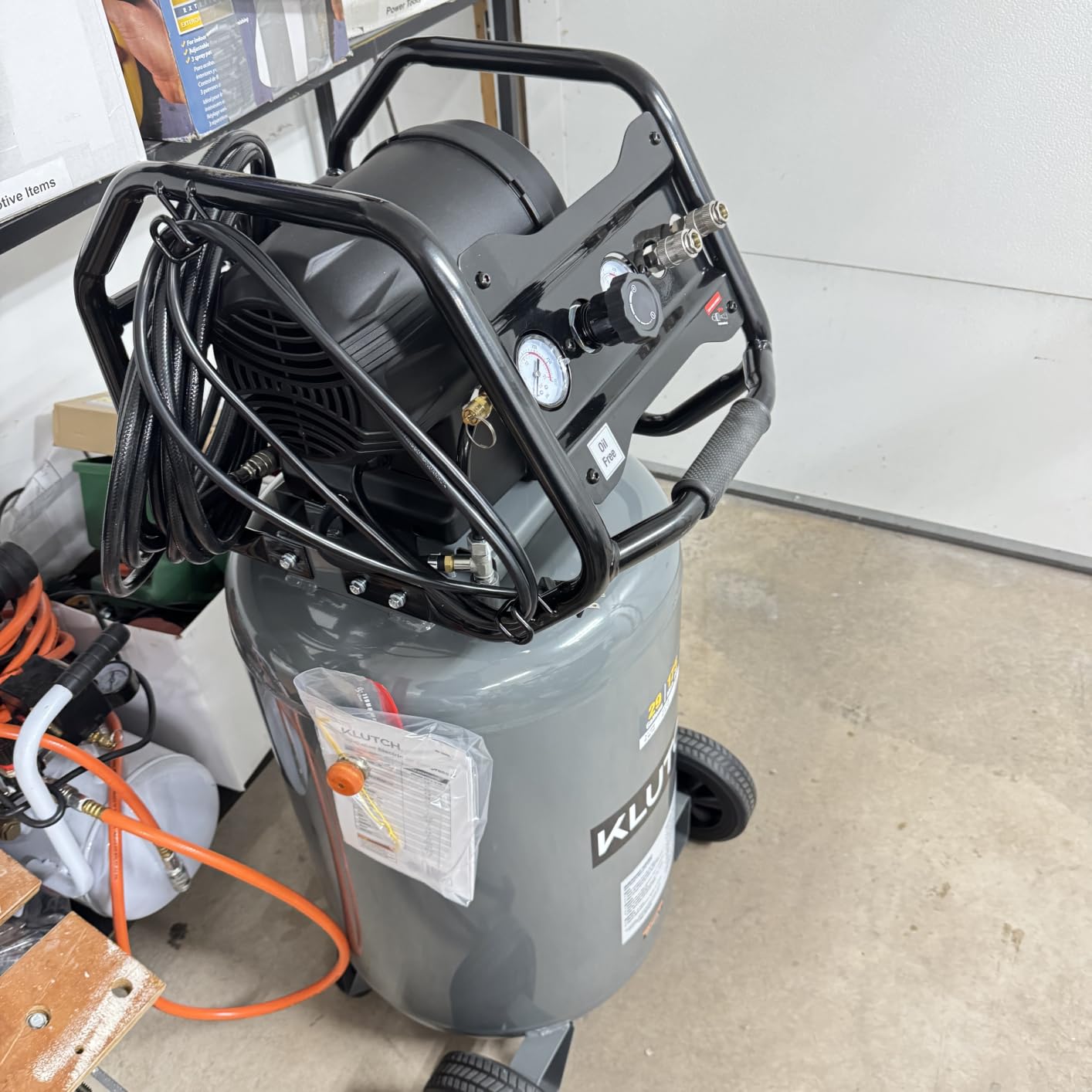
If twenty gallons is the size that makes sense for your work, the Klutch is the version of that idea that fits a residential shop. At 19.1 by 17.5 by 41.5 inches it holds a full 20 gallon tank in a footprint much closer to a 10 gallon vertical, and the large rubber wheels plus ergonomic handle make moving it realistic for one person.
Pressure is 175 PSI, which is a genuine step up from the 125 to 150 PSI ceilings that limit most 110V machines. The 2.0 HP series motor draws 14 amps on 120V with thermal overload protection, so no dedicated circuit or new wiring is needed.
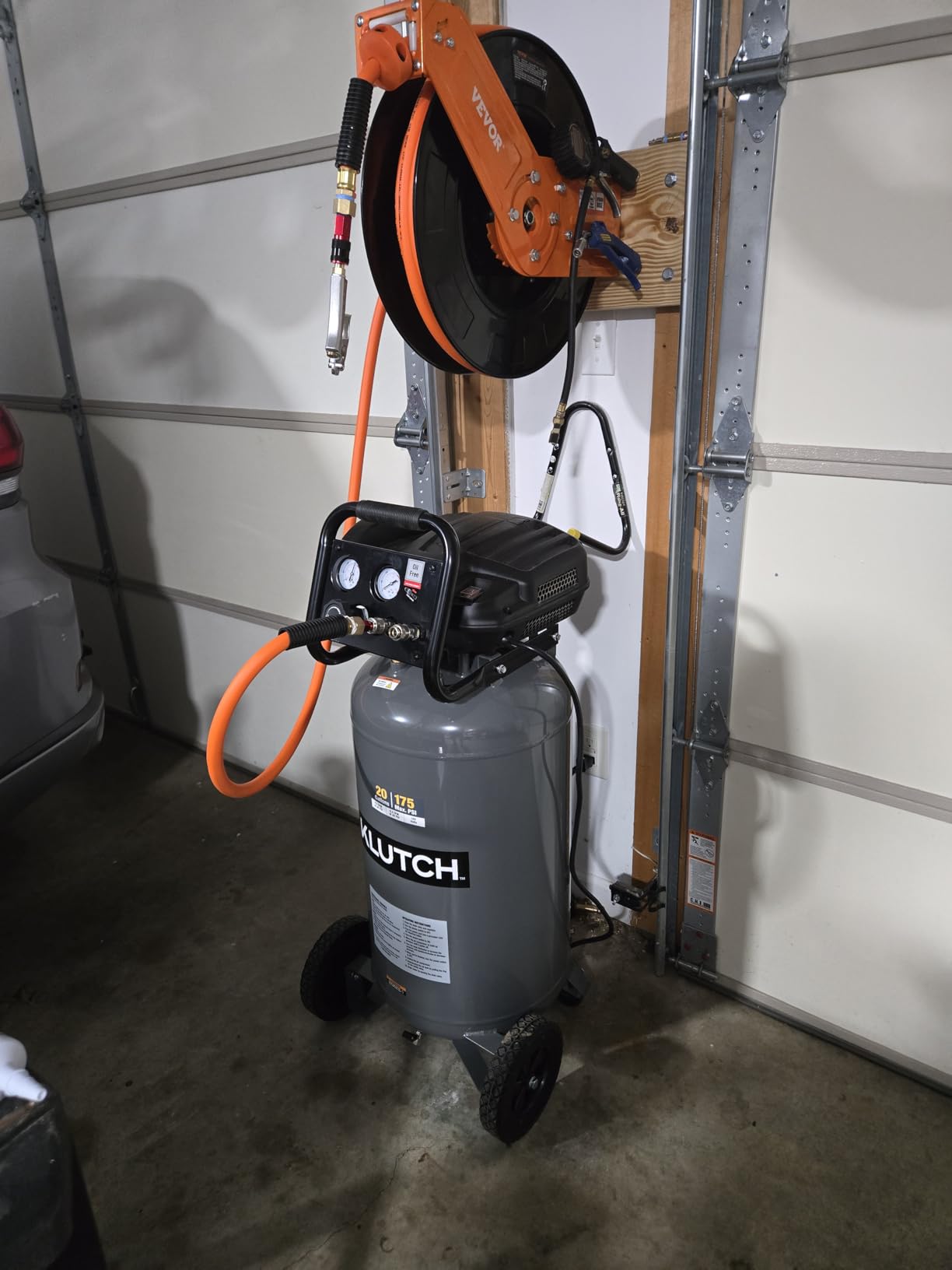
The stated 75 percent duty cycle is the most honest number in this roundup for an oil-free pump, and it is the reason we rank this above the other 20 gallon choices. Owners report that the tank holds pressure for weeks without measurable leaks and that the rubber foot stabilizers noticeably cut vibration.
That 175 PSI matters more than it looks. Most pneumatic finish and trim work wants 90 PSI, and a compressor rated at 175 gives you headroom above that rather than sitting right on the line, which is exactly where a low-rated tank makes a regulator feel sloppy.
Why this fits a two-car garage
Twenty gallons is the size that most workshop owners on r/Tools and r/HomeImprovement land on, because it covers air tools and light painting while still being movable. This one is the most moveable of the big tanks we looked at, and the two hose outlets plus the accessible tank drain make daily use painless.
At 90 lb it is still a two-person lift into a vehicle, so plan the floor position before it arrives. Once it is in a corner with clearance behind it for airflow, it becomes the machine you never think about again.
Where it falls short
At 80 dBA this is one of the louder machines here, and the first detailed negative review we found describes a power switch wired in a way that bypassed it on a larger sibling model. That is a single account, not a pattern, but it is worth confirming the wall switch genuinely cuts power before first use.
Owners also note the 4.2 SCFM figure can be optimistic in practice, and a 20 gallon tank refilling at that flow takes noticeably longer than the manufacturer photos imply. Budget time, not just a tank size, into your session planning.
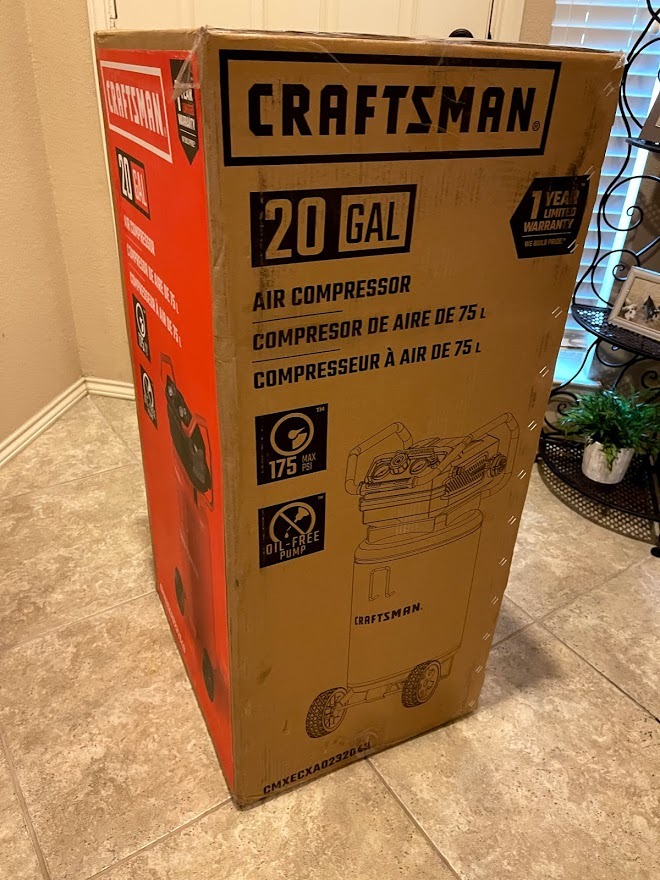
6. Craftsman 20 Gallon 175 PSI Stainless: Best Stainless Tank for Nailing and General Work
Craftsman Air Compressor, 20 Gallon Oil-Free 1.8 HP Max 175 PSI Pressure Two Quick Couplers Big Capacity, Red- CMXECXA0232043
20 gallon stainless tank
175 PSI max
1.8 HP oil-free
4 SCFM at 90 PSI
120V
Pros
- Stainless steel tank resists corrosion in damp shops
- 175 PSI ceiling gives real headroom
- Two quick couplers with drain valve and rubber feet included
- Oil-free pump keeps oil out of the supply line
- One year warranty with a US service team
Cons
- 80 dBA is among the loudest here
- 4 SCFM at 90 PSI is modest for a 1.8 HP 20 gallon machine
- One-star share of 10 percent
- Some units cut out under sustained spray duty
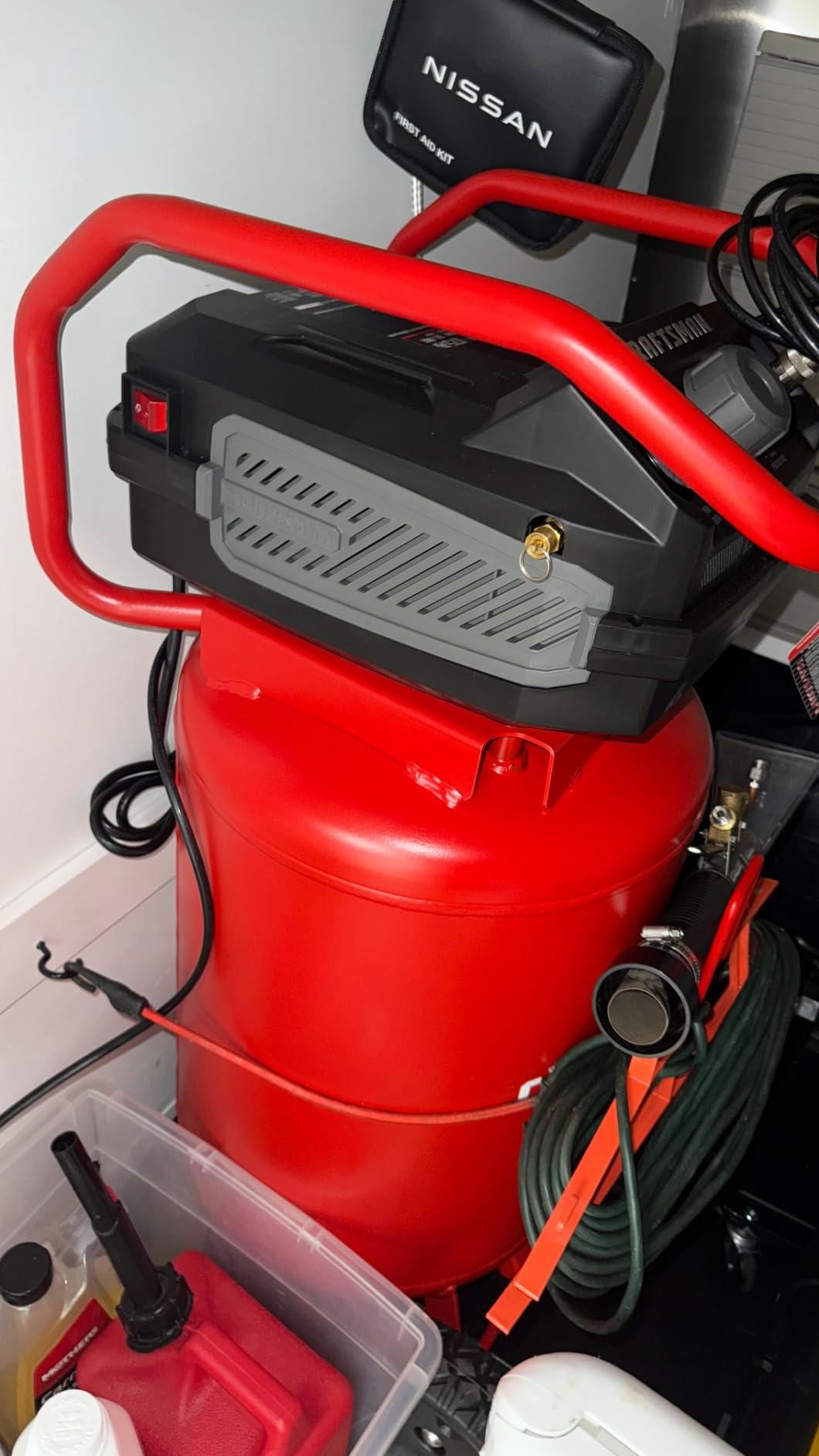
The Craftsman CMXECXA0232043 is sold on capacity and materials rather than flow. A 20 gallon stainless steel tank rated to 175 PSI sounds like a serious machine, and stainless does have one real advantage over painted steel: it will not rust in a damp, poorly heated shop where condensation sits on the tank for months.
The package is well thought out. A 6 foot cord, ball drain valve, plastic filter, two quick couplers, two rubber wheels, and a 1 year limited warranty backed by a US-based service team. At 19.1 by 17.3 by 40.9 inches the vertical layout is compact for the capacity.
Here is the mismatch worth understanding. A 1.8 HP motor delivering 4 SCFM at 90 PSI into a 20 gallon tank gives you excellent reserve and slow recovery. That is the right combination for nailers, staplers, inflators, and impact wrenches in bursts, and the wrong combination for a spray gun or sander running continuously.
Several owners report the unit shutting down under sustained spray or paint duty, which lines up exactly with that math. A 10 percent one-star share is also the second highest here, and much of that tracks back to people expecting paint-grade performance from a nailing-grade machine.
Why stainless matters in a real shop
Condensation forms inside any tank, and in a garage that is not climate controlled all winter, that water sits on the walls. A stainless tank handles that far better than a painted carbon steel one over a decade, and it is the reason this model is worth considering if your shop has a history of dampness.
It also doubles as a 20 gallon unit that does not need a second circuit. If you want impact wrench capability and tire inflation with long pauses between bursts, the tank-to-flow ratio here works in your favor.
Where it falls short
Do not buy it to paint. Our guide to compressors for painting cars covers the airflow and filtration requirements for that job, and this machine does not meet them. At 80 dBA it is also loud for a home shop.
At 359 reviews the owner history is thinner than the top picks, so there is less long-term evidence for you to lean on. That is the trade for the stainless tank and the 175 PSI ceiling.
7. Craftsman 6 Gallon Pancake: Budget Pick for Occasional Workshop Use
CRAFTSMAN 6 Gallon 150 PSI Oil-Free Pancake Air Compressor CMXECXA02106410
6 gallon pancake
150 PSI max
1.0 HP oil-free
2.6 SCFM at 90 PSI
30.8 lb
Pros
- Lowest entry cost in this roundup
- 30.8 lb iron body with a carry handle
- Two quick couplers let two tools share air
- Covers inflation
- brad nailing
- and cleanup
- Oil-free design removes maintenance entirely
Cons
- 82 dBA is the loudest rating in the group
- Some shut down after long continuous sessions
- A minority report cracked fittings or missing handles
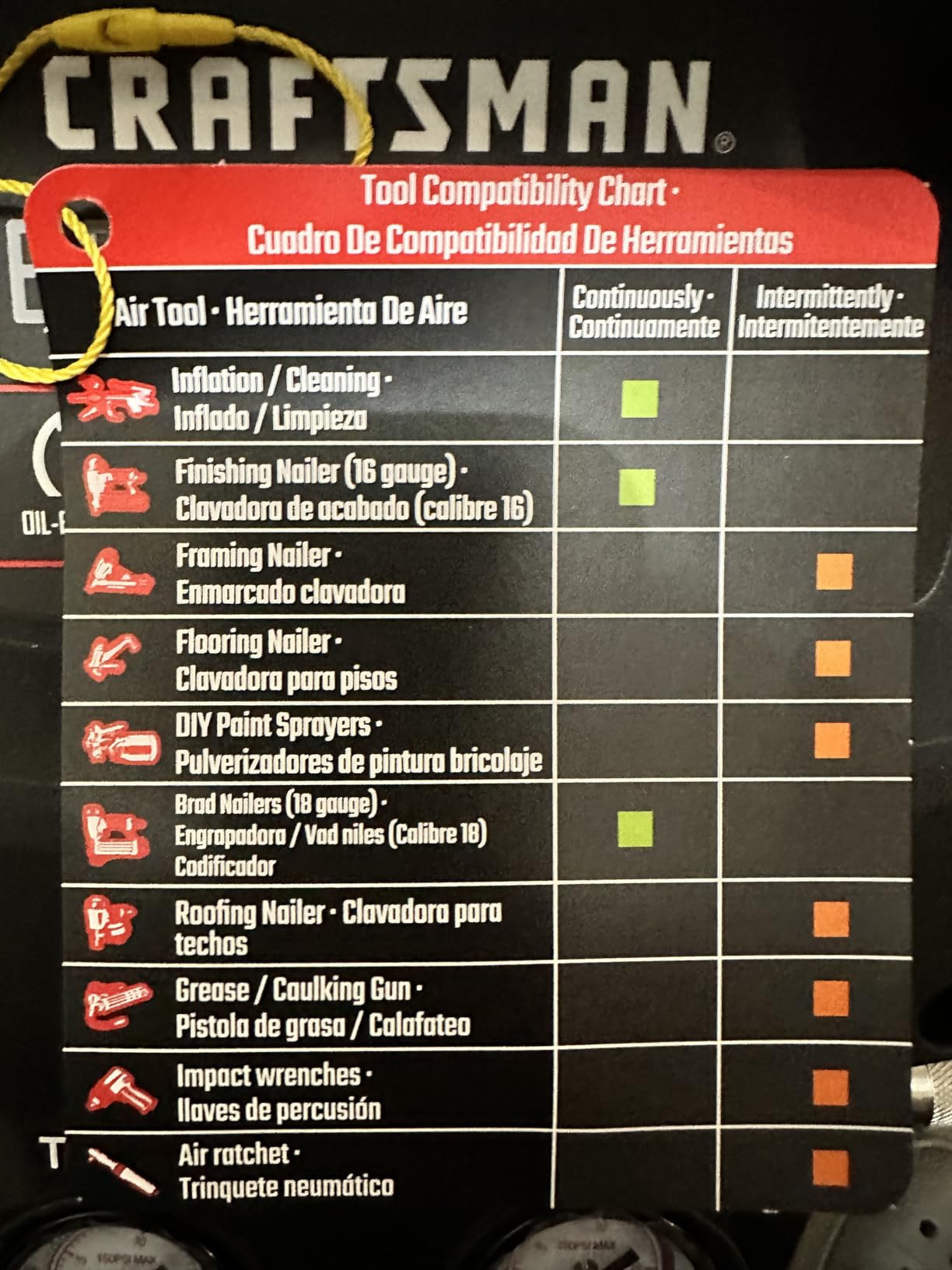
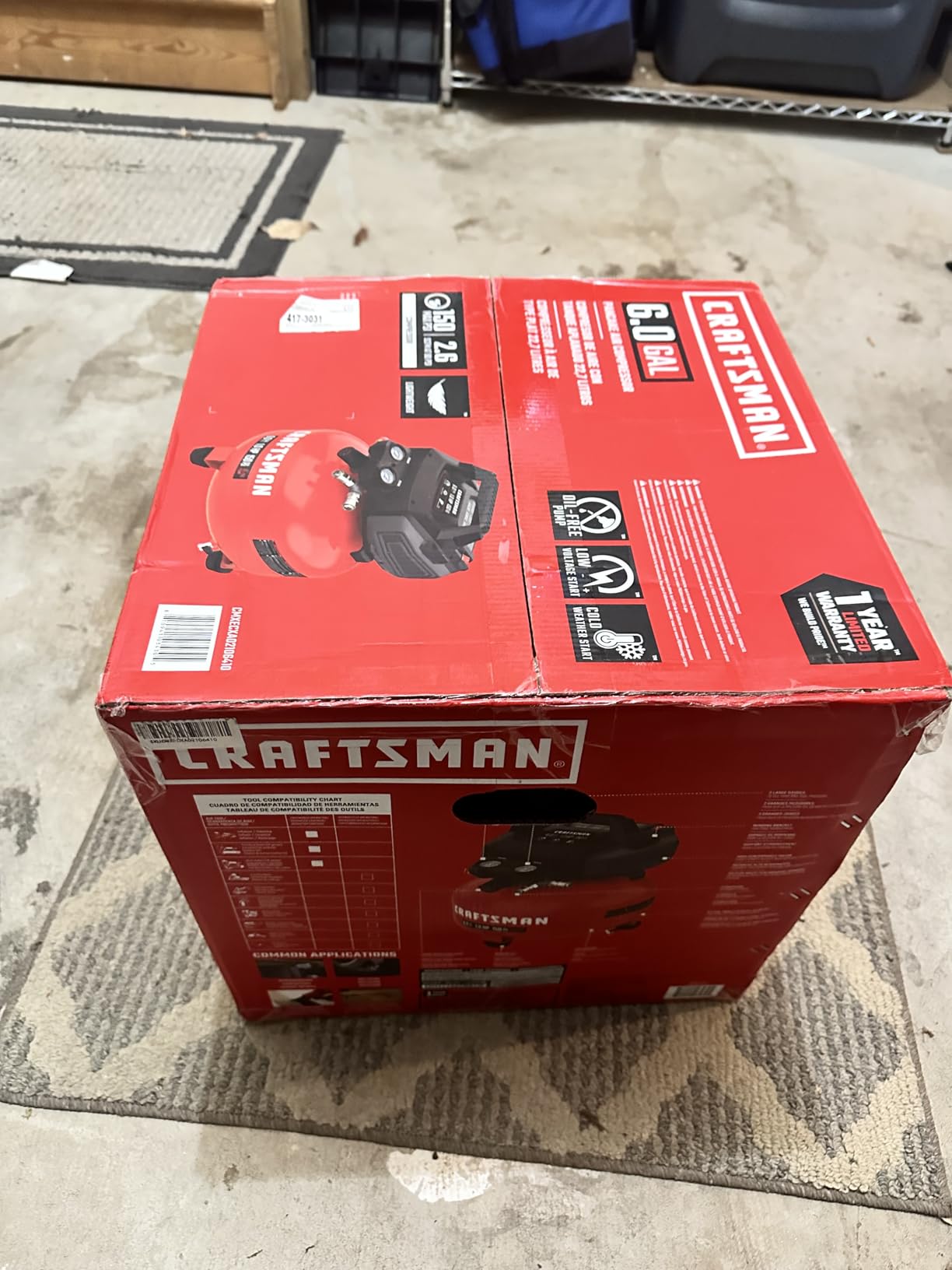
The Craftsman CMXECXA02106410 is the value entry point here. At 30.8 lb with an iron body and a carry handle, it does the four things a first compressor should do: inflate tires, blow off dust, drive brad nails, and handle light automotive jobs. Dual quick couplers mean two tools can share the same machine.
The 1.0 HP low voltage start motor delivers 150 PSI and 2.6 SCFM at 90 PSI, which is honest, unexciting, and sufficient. Owners like the size and the fact that there is no maintenance of any kind, and a 1 year warranty with a US-based service team is more support than many budget machines offer.
The complaints are consistent and predictable. At 82 dBA this is the loudest machine in the roundup by published figure, and owners describe it shutting down after extended continuous use such as an hour of painting. Some buyers also report cracked tank fittings on arrival or a missing carry handle.
None of that matters if your sessions are thirty minutes long and spread across a week, which is how most people use a small pancake. It matters a great deal if you are trying to finish a paint job in a weekend.
Why this is the right first compressor
The advice that repeats across r/mechanics and r/DIY is consistent: buy the small pancake, identify the job that outgrows it, then upgrade. This machine fits that plan and costs the least here, so the money you do not spend now stays available for a real second compressor later.
It is also the easiest to store. A first compressor usually ends up in a closet, a corner, or under a bench, and something that weighs 31 lb with a handle on top is far more likely to get put away properly.
Where it falls short
Two limits: noise at 82 dBA, and no headroom above 150 PSI. It also has no thermal reserve, so a long spray session will push it to its thermal cutoff and stop it.
If you already know you need framing nailer capacity, skip this and go to the Metabo HPT instead. The jump in price buys real airflow, and you will not fight this machine on day one.
8. VEVOR 13 Gallon 2 HP: Best Budget Pick for Inflation and Cleanup
VEVOR 13-Gallon Air Compressor, 2HP, 4.6 SCFM@90PSI, Oil-Free Tank, 66dB Quiet Operation, Ideal for Tire Inflation, Woodworking, Auto Repairs, and Spray Painting (Maximum Pressure 125 PSI)
13 gallon oil-free tank
2 HP
4.6 SCFM at 90 PSI
66 dB
125 PSI
Pros
- Quietest published figure in the roundup at 66 dB
- 13 gallons fills in about the time a small pancake does
- Two outlet connections with quick assembly
- Wheels roll well on rough floors
- Needs no hearing protection to run
Cons
- A detailed review documents a repeatable failure to repressurize
- Manufacturer reportedly admitted about 2.7 CFM real output
- Cracked housings and bent legs reported in transit
- 125 PSI is low for spray gun work
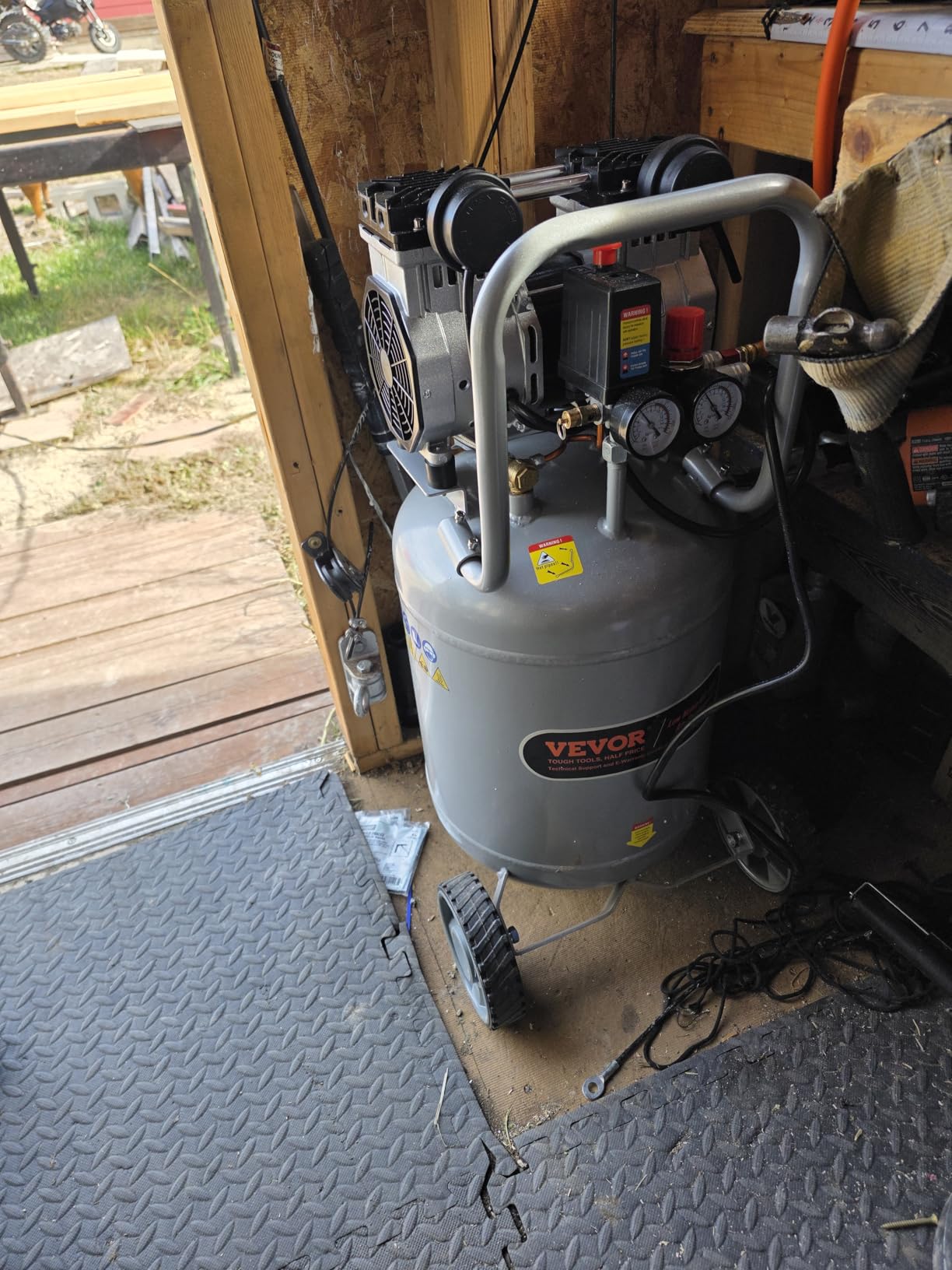
The VEVOR DOF1500-50V is the quietest machine in the roundup on its published figure, and 13 gallons of storage in a 17.5 by 16.5 by 33.3 inch vertical frame is a lot of reserve for the money. Two 7 inch reinforced rubber wheels make it easy to move between the garage and the driveway.
Owners consistently praise the combination of 66 dB quiet operation and a tank that fills in roughly the same time as a much smaller pancake. The bundle includes two plastic air filters, two wheels, two foot pads, two pressure gauges, and a manual, so you are not hunting for parts on day one.
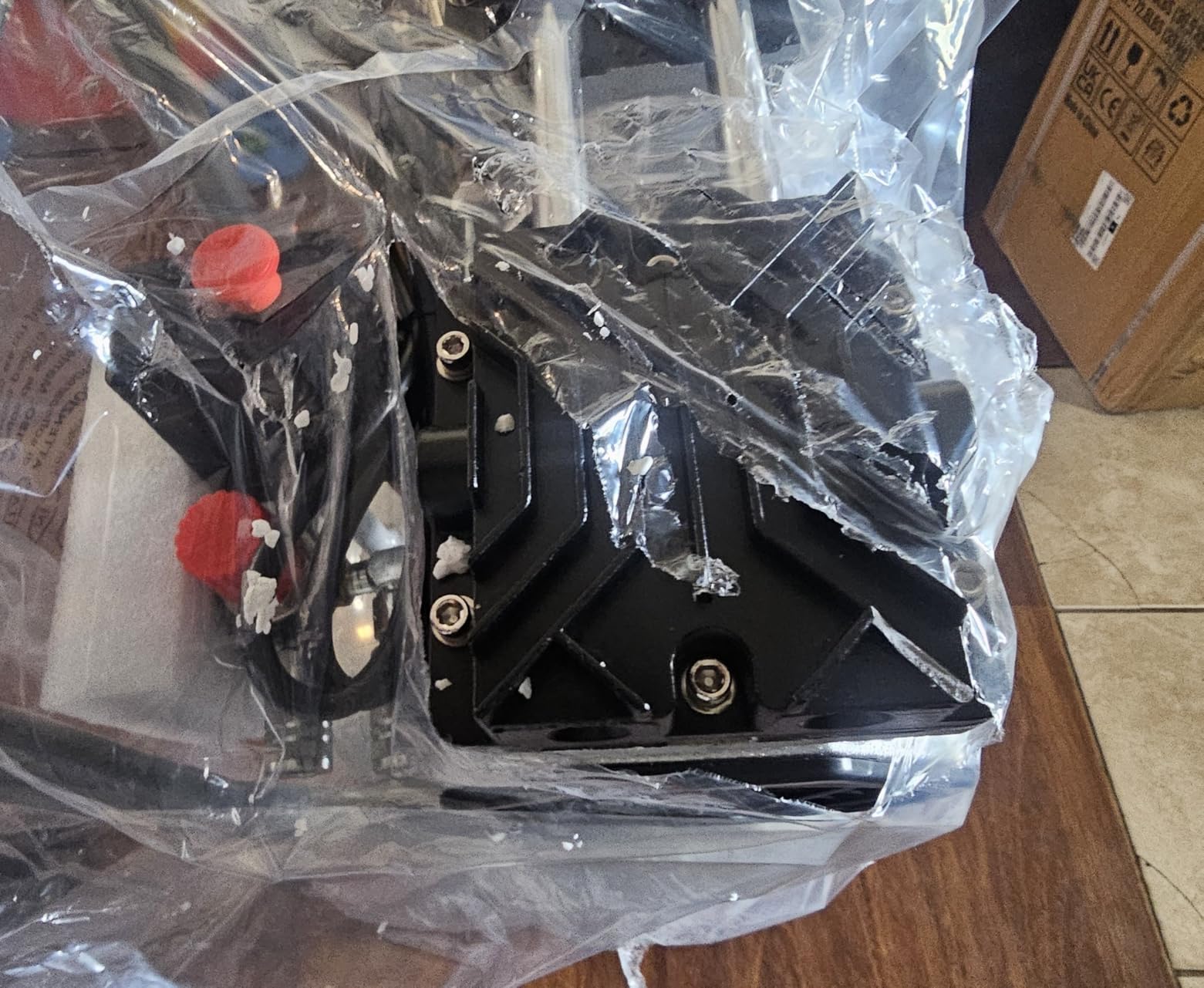
Now the part that deserves a careful read. One detailed review documents a failure to repressurize with thermal overheating, reproduced on a second unit. Another reports that the manufacturer acknowledged actual continuous output near 2.7 CFM against the advertised 4.6 SCFM. Those are specific, checkable claims rather than vague dissatisfaction.
Cracked housings and bent legs showing up on arrival also appear across several reviews, which tells you to inspect the machine before you connect a hose. At 215 reviews the sample is thin, and forum discussion of budget brands rated below their stated output is a recurring theme worth taking seriously.
Why quiet and quick matters for a cleanup compressor
If the machine is going to sit in the garage and run while you blow out a workbench, clean a floor, or top off tires, noise is the factor you notice most. At 66 dB, owners report running it without hearing protection, which is a genuine difference from an 80 dB machine.
Thirteen gallons is also a sensible size for that job specifically. It means you can fill a tall stack of tires or run a cleanup blow-off for a while without standing and watching the gauge. For most home shops that is a better fit than a bigger, louder tank.
Where it falls short
Verify the actual output before you build a project plan around it, and inspect the housing, legs, and fittings on arrival. The 125 PSI ceiling also rules out most spray gun and fine sanding work.
If the repeat failure reports concern you, the California Air Tools 10020C in this list gives you a similar tank size with a stronger brand and a published life cycle figure behind it.
9. DEWALT 27 Gallon Vertical: Best for Impact Wrenches and Long Sessions
DEWALT 27-Gallon Vertical Portable Air Compressor (DXCM271.COM)
27 gallon vertical tank
1.7 HP
200 PSI max
5.1 SCFM at 90 PSI
78 dBA
Pros
- 27 gallons of reserve for burst-heavy impact wrench work
- 200 PSI on 110V avoids running a 240V circuit
- Sturdy industrial-feeling valves and knobs
- Large wheels handle rough floors
- Vertical design saves floor area
Cons
- Takes 10 to 12 minutes to fill from empty
- Some reports of only 4 to 8 minutes runtime with a sander or spray gun
- 136 lb is difficult for one person
- Some arrive with a leak at the safety valve fitting
The DEWALT DXCM271.COM is the largest machine here and the one built for burst work. Twenty-seven gallons means impact wrenches, grinders, and nibblers can run without waiting on refills, and owners upgrading from a small pancake describe it as a step change in run time rather than a step change in size.
Maximum pressure is 200 PSI on a 120V, 15 amp circuit, which is the rare combination that gives you high pressure without pulling a second circuit. The 5.1 SCFM at 90 PSI figure is solid, and the build quality, particularly the valves and knobs, is what owners consistently single out as better feeling than it should be at this level.
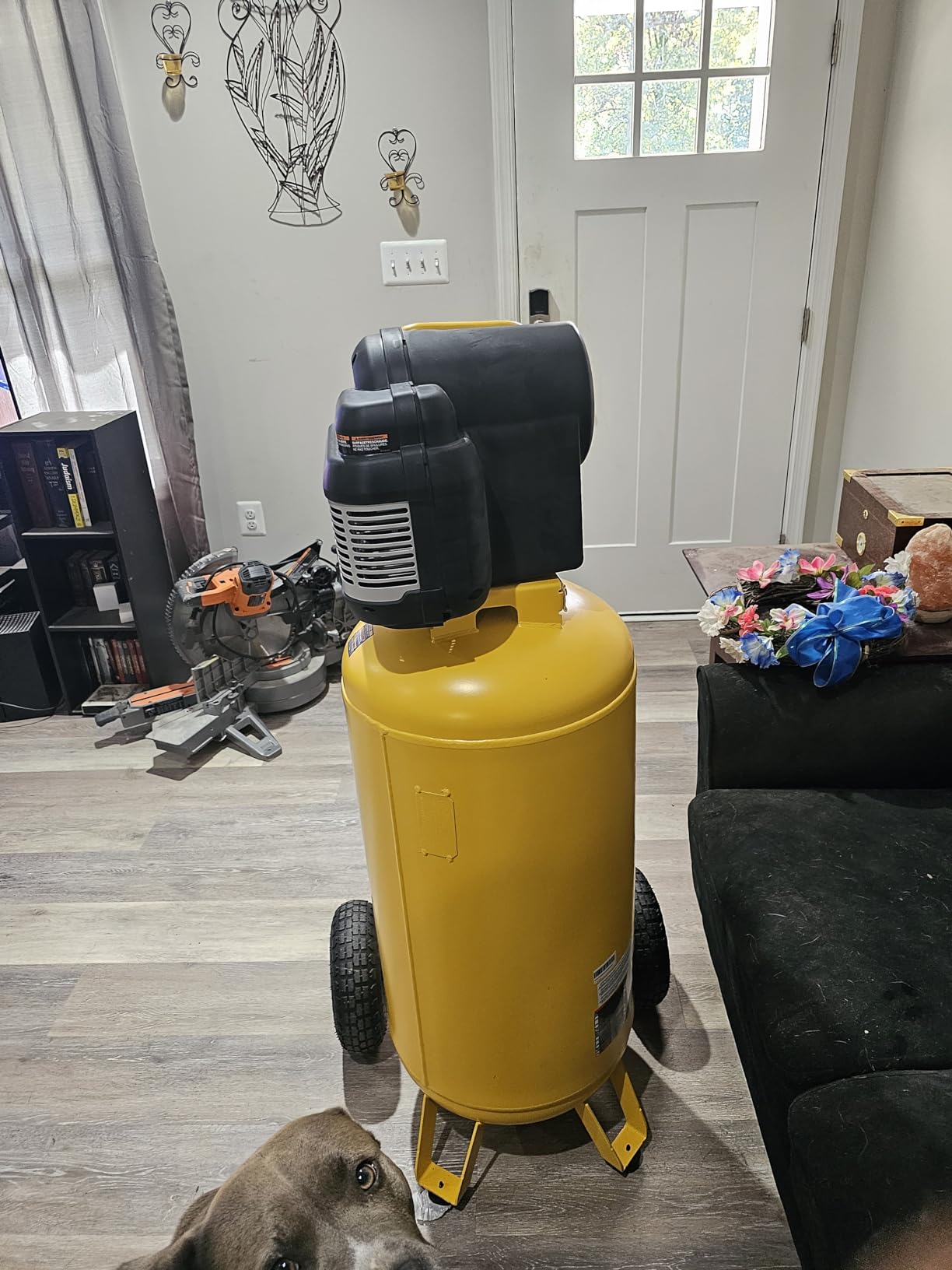
The catch is fill time. A 27 gallon tank at this flow takes roughly 10 to 12 minutes to fill from empty, and some owners report longer. That does not matter if you run your tools in bursts, because the tank is rarely fully empty. It matters a great deal if you plan to drain it for a painting session.
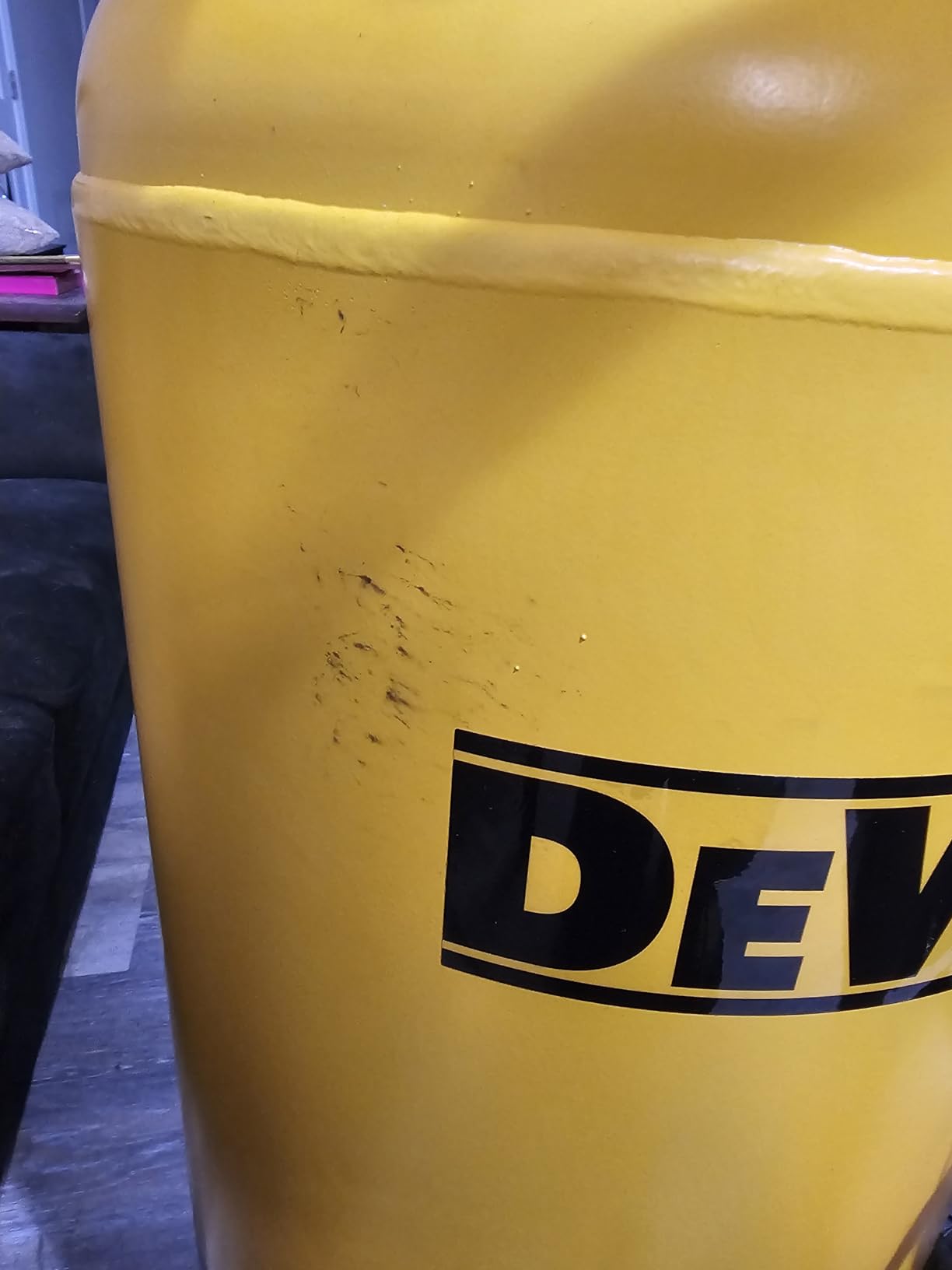
There is a 1 star report of the machine only running 4 to 8 minutes with a sander or spray gun, which is the same flow-versus-capacity mismatch we saw with the Craftsman 20 gallon. At 136 lb it is a two-person move, and a few owners arrive to find a leak at the safety valve fitting that needs hand repair.
Why automotive work justifies the size
Impact wrenches, air chisels, and ratchets are burst tools, and burst tools reward reserve far more than they reward flow. Twenty-seven gallons means you can pull several fasteners, put the wrench down, and come back to the same working pressure rather than waiting through a full recovery cycle.
The 200 PSI ceiling also gives pneumatic tools room to operate. Most air tools are designed for 90 to 100 PSI, so a 200 PSI tank lets the regulator sit comfortably in the middle of its range instead of at the end of it.
Where it falls short
It is the largest and heaviest machine here, at 136 lb and 54.5 inches tall. Plan the floor space and the path to it before ordering, and do not plan on lifting it into a vehicle alone.
It is also the most expensive machine in this roundup, and at 201 reviews the owner evidence is thinner than the popularity of the brand suggests. If your work is nailing and inflation rather than automotive burst work, the smaller 20 gallon picks cover you at a fraction of the size.
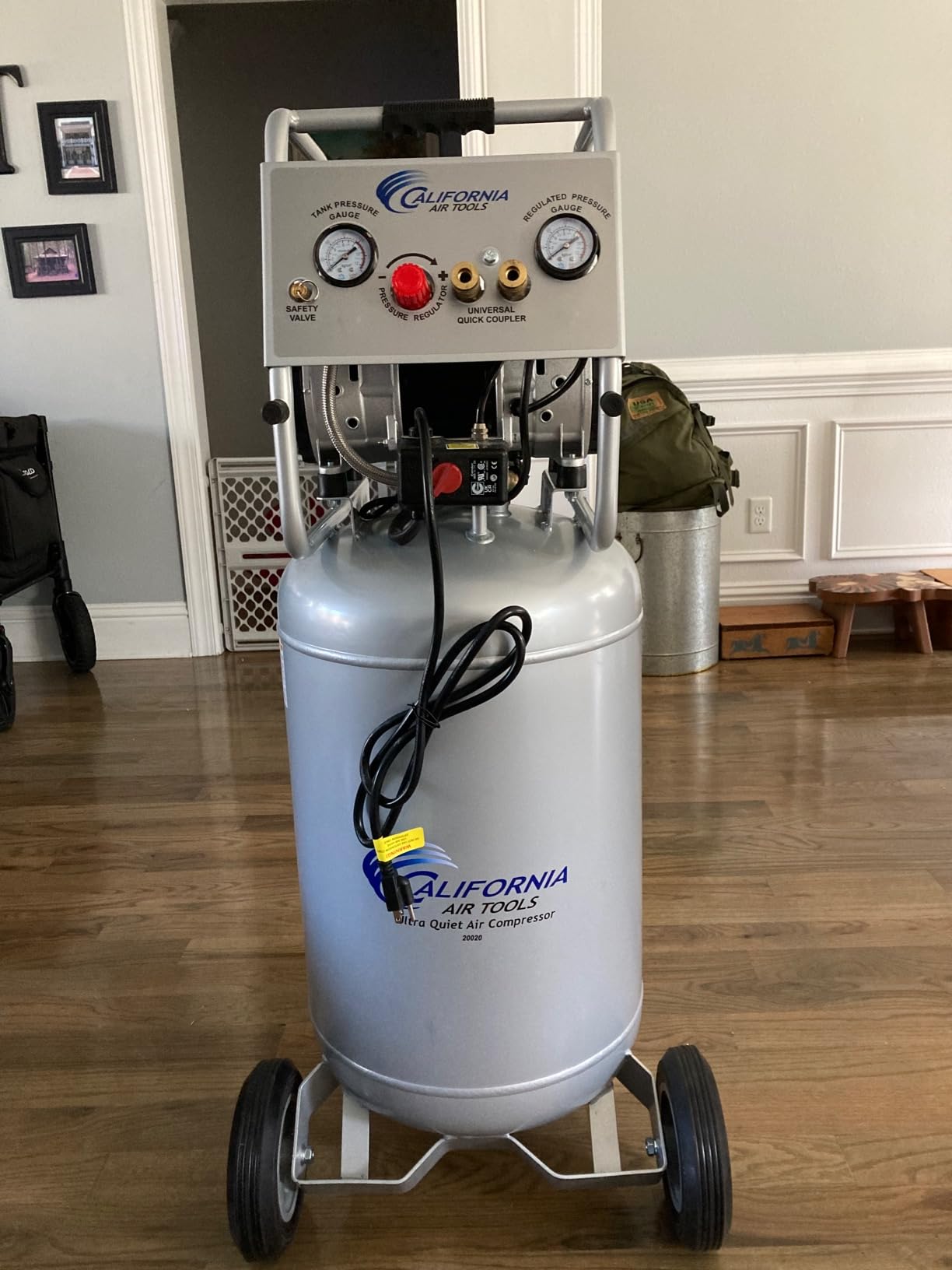
10. California Air Tools 20020 20 Gallon: Best Quiet 20 Gallon Tank on 110V
California Air Tools 20020 2.0 HP Ultra Quiet and Oil-Free Air Compressor with Wheels, 20 Gallon Tank Capacity, 70 dB Noise Level, Electric, Portable
20 gallon steel tank
2.0 HP at 1680 RPM
70 dB
5.30 CFM at 90 PSI
110V 14 amp
Pros
- Largest 110V compressor in this roundup
- 70 dB from the low 1680 RPM motor design
- 14 amp draw works on a standard outlet
- Oil-free dual piston pump rated past 3000 hours
- No-flat wheels move a 134 lb machine
Cons
- 125 PSI maximum is low for a 20 gallon tank
- 134 lb is heavy to reposition
- 20 inch footprint limits placement options
- Warranty and support trail the branded picks
The California Air Tools 20020 is the 20 gallon version of the quiet-motor design, and it solves a specific problem: getting real tank capacity on a 110V circuit without a second phase of wiring work. The 2.0 HP motor runs at 1680 RPM, the same slow speed that makes the 10 gallon model so quiet, and it delivers 5.30 CFM at 90 PSI.
At 14 amps it draws less than a hair dryer, thermal overload protection is built in, and the no-flat wheels make moving 134 lb manageable on a flat garage floor. The oil-free dual piston pump is rated for over 3000 hours of life, and the unit is rated to handle a range of temperatures and terrains.
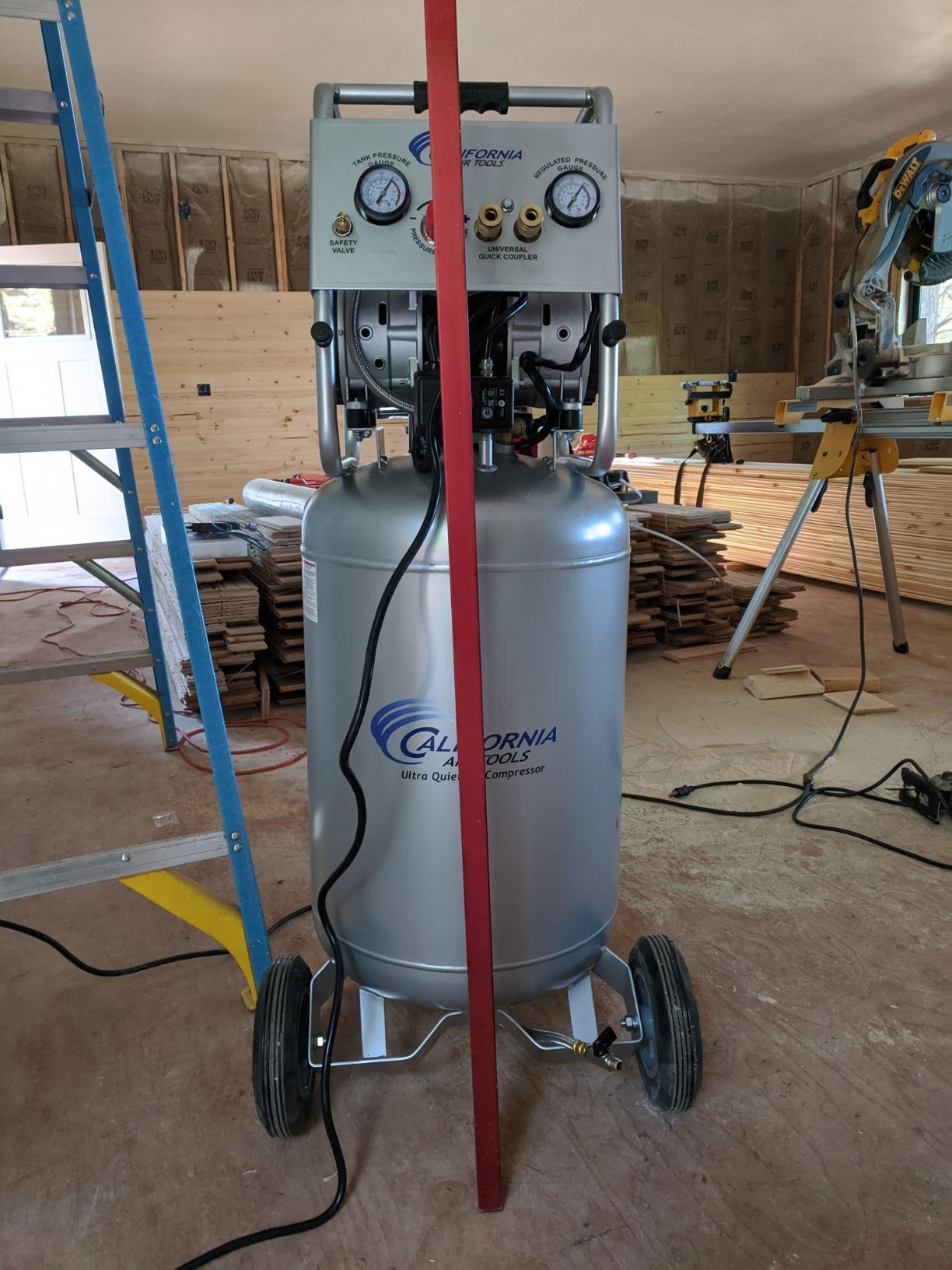
What holds it back is the 125 PSI ceiling. Twenty gallons is a lot of air, and capping it at 125 PSI wastes some of that capacity, because the useful working range for most pneumatic tools starts around 90 PSI. The 20 by 20 by 45 inch footprint is also the largest of the verticals here, which can be awkward in a small garage.
At 169 reviews this is also the thinnest evidence base in the roundup, and the listed weight of 134 lb conflicts with the 114 pound figure in the product description. Check both on arrival. A manual drain is standard, with an automatic drain variant available separately.
Why quiet plus capacity matters for a shared shop
If you need genuine reserve, such as inflating multiple tires, running a nailer through a long framing job, or feeding a pressure washer, and you cannot tolerate a machine you can hear through a wall, this is the combination that works. Seventy decibels and twenty gallons on a 14 amp draw is a rare set of numbers.
It is also the pick for anyone who has decided a separate air receiver tank is not worth the plumbing and code work, and wants the storage built into a machine from the start.
Where it falls short
The 125 PSI limit is the deal breaker for a lot of people. If you plan to run pneumatic sanders, spray equipment, or anything that benefits from headroom above 100 PSI, a 175 or 200 PSI machine is the better investment.
Weight and footprint are the practical concerns. At 134 lb and 20 inches square, this wants a dedicated corner rather than a shelf, and it is not a machine you will be moving weekly.
Buying Guide: How to Size a Compressor for Your Workshop
Match tank size to the job, not to the ambition
Tank size decides how long you can work between pump cycles. One to six gallons covers inflation, cleanup, and single small tools. Eight to fifteen gallons covers nailers, staplers, and light impact work. Twenty gallons and up covers impact wrenches, multiple nailers, and pressure washer feed.
Beyond about 30 gallons you are buying air storage rather than airflow, and at that point a separate receiver tank usually costs less than the compressor upgrade does.
Match airflow to the tool, not to the tank
CFM is what keeps a tool running at its rated speed. A framing nailer, a finish nailer, and a spray gun have very different appetite, and matching the compressor to the least demanding tool you own is the classic mistake. Check the CFM figure at 90 PSI, not at 40 PSI, because that is where tools actually work.
Pancake compressors in this roundup deliver roughly 2.6 to 4 CFM. The mid-size machines deliver 4.2 to 5.3 CFM. If you plan to run two tools at once, plan for the higher end.
Oil-free or oil-lubricated: the honest answer
Oil-free means no oil in your supply line, no oil changes, and no rust stains on finished wood from an exhaust leak. It also means aluminum or coated pistons with wear components that most manufacturers do not sell as spares, which is why r/BuyItForLife regulars treat oil-free machines as consumable rather than long-term assets.
Oil-lubricated crankcases are heavier, louder, and need scheduled oil changes, but the wear parts are standard sizes and the motors run cooler. Long-term owners on the forums consistently recommend them for anyone running a compressor daily for years.
One more note on terminology, because search results mix these up constantly: the air conditioning compressor on your roof is an entirely different device from the tank-and-pump compressor on your bench. This guide covers only the workshop kind.
Duty cycle tells you whether it can keep up
Duty cycle is the share of an hour the machine may run. Consumer machines sit at 50 percent, better oil-free units reach 70 to 75 percent, and continuous-duty ratings exist for a reason. If you plan continuous sanding or painting, an intermittent machine will hit its thermal cutoff and stop, which is the single most common complaint in the reviews here.
Power supply and extension cords
Everything on this list runs on 120V at 14 or 15 amps, so a normal outlet works. Use a 12 gauge extension cord at 50 feet or less, and never a lighter one. Starting current spikes trip breakers on thin cords long before they trip anything in the compressor.
Noise and where the machine lives
Published figures range from 66 dBA on the VEVOR up to 82 dBA on the small Craftsman pancake. Below about 70 dBA, the compressor becomes workable in an indoor or basement shop. Above 80 dBA, plan on keeping the door open and accepting ear protection during long sessions.
Whatever the figure, leave clearance behind the machine. Oil-free pumps cool poorly when boxed in, and a machine in a corner with no airflow will run hotter and last less.
Should you add a separate air receiver tank?
Yes, if your compressor performs but you keep running out of air. A larger tank gives you pressure reserve for much less money than a bigger compressor, and it is the standard answer to a machine that is quiet and reliable but a little too small for one demanding job.
Accessories and the first hour
Budget for a 25 foot hose, a good regulator, an oil and water separator for any finish work, and an in-line oiler on pneumatic tools you use constantly. Forum owners treat the oiler as non-optional for high-use tools.
Run the machine unloaded for the first thirty minutes, check the drain while it is pressurized, and confirm the wall switch genuinely cuts power. A clean filter and a drained tank on day one will still be true in year five. Our under cabinet lighting guide covers the other half of getting a workbench usable.
Frequently Asked Questions
What size air compressor do I need for my garage?
A 6 gallon pancake handles tire inflation, cleanup, brad and finish nailing, and light impact work. A 10 to 15 gallon machine adds room for multiple tools and pressure washer feed. A 20 gallon tank is the size most home workshop owners settle on because it covers air tools and light painting while still being movable.
What is a good compressor for air tools?
Look at CFM at 90 PSI rather than maximum PSI. A single nailer needs about 2 to 3 CFM, two framing nailers need 4 CFM or more, and sanders and spray guns need steady 4 to 5 CFM without stopping. Every compressor in this roundup runs on standard 120V household power.
Should I buy an oil-free or oil-lubricated compressor?
Oil-free needs no maintenance and keeps oil out of the air line, but its piston and Teflon wear parts are rarely sold as spares and the pump is not a continuous-duty machine. Oil-lubricated units run cooler and quieter, need scheduled oil changes, and use standard replacement parts, which makes them the better long-term choice for daily use.
How much CFM do I need for an impact wrench?
Most impact wrenches fall in the 3 to 5 CFM range at 90 PSI, but they are burst tools that fire in short bursts rather than drawing continuously. A 20 gallon tank with 4 to 5 CFM gives you the pressure reserve to run several fasteners before waiting on recovery.
How loud is a home shop air compressor?
Published figures in this roundup run from 66 dBA to 82 dBA. Around 70 dBA or below is workable in a basement or shared building, while anything above 80 dBA calls for an open door and hearing protection. Slower motor RPM is the main reason the quieter models are quieter.
The Best Air Compressors for Home Workshops in 2026: Final Verdict
The BOSTITCH 6 Gallon Pancake is our pick for the best air compressors for home workshops because it does the most jobs, weighs the least, and has 7528 owners who agree. It is the compressor to buy first, and for many shops it is the only one they will ever need.
Buy the California Air Tools 10020C instead if noise is your constraint, the Metabo HPT EC914S if you frame or roof, the Klutch 20 gallon if you want 175 PSI with an honest duty cycle, and the DEWALT 27 gallon if your work is burst-heavy automotive jobs. Match the compressor to the loudest, thirstiest tool you actually own, and skip the rest of the spec sheet.